The Forex market is open around the clock during the trading week, but that does not mean every hour offers the same trading conditions.
Liquidity, volatility, spreads, and the currency pairs attracting the most attention can change significantly as different financial centres open and close.
That is why understanding Forex trading sessions can help you decide not only what to trade, but also when to trade.
The four major Forex centres are Sydney, Tokyo, London, and New York. Together, they create the continuous global market that allows Forex trading to operate 24 hours a day, five days a week.
In this guide, we will focus particularly on the Asian, London, and New York sessions, the overlaps between them, and how traders can use session timing more intelligently.
Want to access the tools, systems, and real-time education we use daily?
With AvaTrade Broker’s support, you can now enjoy up to one full year of access to the Home Trader Club — including:
All professional trading systems
Access to our new project, the Home Trader Club trade copier, where our traders trade and you can copy.
Real-time trade ideas and setups
Full access to our course library and trading marketplace
Forex trading sessions are periods when major financial centres around the world are actively conducting business.
Unlike the stock market, Forex does not have one central exchange with a single opening and closing bell. Instead, trading moves from one major financial centre to another.
The four commonly referenced sessions are:
As one region becomes less active, another becomes more active. This creates the continuous weekday Forex market.
However, the market’s 24-hour availability should not be confused with 24 hours of equal opportunity.
Some periods are considerably more active than others.
The Trading Sessions Indicator (TSI) puts Sydney, Tokyo, London, and New York directly on your charts, making it easy to see active sessions, overlaps, and key market periods at a glance.
With session and mid-session alerts, you can stay informed about important trading windows without constantly checking the clock.
Know the session. See the opportunity. Stay in control.
Learn more about the Trading Sessions Indicator (TSI)
The most important reason to understand sessions is market activity.
When more banks, institutions, businesses, and traders are participating, liquidity can increase. This can lead to more price movement and, depending on the currency pair and market conditions, potentially tighter spreads.
But higher activity does not automatically mean better trades.
More volatility can create opportunities, but it can also create larger losses if your position size and risk are not properly controlled.
The goal is not to trade the busiest session simply because it is busy.
The goal is to understand which session fits your strategy and currency pair.
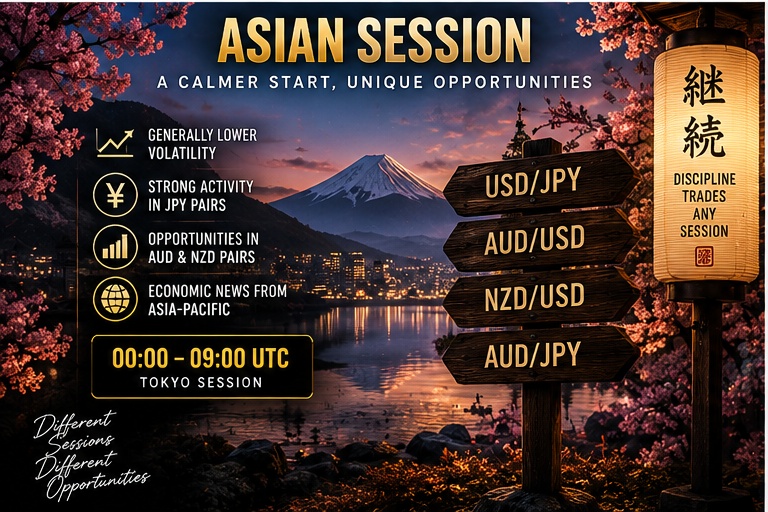
The Asian trading period begins with Sydney and becomes more active as Tokyo opens.
When traders talk about the Asian session, they often focus particularly on Tokyo because Japan is one of the world’s major financial centres.
The Asian session is generally associated with:
This makes the Asian session particularly relevant when trading currencies connected to the region.
Some commonly watched pairs include:
This does not mean these pairs will always move more during Asian hours.
Market conditions change every day.
The important point is that currency activity often follows the regions represented by the currencies in the pair.
London is one of the most important centres in the global Forex market.
The London session typically brings a significant increase in liquidity and activity as European traders and institutions enter the market.
For traders focusing on European currencies, this can be an important part of the trading day.
The London session is commonly associated with:
Popular pairs include:
The London session also connects two major parts of the trading day: the Asian session and the New York session.
That makes its opening and later overlap with New York particularly important.
The New York session brings the United States into the global trading cycle.
This session is particularly important for traders watching USD pairs because many major US economic releases occur during New York hours.
These can include:
Because the US dollar is involved in a large proportion of global Forex transactions, US news can have a significant impact across many currency pairs.
However, traders should remember that economic news can create sudden volatility.
A session with high liquidity does not protect you from poor risk management.
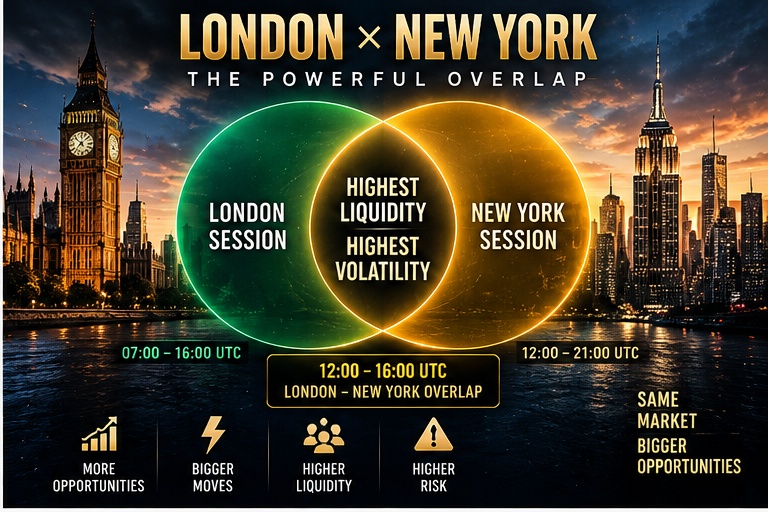
If there is one session overlap every Forex trader should understand, it is the London-New York overlap.
This is the period when both major financial centres are active simultaneously.
It is therefore commonly regarded as one of the most active periods of the Forex trading day.
During this window, traders can see:
EUR/USD and GBP/USD are particularly relevant during this period.
But here is the important part:
More movement does not automatically mean more profit.
A volatile market can just as easily move against you.
If your strategy requires clear momentum and sufficient liquidity, this overlap may be worth studying.
If your strategy performs better in quieter conditions, forcing yourself to trade the overlap simply because it is popular may be a mistake.
One common mistake is memorizing session times without considering daylight saving time.
Trading session times can shift by one hour depending on the time zone and seasonal clock changes. Specifically note that session opening and closing times can move by an hour during daylight saving changes.
As a general reference, traders commonly use approximately:
| Session | Typical UTC Reference |
|---|---|
| Tokyo | 00:00–09:00 UTC |
| London | 07:00–16:00 UTC during UK summer time |
| New York | 12:00–21:00 UTC during US summer time |
|
These are reference times, not permanent fixed hours.
For example, when the US and Europe change their clocks on different dates, the London-New York overlap can temporarily shift by one hour relative to some other time zones.
Therefore, always verify the current session schedule using your broker or trading platform.
There is no single answer.
The best session depends on your:
For example, a trader specializing in USD/JPY may pay particular attention to Tokyo and New York activity.
A trader focused on EUR/USD may find the London and New York sessions more relevant.
A trader who works during European hours may have completely different practical opportunities from someone trading from Asia or North America.
The best session is therefore not necessarily the one with the highest volatility.
It is the session where your strategy has a logical reason to operate.
Different pairs can become more active during different regional sessions.
EUR/USD tends to attract substantial activity during the London and New York sessions.
The London-New York overlap is particularly important because both the euro and US dollar markets are highly active at the same time.
GBP/USD is strongly associated with London and New York activity.
Traders should also pay close attention to UK and US economic announcements because these can produce sharp moves.
USD/JPY has strong connections to both the Asian and US sessions.
The pair typically experiences increased liquidity during Tokyo and New York hours.
These pairs can be particularly relevant during the Asian session because of their connection to the Australian and New Zealand economies.
Again, session preference should support your strategy rather than become a rule that every trader must follow.
No.
One of the biggest mistakes traders make is assuming that being available to trade means they should be trading.
You don’t need to participate in every market movement.
In fact, deliberately limiting your trading hours can help you remain selective.
Ask yourself:
Which session gives my strategy the conditions it needs?
If your strategy performs best during strong breakouts, you may focus on periods when liquidity and volatility increase.
If your strategy is designed for ranges and quieter price action, a calmer session may be more appropriate.
The answer should come from testing and evidence—not from simply choosing the session that appears most exciting.
Session overlaps deserve special attention because multiple financial centres are active simultaneously.
The most important overlap for many traders is London-New York.
But other overlaps exist as well.
For example, Tokyo and London have a period of overlap, while Sydney and Tokyo can also overlap.
The characteristics of each overlap are different.
The key principle is simple:
More participants can mean more activity, but more activity can also mean faster price movement.
If you trade during an overlap, make sure your stop-loss placement, position size, and overall risk are appropriate for the market conditions.
This is perhaps the most important lesson about Forex sessions.
A market moving 100 pips is not automatically better than a market moving 30 pips.
What matters is how that movement fits your trading plan.
Imagine you normally trade with a 30-pip stop.
If market volatility suddenly increases and price starts making much larger swings, entering with exactly the same position size may expose you to more risk than your strategy was designed for.
This is why session awareness should work together with proper risk management.
The session tells you what type of market conditions may be present.
Your trading plan tells you whether you should participate.
You don’t need a complicated system.
Start by creating a simple session routine.
Don’t monitor every pair in the market.
Select a small group that fits your strategy.
Understand when those currencies are most active.
Know when major scheduled events could affect your pairs.
Don’t automatically enter when a session opens.
Watch how price behaves.
The session itself is not a trading signal.
Your strategy still needs to provide the entry.
After enough trades, examine whether your strategy actually performs better during certain sessions.
This turns session timing from a guess into something you can evaluate.
Forex gives traders something unique: access to a global market across multiple time zones.
But that flexibility can become a disadvantage if it encourages you to trade constantly.
You do not need to catch every move.
You need to identify the periods where your strategy has the best opportunity to work and then remain selective.
The London session may provide excellent conditions for one trader.
The Tokyo session may be more appropriate for another.
The London-New York overlap may be ideal for a strategy that depends on liquidity and momentum.
There is no universal “best” trading session.
The best session is the one where your strategy, currency pair, schedule, and risk management align.
Understanding Forex trading sessions can make your trading more structured.
Instead of looking at the market as one continuous 24-hour environment, you can divide the trading day into periods with different levels of participation and different characteristics.
Remember the basic framework:
Asia → Europe → New York
Watch how liquidity changes.
Understand which currencies are most relevant to each region.
Pay attention to session overlaps.
And most importantly, don’t trade simply because the market is active.
A good trader does not ask:
“When can I trade?”
A better question is:
“When does my strategy have the best reason to trade?”
That difference can help you become much more selective.
To Your Trading Success,
Vladimir Ribakov
Internationally Certified Financial Technician
Home Trader Club
Have you ever opened your trading platform, watched the market move, and felt that you…
Employment data is one of the most important economic indicators in Forex fundamental analysis. It…
Welcome back to our weekly Forex forecast at Home Trader Club. This week, we are…
GDP growth is one of the most important indicators of economic health. But does stronger…
When it comes to fundamental Forex analysis, few institutions matter as much as the Federal…
Interest rates are one of the most important fundamental forces in the Forex market. But…