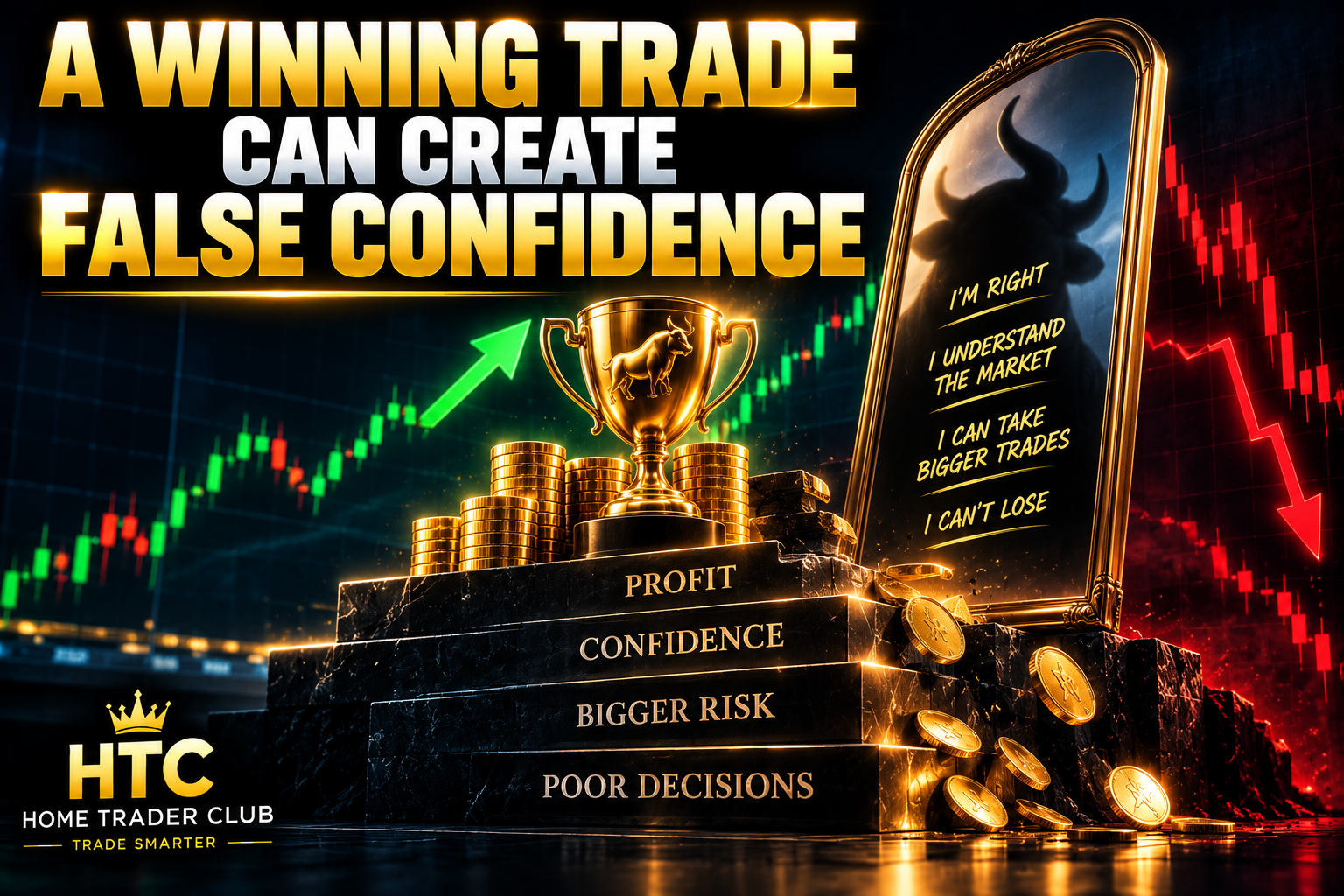
A winning trade feels good. A series of winning trades feels even better. Confidence increases. Doubt disappears. The market suddenly seems easier to understand. Decisions become faster, and the trader may begin to feel that their strategy is finally “working.”
But this is where an interesting psychological problem can begin.
Winning can change the way a trader behaves.
After several successful trades, some traders start taking larger positions, entering trades that do not fully meet their rules, trading more frequently, or believing that they understand the market better than they actually do.
Behavioral-finance research has long examined the relationship between successful outcomes, overconfidence, and increased risk-taking. Research summarized by CFA Institute notes that overconfidence can lead investors to trade too frequently and take unnecessary risks.
The danger is not the winning trade itself.
The danger is what the winning trade teaches the trader about themselves.
We have partnered with AvaTrade, one of the industry’s leading regulated brokers.
When you open and trade with AvaTrade through our partnership, you receive:
If you’re looking to accelerate your trading journey while enjoying premium education, this partnership gives you everything you need under one roof.
If you already have account with them, still follow this link to open separate account with separate email. Once you did that, contact me with the telegram link below and we will give you the access.
Telegram Channel: https://t.me/vladimirribakovtradingchannel
One profitable trade does not necessarily prove that a trading decision was good.
A trade can make money because of:
These are not always the same thing.
A trader can follow poor reasoning and still make money.
Likewise, a trader can follow excellent reasoning and still lose money.
This distinction is extremely important.
If a trader makes a profit and immediately concludes:
“I was right because I understand the market.”
they may begin giving themselves more confidence than the evidence actually supports.
That can gradually turn into overconfidence.
Imagine a trader normally risks 1% per trade.
After three consecutive winners, the trader starts thinking:
“I am in a good rhythm.”
The next trade suddenly looks more attractive.
Instead of risking 1%, they risk 2%.
After another winner, they may increase it again.
The problem is not simply the larger position.
The deeper problem is why the position became larger.
Was the next opportunity objectively better?
Or did the trader increase the risk because recent success made them feel more confident?
When risk increases because of emotional confidence rather than a predefined trading plan, the trader is no longer following exactly the same process that produced the earlier results.
Winning streaks can create a dangerous psychological illusion:
“Everything I am doing is working.”
This can cause a trader to underestimate uncertainty.
Markets do not know that a trader has just won five trades.
The sixth trade does not become more likely to succeed simply because the previous five were profitable.
Each new trade still has its own conditions, risks and uncertainties.
Yet after a winning streak, traders can sometimes behave as if their recent success gives them an advantage that does not actually exist.
That is one reason maintaining consistent risk becomes particularly important after strong performance.
Another psychological change is increased activity.
A trader makes money and becomes more engaged with the market.
They start looking at more currency pairs.
Then more timeframes.
Then more setups.
Then more opportunities.
Eventually, a trader who previously waited for two or three high-quality setups may suddenly find ten opportunities every day.
This can happen because confidence makes the trader more willing to act.
Research on investor behavior has repeatedly connected overconfidence with excessive trading.
More trading, however, does not automatically mean better trading.
Sometimes it simply means more decisions influenced by the trader’s current emotional state.
Confidence can also change perception.
Before a winning streak, a trader might look at a chart and think:
“There isn’t enough confirmation.”
After several wins, the same trader might think:
“I can see where this is going.”
This is an important psychological shift.
The trader may start interpreting ambiguous market information more favorably.
Instead of waiting for their conditions to appear, they begin finding reasons to justify trades.
This is how a disciplined process can slowly turn into discretionary decision-making driven by confidence.
Confidence itself is not the enemy.
A trader needs confidence to execute a strategy consistently.
The problem is confidence without sufficient evidence.
A trader thinks:
“I have a process. I know my risk. I know when to enter and when to stay out.”
A trader thinks:
“I have been right several times, so I can probably make this trade work.”
The first statement is process-based.
The second is outcome-based.
That distinction matters.
Another interesting psychological effect can occur after a trader has accumulated profits.
Suppose a trader starts the week with a $10,000 account and makes $500.
They may now feel that they are “playing with profits.”
A subsequent $200 loss might not feel like a real loss.
This can reduce the trader’s emotional sensitivity to risk.
Behavioral-finance literature describes a related phenomenon often called the house-money effect: after recent gains, people can become less risk-averse and more willing to take risks.
For a trader, this mindset can be dangerous:
“I’ve already made money, so I can afford to take this trade.”
But the market does not distinguish between original capital and recently earned profits.
Money is money. Risk is risk.
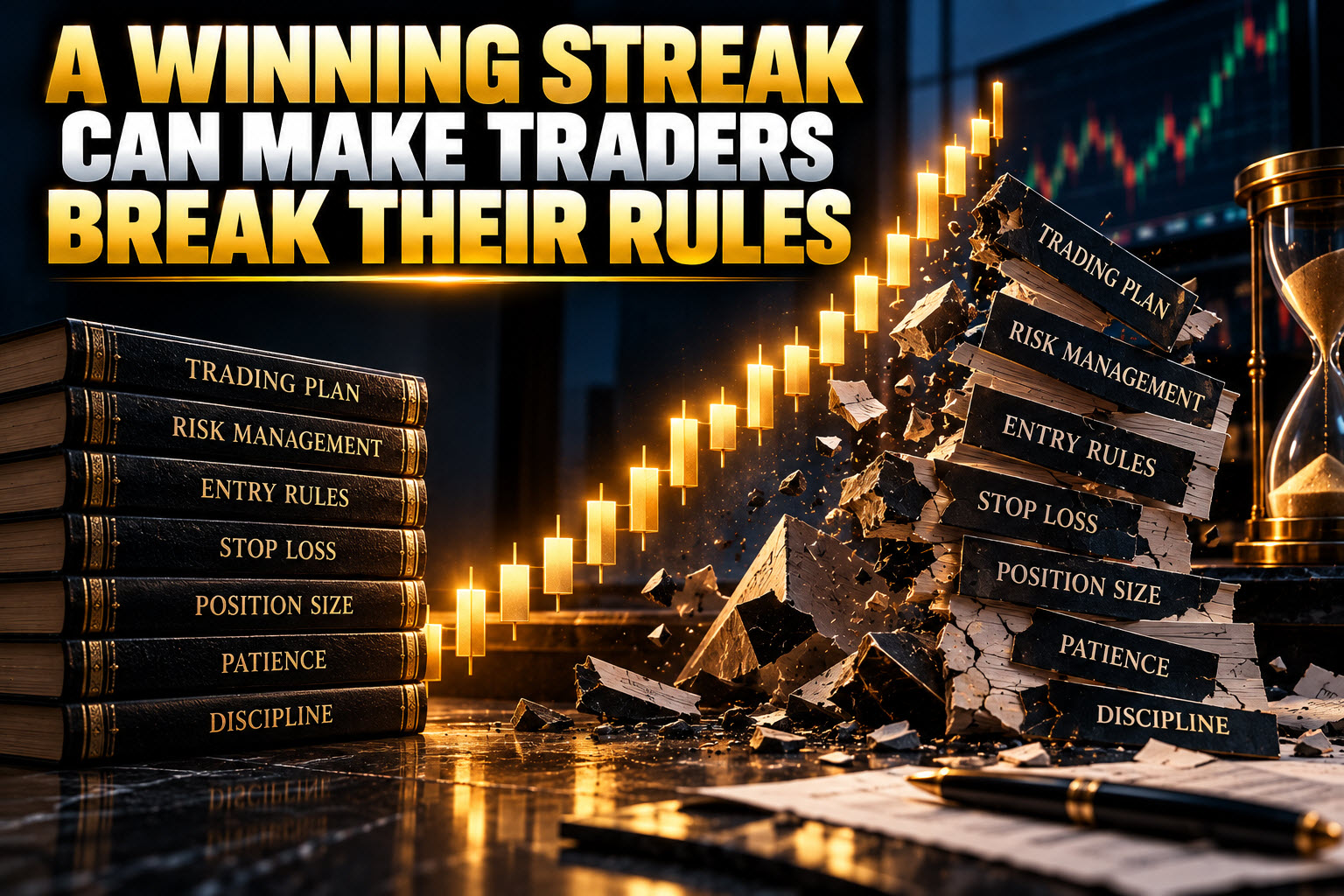
Perhaps the biggest danger is that winning creates the belief that rules are no longer necessary.
The trader may start:
And because some of these trades may initially work, the behavior gets reinforced.
This creates a particularly dangerous cycle:
Break the rule → make money → gain confidence in breaking the rule → take more risk.
The fact that a rule violation produced a profit does not make the violation a good decision.
This is one of the hardest lessons in trading psychology.
A bad decision can sometimes produce a good result.
For example, a trader might enter a trade without proper confirmation and make a large profit.
That profit can teach the trader:
“Entering early works.”
The next time, they enter early again.
Eventually, the market produces the opposite outcome.
Now the trader discovers that the original profit did not prove the decision was sound.
It only proved that the particular outcome was favorable.
This is why traders should evaluate their decisions based on their process—not simply whether the trade made money.
A trader might have five, eight or even ten profitable trades.
That can certainly be encouraging.
But it does not automatically mean the trader has suddenly become a much better trader.
Performance should be evaluated over a meaningful sample of trades rather than a small number of recent outcomes.
A short winning streak can happen within a perfectly normal distribution of results.
The important question is not:
“How many trades did I win recently?”
It is:
“Did I execute my strategy correctly?”
That is a much more useful question.
Many traders think discipline is mainly tested after losses.
But winning can be an equally important test.
After a loss, you may feel afraid.
After several wins, you may feel powerful.
Both emotional states can interfere with decision-making.
The disciplined trader tries to maintain the same framework in both situations.
Same strategy.
Same risk rules.
Same standards.
Same patience.
The goal is not to become emotionless.
The goal is to prevent emotions from changing the process.
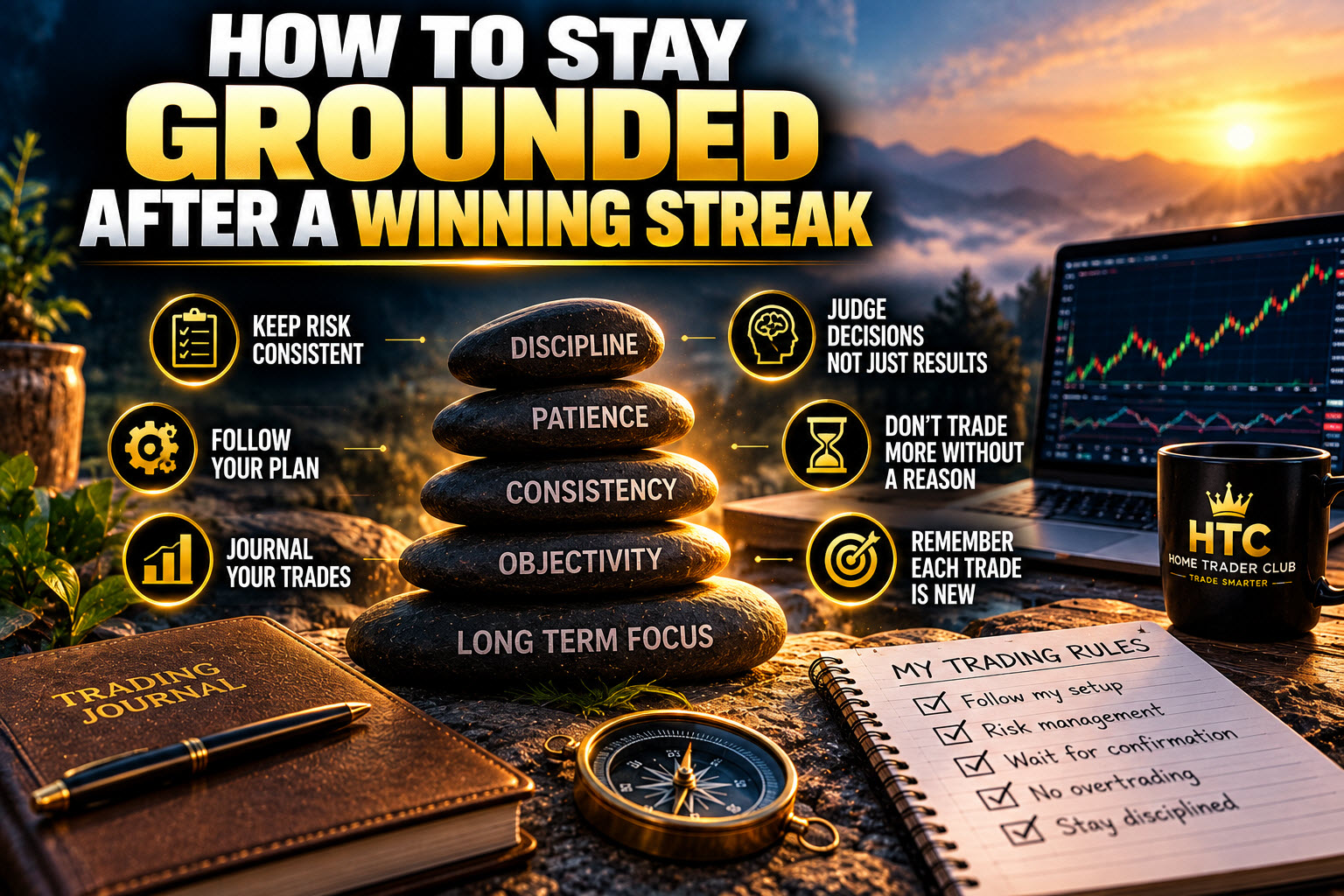
There are several simple ways traders can protect themselves from overconfidence.
Don’t automatically increase risk because you’ve recently made money.
If your strategy has predefined risk rules, follow them.
After every trade, ask:
A profitable trade with poor execution should still be recognized as poor execution.
A winning streak doesn’t create more valid setups.
Wait for your conditions.
Your trading journal can help reveal whether your behavior changes after winning.
Look for patterns such as:
The previous trade is finished.
A winning trade does not give the next trade a guaranteed advantage.
Approach each new opportunity according to your process.
This is an important psychological shift.
Traders can become obsessed with protecting a winning streak.
They may start thinking:
“I don’t want to lose now.”
That can create fear and hesitation.
Instead, focus on something you can actually control:
executing your process correctly.
You cannot control whether the next trade wins.
You can control whether you followed your rules.
Perhaps one of the most dangerous thoughts in trading is:
“I know what I’m doing now.”
It sounds harmless.
But if that thought causes you to increase risk, trade more frequently, ignore your rules, or believe you can predict the market with greater certainty, it becomes a problem.
A healthier mindset is:
“My process worked on this trade. I will follow the same process on the next one.”
That keeps the focus where it belongs.
Winning trades are rewarding, but they can also change the psychology of a trader.
A few successful trades can increase confidence, reduce the perceived importance of risk, encourage more trading, and create the illusion that the trader has greater control over the market.
Behavioral-finance research provides evidence that overconfidence can contribute to excessive trading and unnecessary risk-taking.
The solution is not to fear winning.
It is to remain disciplined when winning.
A good trading process should not change simply because your last few trades were profitable.
Remember:
A winning trade is a result.
A good decision is a process.
Don’t let a profitable streak convince you that the rules no longer matter.
The market will always provide another trade.
Your job is to make sure that when it arrives, you are still trading the same disciplined process that got you there.
To Your Trading Success,
Vladimir Ribakov
Internationally Certified Financial Technician (CFTe)
Home Trader Club
GDP growth is one of the most important indicators of economic health. But does stronger…
When it comes to fundamental Forex analysis, few institutions matter as much as the Federal…
Interest rates are one of the most important fundamental forces in the Forex market. But…
The latest U.S. employment report has delivered a significant warning for the market. With only…
The Forex market does not always offer clear trading opportunities. Sometimes, price moves sharply in…
Open social media for a few minutes and you can easily find someone talking about…