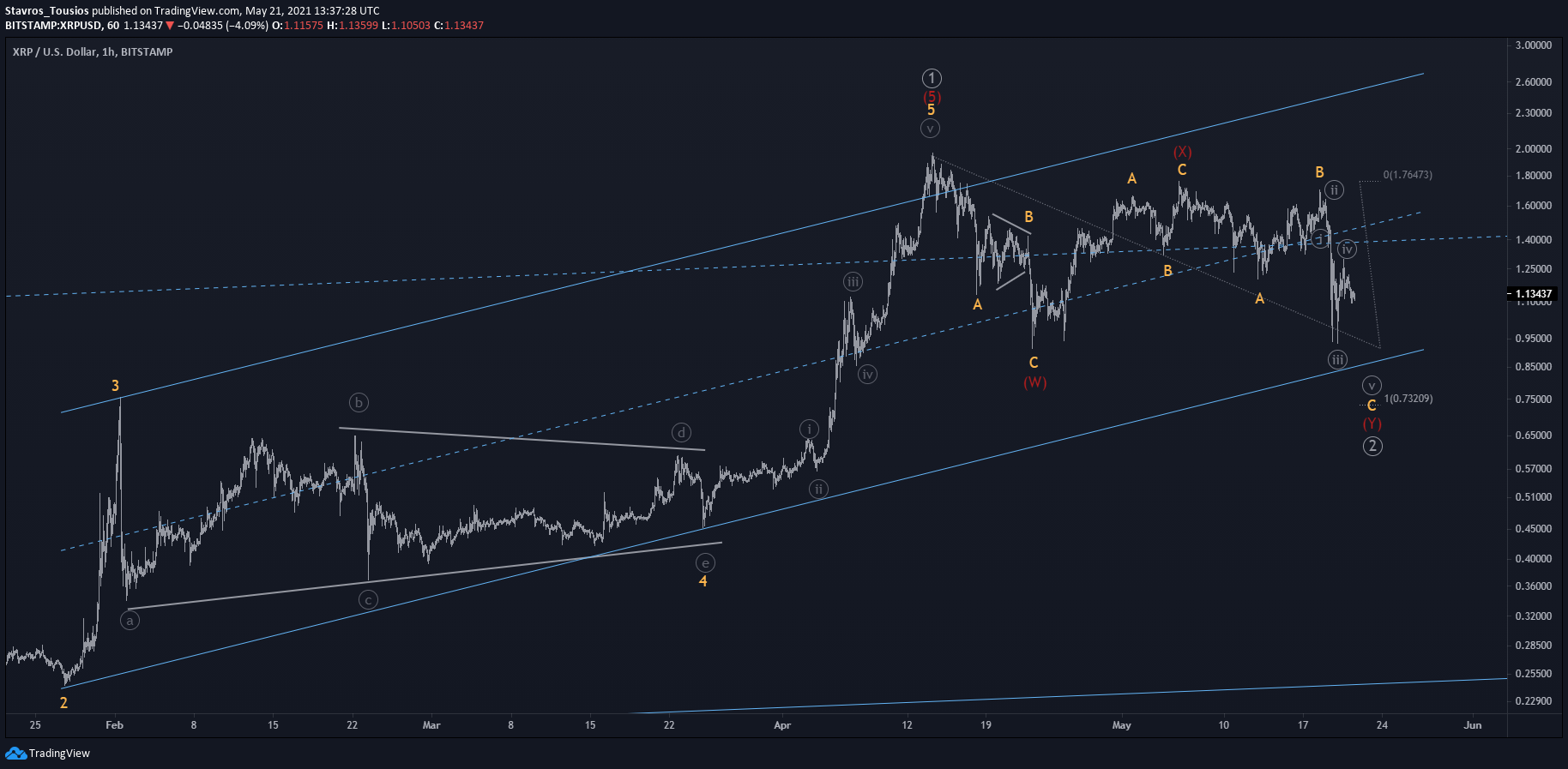
Cryptocurrency investors have decreased demand for XRP bids over the past few hours, sending prices to fresh post-crash lows of 1.09$.
But selling could continue to accelerate further should prices remain below the 1.30$ handle.
XRP Upside a 5-Wave Move?
With prices having failed to sustain breaks below the crash low of 0.93$ and the 50% Fibonacci retracement of the 5-wave 0.93-1.29 impulse, the overall risk sentiment could remain positive going forward.
However, a setback can be expected lower than the 61.80% and even the 78.6% Fibonacci retracement levels.
This should lineup with the main scenario of primary wave ② having completed its course in a double-three fashion.
To insure against weakness, traders can place a safety net below the crash low. Contrary, should the impulse move prevail, the first strong resistance buyers could meet lays by the 1.618% Fibonacci expansion of waves 1-2, at $1.80.
Another Leg Down Can Be Expected
Although the alternative scenario does not suggest radical changes, it is a short-term failure that increase probabilities of moving into lower territories.
While the main scenario is bullish, the alternative points at an incomplete 5-wave impulse in wave C of (Y), thus, bearish in the short-term. And that impulse just finished correcting in minute wave four, heading to its last and final leg to wave (Y).
Wave C of (Y) could end anywhere between the previous low of 0.93$ and 0.73$ as the latter is the 100% Fibonacci expansion of waves (W)-(X). However, should bears become stronger and break the first barrier, they will also have to get past the base-channel lower trendline, making firm dynamic support.
Long-term Potential Looking Bright
Rejection at any of the said levels would offer a better bargain for bulls, short and long term.
Short-term traders can look at drawing their Fibonaccis once the first impulse is complete. On the other hand, long-term holders have a greaterupside potential.
Both scenarios see wave 1 only as the start of a higher degree wave impulse, intermediate wave (1), followed by a full 5-wave move in primary wave ③,which continues in ⑤.
About the Author
You can follow Stavros on Twitter and Linkedin here: twitter.com/StavrosTousios & linkedin.com/in/stavrostousios/
Understanding market volatility is an important part of successful trading. Financial markets do not move…
This week, I am watching four markets for potential trading opportunities: EUR/USD, USD/JPY, Gold and…
The Forex market is one of the largest and most liquid financial markets in the…
One of the most important decisions in Forex trading is determining where to place a…
The financial markets are entering another potentially volatile week, with several interesting technical developments creating…
Why Consumer Confidence Matters in Forex Trading When analyzing the Forex market, traders often pay…