The Forex market is one of the largest and most liquid financial markets in the world. Every day, currencies are exchanged by banks, financial institutions, corporations, investors, governments and individual traders.
Most currency movements are driven by supply and demand, economic conditions, interest rate expectations and international capital flows.
However, there is another powerful participant that can sometimes influence currency prices: the central bank.
Central banks do not simply observe currency movements. Under certain circumstances, they actively participate in the foreign exchange market by buying or selling currencies. These transactions can involve substantial amounts of money and may influence exchange rates, market liquidity and investor expectations.
But why would a central bank spend billions buying its own currency? Why would it deliberately sell its own currency? And can a central bank actually control the value of a currency?
Understanding central bank intervention is an important part of Forex fundamental analysis because these operations can create significant market movements, particularly when currency markets experience excessive volatility or financial stress.
In this article, we will explore why central banks intervene in Forex markets, how these transactions work, what they are trying to achieve and what traders should monitor.
We have partnered with AvaTrade, one of the industry’s leading regulated brokers.
When you open and trade with AvaTrade through our partnership, you receive:
If you’re looking to accelerate your trading journey while enjoying premium education, this partnership gives you everything you need under one roof.
If you already have account with them, still follow this link to open separate account with separate email. Once you did that, contact me with the telegram link below and we will give you the access.
Telegram Channel: https://t.me/vladimirribakovtradingchannel
Central bank intervention occurs when a country’s monetary authority buys or sells currencies in the foreign exchange market to influence exchange rate movements or manage market conditions.
Normally, exchange rates are determined by the interaction between currency buyers and sellers.
For example, demand for a currency may increase when:
However, currency movements do not always develop smoothly.
Sudden capital outflows, financial uncertainty, geopolitical developments or speculative activity can create excessive pressure on a currency.
When these conditions become disruptive, a central bank may decide to intervene.
It can purchase its domestic currency to support its value or sell its domestic currency to limit excessive appreciation.
The purpose is not necessarily to establish a permanently fixed exchange rate. In many cases, intervention is intended to reduce excessive volatility, improve market functioning or address temporary imbalances between currency supply and demand.
Central bank intervention is therefore an important monetary and financial stability tool.
One of the main reasons a central bank purchases its domestic currency is to support it when it faces significant downward pressure.
When a currency depreciates rapidly, the consequences can extend beyond the foreign exchange market.
A weaker currency can increase the domestic cost of imported products, particularly energy, raw materials and other internationally traded goods.
It can also increase the repayment burden for businesses and institutions with debts denominated in foreign currencies.
If depreciation becomes disorderly, it may create uncertainty among investors and increase financial stability risks.
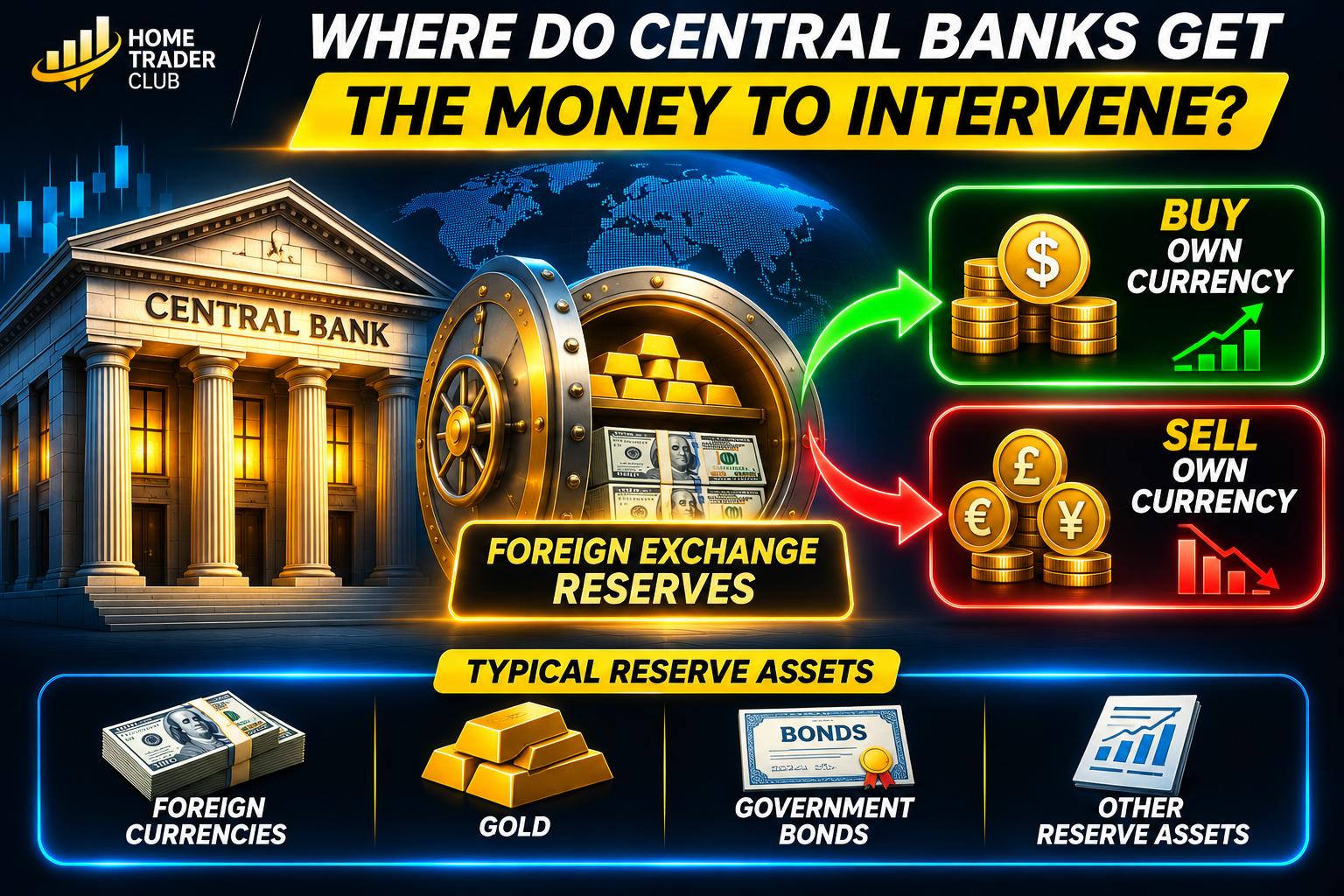
To address these conditions, a central bank can sell part of its foreign currency reserves and use the proceeds to purchase its domestic currency.
This creates additional demand for the domestic currency in the foreign exchange market.
The intended effects may include:
However, purchasing its own currency does not guarantee that a central bank can reverse a long-term depreciation trend.
If the underlying economic problems remain unresolved, market pressure may continue.
Central banks do not intervene only when their currencies are weakening.
Sometimes, they may also purchase foreign currencies by selling their domestic currency.
This can happen when the domestic currency appreciates too rapidly or when large international capital inflows create excessive upward pressure.
A very strong currency may create challenges for certain parts of the domestic economy.
For example:
In such circumstances, a central bank may purchase foreign currencies using newly supplied domestic currency.
This increases its foreign exchange reserves while adding supply of its domestic currency to the market.
The intended effect may be to moderate excessive appreciation and reduce the impact of unusually large capital inflows.
It is important to understand that central banks do not necessarily want a permanently weak currency.
Their objective may simply be to prevent exchange rate movements from becoming excessively disruptive.
This is one of the most interesting aspects of central bank intervention.
When a central bank wants to influence its domestic currency, it often uses its foreign exchange reserves.
Foreign exchange reserves are assets held by a central bank or monetary authority, typically in internationally accepted currencies and other reserve assets.
These reserves can be used for several purposes, including:
When a central bank sells foreign currency to purchase its domestic currency, its foreign exchange reserves generally decline, all else being equal.
When it purchases foreign currency using domestic currency, its reserves generally increase.
However, reserve levels can also change because of valuation movements, investment returns and other transactions.
This is why changes in published reserve figures should not automatically be interpreted as evidence of intervention.
The availability of foreign exchange reserves is important because it influences how much foreign currency a central bank can potentially use during periods of market pressure.
However, having substantial reserves does not guarantee that intervention will always succeed.
Central bank intervention influences the Forex market through several channels.
Understanding these mechanisms helps traders appreciate why an official transaction can sometimes have a significant impact on currency prices.
The most direct mechanism is the change in currency supply and demand.
When a central bank purchases its domestic currency, it creates additional demand for that currency.
When it sells its domestic currency, it adds supply to the market.
These transactions can influence the balance between buyers and sellers, particularly when market liquidity is limited or conditions are already unstable.
Central bank intervention can also influence investor expectations.
Suppose market participants believe that a central bank is concerned about excessive currency depreciation.
If the central bank takes action, investors may interpret the intervention as a sign that monetary authorities are prepared to respond to further instability.
This can change expectations about future policy decisions and influence trading behaviour.
Intervention can communicate that a central bank is monitoring financial conditions and is prepared to respond to disorderly market developments.
If investors believe the intervention is credible and supported by appropriate economic policies, confidence may improve.
However, if investors believe the intervention is unlikely to succeed, the market reaction may be limited.
During periods of financial uncertainty, demand for foreign currency can increase sharply.
Central bank intervention can help supply foreign currency to the market or absorb temporary imbalances.
This may improve market functioning and reduce disorderly price movements.
These mechanisms explain why intervention can influence exchange rates even when the transaction represents only a portion of total market activity.
There is another important concept that Forex traders should understand: sterilized intervention.
When a central bank buys or sells foreign currency, the transaction can affect the amount of domestic currency liquidity in the financial system.
For example, when a central bank purchases foreign currency using domestic currency, it generally supplies domestic currency to the banking system.
When it sells foreign currency and receives domestic currency, it generally withdraws domestic currency liquidity.
However, central banks may not want these transactions to change domestic monetary conditions.
They can therefore use additional operations to offset the liquidity effects of foreign exchange intervention.
This process is known as sterilization.
Imagine a central bank purchases foreign currency and supplies domestic currency to the market.
If it wants to neutralize the resulting increase in domestic liquidity, it can conduct an offsetting domestic market operation, such as selling domestic securities.
The additional transaction helps absorb the liquidity that was created through the foreign exchange purchase.
Similarly, other operations can be used to offset liquidity withdrawals.
The objective is to influence the foreign exchange market without necessarily changing the domestic monetary base or short-term monetary conditions by the same amount.
Sterilization gives central banks greater flexibility.
They may want to influence exchange rate conditions while maintaining their existing monetary policy objectives.
However, sterilization is not always cost-free or straightforward. Its effectiveness depends on market conditions, available instruments and the broader economic environment.
This is one of the most important questions in Forex fundamental analysis.
The short answer is that central banks can influence currency prices, but they cannot always control them.
The Forex market is influenced by many powerful factors:
A central bank may intervene to support its domestic currency, but if investors continue moving capital out of the country because of weak economic fundamentals, downward pressure may remain.
Similarly, a central bank may sell its domestic currency to slow appreciation, but strong capital inflows and attractive investment opportunities may continue creating demand.
Intervention is generally more effective when it is consistent with broader economic policies and supported by credible communication.
It may be less effective when market participants believe that the underlying economic conditions are working against the central bank’s objectives.
Therefore, traders should never assume that a central bank can permanently reverse a currency trend simply by entering the market.
Central banks do not always need to execute large currency transactions to influence market expectations.
Sometimes, official statements and public comments can influence currency prices.
This is commonly known as verbal intervention.
Verbal intervention occurs when central bank officials or government representatives communicate concerns about exchange rate movements or indicate that authorities are prepared to take action if market conditions become disorderly.
Such statements can influence traders because markets constantly assess the possibility of future intervention.
For example, if officials express concern about rapid currency depreciation and indicate that they are monitoring market developments closely, traders may begin reassessing their expectations.
Some market participants may reduce positions against the domestic currency because they believe intervention could become more likely.
However, not every strong statement leads to actual intervention.
Traders should distinguish between:
The difference matters because verbal intervention can influence expectations without any immediate purchase or sale of currency.
Despite their financial resources and policy influence, central banks cannot guarantee successful intervention.
There are several reasons why intervention may fail to produce the desired long-term result.
If a country experiences persistent inflation, weak economic growth, declining investor confidence or significant external imbalances, intervention alone may not resolve the underlying problems.
Market participants may continue selling the domestic currency.
International capital flows can be extremely large.
If investors are consistently moving funds away from a country, a central bank may find it difficult to offset the pressure through repeated currency purchases.
Foreign exchange reserves are valuable resources, but they are not unlimited.
A central bank that repeatedly sells foreign currency to support its domestic currency may eventually face concerns about the sustainability of its intervention.
Intervention is more likely to influence market expectations when investors believe that the central bank’s actions are consistent with its broader economic policies.
If investors believe the intervention is temporary or unsupported by other policy measures, confidence may remain weak.
A strong global movement in capital flows, a sudden change in risk appetite or a major international financial shock can overwhelm the impact of an individual central bank’s intervention.
This is why intervention should be viewed as one policy instrument rather than a guaranteed solution to currency weakness or strength.
For Forex traders, understanding intervention is not only about knowing why central banks buy and sell currencies.
It is also about recognizing conditions in which intervention may become more likely.
There are several developments worth monitoring.
Central banks may become concerned when exchange rates move sharply over a short period, particularly when price movements appear disorderly.
Rapid depreciation or appreciation does not automatically mean intervention is coming, but it can increase market attention.
Pay attention to comments from central bank officials, finance ministries and other relevant authorities.
Statements about excessive volatility, disorderly market conditions or the need to maintain stability may indicate increased concern.
Changes in foreign exchange reserves can provide useful information about a country’s external financial position.
However, reserve changes should be interpreted carefully because valuation effects and other transactions can also influence the figures.
Confirmed intervention operations, official statements and published foreign exchange reports can help traders distinguish actual intervention from market speculation.
Unexpected price movements, sudden changes in liquidity and unusual volatility may attract attention.
However, these developments are not proof of intervention. Economic announcements, large institutional orders and changing market expectations can also produce similar behaviour.
The objective is to combine several sources of information rather than relying on a single price movement or headline.
Central bank intervention can create unpredictable market conditions.
For this reason, traders should avoid treating every intervention announcement as an automatic trading signal.
A more structured approach includes the following considerations.
Understand the reason for intervention.
Determine whether the central bank is attempting to support a depreciating currency, moderate excessive appreciation, improve liquidity or reduce disorderly volatility.
Evaluate the broader economic environment.
Intervention should be considered alongside inflation, economic growth, interest rate expectations and international capital flows.
Distinguish temporary reactions from lasting changes.
A currency may react sharply to intervention, but the longer-term direction may still depend on underlying economic conditions.
Monitor official communication.
Statements and subsequent policy decisions can help traders understand whether the intervention represents an isolated operation or part of a broader policy approach.
Use disciplined risk management.
Sudden intervention announcements can produce sharp price movements, wider spreads and slippage.
Traders should avoid excessive leverage and ensure that potential losses remain within their predefined risk limits.
Combine fundamental and technical analysis.
Fundamental analysis helps explain why intervention may occur, while technical analysis can help assess market structure, price behaviour and potential trading levels.
The objective is to understand the market environment before making a trading decision, rather than reacting emotionally to headlines.
Central bank intervention is one of the most important tools available to monetary authorities when dealing with disorderly foreign exchange market conditions.
By purchasing or selling currencies, central banks can influence supply and demand, manage foreign exchange reserves, support market liquidity and attempt to moderate excessive exchange rate movements.
However, intervention does not give central banks unlimited control over currency prices.
Economic fundamentals, international capital flows, monetary policy expectations and investor confidence continue to play major roles in determining exchange rates.
For Forex traders, understanding why central banks intervene and how these transactions work provides an additional layer of fundamental market analysis.
The key is to recognize that currencies are influenced not only by economic data and interest rate decisions, but also by the actions and expectations of the institutions responsible for managing monetary and financial stability.
To Your Trading Success,
Vladimir Ribakov
Internationally Certified Financial Technician (CFTe)
Home Trader Club
Forex and CFD trading involve significant risk and may not be suitable for every investor. Leverage can amplify both profits and losses, and traders may lose some or all of their invested capital. Central bank intervention can create sudden and unpredictable market movements, including increased volatility, slippage and changes in liquidity. The information in this article is provided for educational purposes only and should not be considered financial or investment advice. Always assess your financial circumstances and risk tolerance before trading.
One of the most important decisions in Forex trading is determining where to place a…
The financial markets are entering another potentially volatile week, with several interesting technical developments creating…
Why Consumer Confidence Matters in Forex Trading When analyzing the Forex market, traders often pay…
When traders study the Forex market, they often focus on economic indicators such as inflation,…
The markets are showing some fascinating technical developments this week, and there are several opportunities…
When Being Right Becomes More Important Than Making Money Every Forex trader wants to make…