Forex trading attracts millions of people around the world because it offers access to one of the largest and most actively traded financial markets. However, getting started is not as simple as opening a trading account, looking at a chart, and placing a buy or sell order.
Successful Forex trading requires knowledge, preparation, discipline, and a clear understanding of risk.
For beginners, the biggest challenge is often knowing where to start. There are currency pairs to understand, charts to analyse, trading platforms to learn, indicators to explore, and risk-management rules to follow. With so much information available, it is easy to become overwhelmed.
The good news is that you do not need to learn everything at once.
The best approach is to build your knowledge step by step, starting with the fundamentals and gradually progressing towards market analysis, trading strategies, and practical execution.
In this complete Forex trading guide for beginners, we will explore how the Forex market works, explain the essential terminology, examine the different types of analysis, and outline the steps you should follow before risking real money.
Whether you are completely new to trading or have already explored a few charts, this guide will help you understand the foundations of Forex trading and develop a more structured approach.
Forex, short for foreign exchange, is the global marketplace where currencies are exchanged against one another.
The Forex market allows individuals, banks, financial institutions, corporations, governments, and other participants to exchange currencies for different purposes.
These include international business transactions, tourism, investment, international payments, and currency speculation.
Forex trading involves buying one currency while simultaneously selling another, with the objective of benefiting from changes in their relative exchange rates.
For example, when a trader expects one currency to strengthen relative to another, they may consider buying the currency pair. When they expect it to weaken, they may consider selling it.
Unlike traditional stock exchanges, the global Forex market operates primarily through an over-the-counter (OTC) network rather than one centralised exchange.
It is an international market that operates around the clock during the working week, with trading activity moving between major financial centres around the world.
There are several reasons why Forex attracts traders:
It is important to understand that these characteristics do not make Forex an easy way to earn money. Trading involves substantial financial risk, and beginners should focus on education and capital preservation before considering profitability.
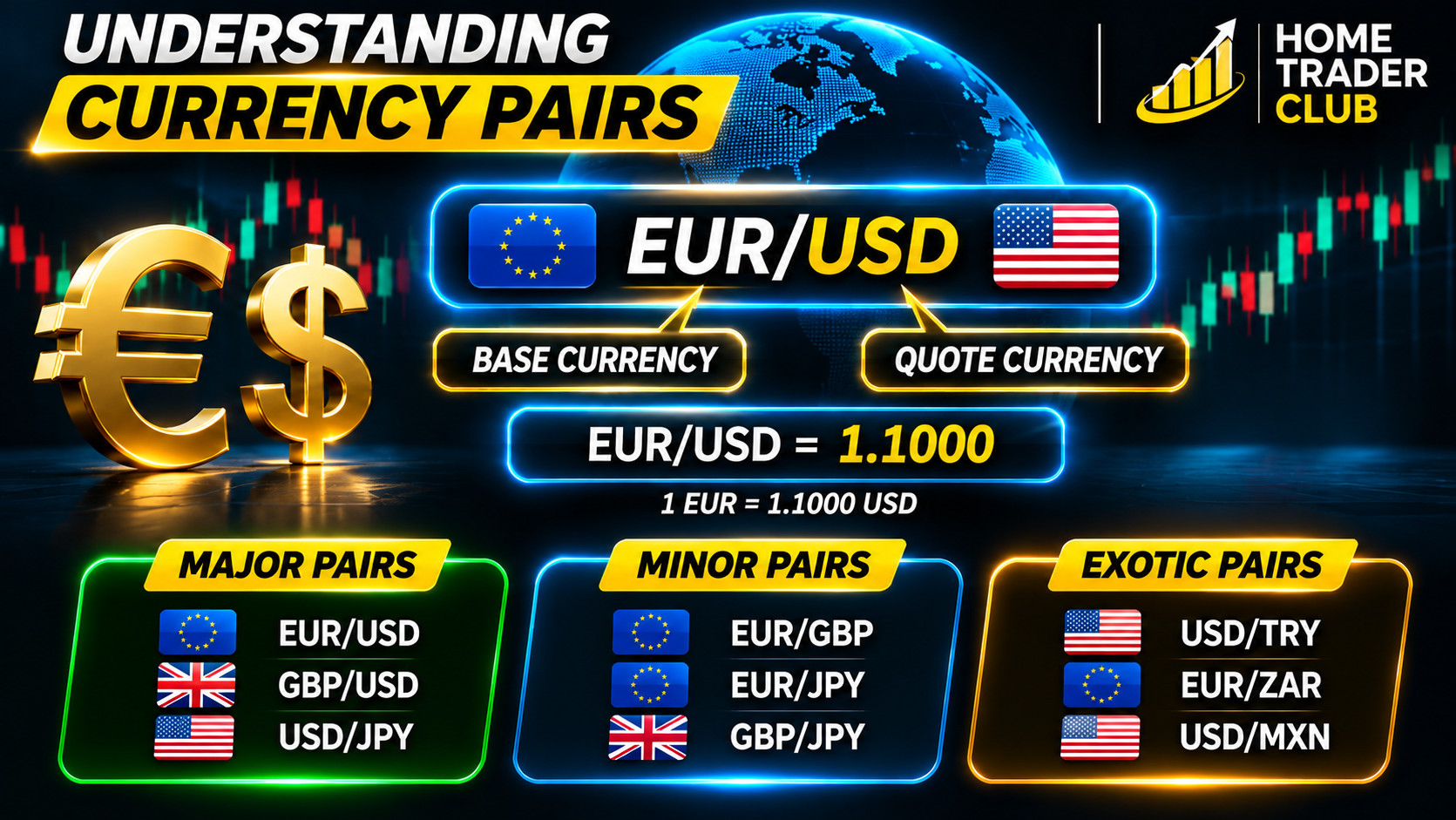
The first essential concept every Forex beginner must understand is the currency pair.
Currencies are traded in pairs because Forex trading always involves comparing the value of one currency against another.
A currency pair contains two components:
The exchange rate tells you how much of the quote currency is required to purchase one unit of the base currency.
For example, if a currency pair is trading at 1.1000, it means one unit of the base currency is worth 1.1000 units of the quote currency.
When the exchange rate rises, the base currency is strengthening relative to the quote currency. When the exchange rate falls, the base currency is weakening relative to the quote currency.
Currency pairs are generally divided into three main categories.
Major currency pairs
These involve the most widely traded currencies and typically include the US dollar against another major currency.
Major pairs generally attract significant trading activity and often have relatively competitive spreads.
Minor currency pairs
These involve major currencies but do not include the US dollar.
They can offer different market conditions and liquidity characteristics compared with major pairs.
Exotic currency pairs
These usually combine a major currency with the currency of an emerging or smaller economy.
Exotic pairs can have wider spreads, lower liquidity, and greater trading costs.
For beginners, understanding how different currency pairs behave is more important than trying to trade as many instruments as possible.
Start by studying a small selection of markets and become familiar with their volatility, trading costs, and price behaviour.
Before placing your first trade, you should understand the basic language used in the Forex market.
These terms appear regularly on trading platforms, charts, economic calendars, and broker statements.
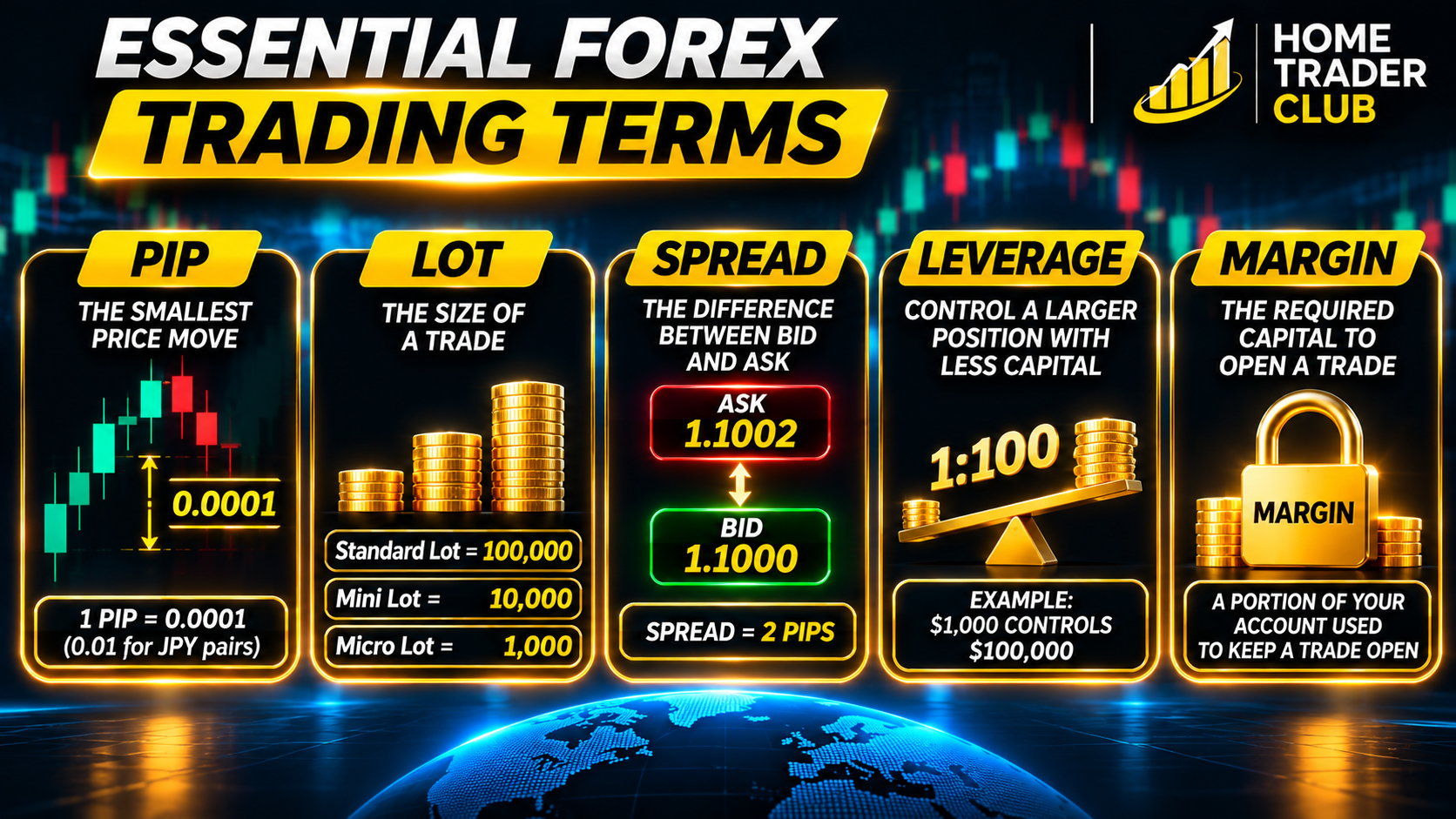
A pip is a standard unit used to measure changes in the exchange rate of a currency pair.
For many currency pairs, one pip represents a movement of 0.0001. For currency pairs involving the Japanese yen, one pip is commonly 0.01.
Some trading platforms also display fractional pips, often called pipettes.
Understanding pips is important because they help traders measure price movements, calculate potential profits and losses, and determine stop-loss distances.
A lot represents the size of a Forex trading position.
Commonly used lot sizes include:
Smaller position sizes allow traders to control their exposure more carefully.
However, the financial value of a pip depends on the currency pair, position size, and account currency.
Never assume that the same price movement will produce the same financial result across different instruments or position sizes.
The spread is the difference between the bid price and the ask price.
The bid is the price at which the market or broker is willing to buy the base currency, while the ask is the price at which it is willing to sell it.
The spread represents one of the costs involved in opening and closing a trade.
Spreads can change depending on market liquidity, volatility, trading sessions, and the broker’s pricing model.
Leverage allows traders to control a larger market position using a smaller amount of capital.
For example, leverage of 1:100 means that a trader may be able to control a position worth 100 times the required margin.
Although leverage can increase market exposure, it also magnifies the financial impact of adverse price movements.
A small market movement can produce a significant loss when the position size is too large relative to the account balance.
Beginners should approach leverage carefully and understand the relationship between leverage, margin, and position sizing before using it.
Margin is the amount of money required by a broker to maintain an open leveraged position.
It is not the same as a trading fee.
When a trader opens a leveraged position, a portion of their available account equity is reserved as margin.
If the account equity falls too far relative to the required margin, the broker may issue a margin call or automatically close positions according to its terms and applicable regulations.
Understanding margin is essential because poor position sizing can quickly create unnecessary pressure on a trading account.
Once you understand the basic terminology, the next step is selecting a suitable Forex broker.
Your broker provides access to the trading market and determines important aspects of your trading experience, including pricing, execution, available instruments, account conditions, and platform access.
Choosing a broker should never be based only on advertising or attractive promotional offers.
Consider the following factors:
Regulation and credibility
Check whether the broker is authorised by a recognised financial regulator in the jurisdiction where it operates.
Verify the regulatory information independently rather than relying entirely on claims made on the broker’s website.
Trading costs
Understand spreads, commissions, overnight financing charges, deposit fees, withdrawal fees, and any other applicable costs.
Execution quality
Look into how the broker handles order execution, slippage, rejected orders, and periods of high market volatility.
Trading platform
Choose a platform that provides the tools you need to analyze charts, manage orders, monitor positions, and review trading history.
Customer support
Reliable customer support can be important when dealing with technical problems, account access, or withdrawal-related questions.
A trading platform is the software used to monitor the market and execute trades.
Popular platforms offer features such as:
Spend time learning how your platform works before placing trades with real money.
You should know how to open and close positions, modify orders, calculate position sizes, and check your available margin.
We have partnered with AvaTrade, one of the industry’s leading regulated brokers.
When you open and trade with AvaTrade through our partnership, you receive:
If you’re looking to accelerate your trading journey while enjoying premium education, this partnership gives you everything you need under one roof.
If you already have account with them, still follow this link to open separate account with separate email. Once you did that, contact me with the telegram link below and we will give you the access.
Telegram Channel: https://t.me/vladimirribakovtradingchannel
The Forex market operates across major international financial centres.
Trading activity generally moves through four widely recognised sessions:
Each session has different characteristics in terms of market participation, liquidity, and volatility.
The London and New York sessions are particularly important because their trading hours overlap for part of the day, often creating periods of increased activity in major currency markets.
However, higher volatility does not automatically mean better trading opportunities.
A market can move quickly in either direction, and unexpected economic announcements can create sharp price movements.
Beginners should learn how different sessions affect market behaviour and identify the periods that best suit their trading approach and availability.
Market analysis is one of the most important skills a Forex trader must develop.
Before entering a trade, you should understand why you are considering that position and what market conditions support your decision.
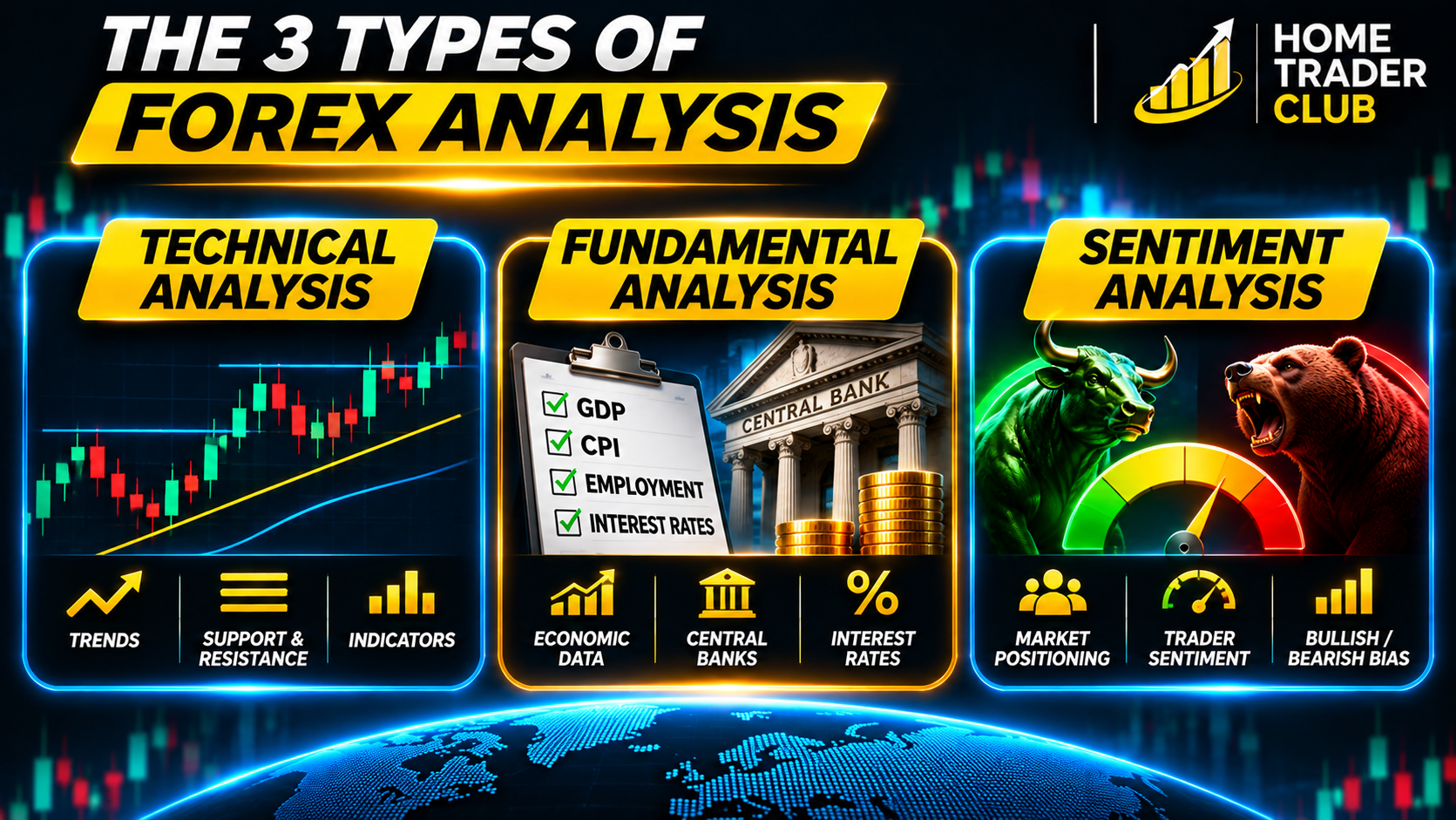
There are three main approaches to Forex market analysis.
Technical analysis involves studying historical price movements and chart patterns to identify potential trading opportunities.
It is based on the idea that price behaviour can provide useful information about market sentiment, supply and demand, and potential future price movements.
Common technical analysis tools include:
Technical analysis can help traders identify trends, potential reversals, momentum changes, and important price levels.
However, no indicator or chart pattern guarantees that the market will move in a particular direction.
The objective is to build a consistent analysis process rather than search for a perfect indicator.
Fundamental analysis focuses on economic, financial, and political factors that influence currency values.
Currencies can respond to changes in economic growth, inflation, interest rates, employment conditions, central bank policies, and geopolitical developments.
Important economic indicators include:
For example, changing interest rate expectations can influence the demand for a currency because investors continually assess the potential return from holding assets denominated in different currencies.
Fundamental analysis helps traders understand the broader economic forces that may influence currency markets.
Sentiment analysis examines the overall positioning and attitude of market participants.
It attempts to identify whether traders are predominantly bullish, bearish, optimistic, or cautious.
Market sentiment can be influenced by economic releases, geopolitical events, financial market developments, and unexpected news.
Tools such as positioning reports and sentiment indicators can provide additional context.
However, sentiment data should not be treated as a standalone trading signal.
Technical, fundamental, and sentiment analysis provide different perspectives on the same market.
Technical analysis helps examine price behaviour. Fundamental analysis provides economic context. Sentiment analysis offers insight into market positioning and expectations.
Combining these approaches can help traders develop a more complete understanding of market conditions.
The objective is not to make every type of analysis agree perfectly. It is to understand the available evidence and identify situations where the potential opportunity justifies the risk.
A trading strategy is a defined set of rules that determines when to enter a trade, when to exit, and how to manage risk.
Without a strategy, beginners often make decisions based on emotions, random indicators, or short-term price movements.
There are several popular Forex trading styles.
Scalping involves taking relatively short-term trades, sometimes lasting only seconds or minutes.
Scalpers aim to capture small price movements and may execute several trades during a trading session.
This style requires quick decision-making, close attention, disciplined execution, and careful consideration of spreads and transaction costs.
Day traders generally open and close their positions within the same trading day.
They avoid holding positions overnight as part of their trading approach.
Day trading requires a structured routine and the ability to manage trades during specific market sessions.
Swing trading involves holding positions for several days or sometimes weeks.
Swing traders aim to benefit from larger price movements rather than focusing on every short-term fluctuation.
This approach often involves analysing higher timeframes and identifying broader market trends or price structures.
Position trading is a longer-term approach in which traders may hold positions for weeks or months.
It often involves greater emphasis on fundamental developments, long-term trends, and broader economic conditions.
There is no universally best trading style.
The right approach depends on your availability, personality, risk tolerance, experience, and ability to follow a consistent trading plan.
A beginner with limited time may find it difficult to monitor the market continuously.
Rather than copying another trader’s style, focus on finding an approach that you can realistically practise, understand, and execute with discipline.
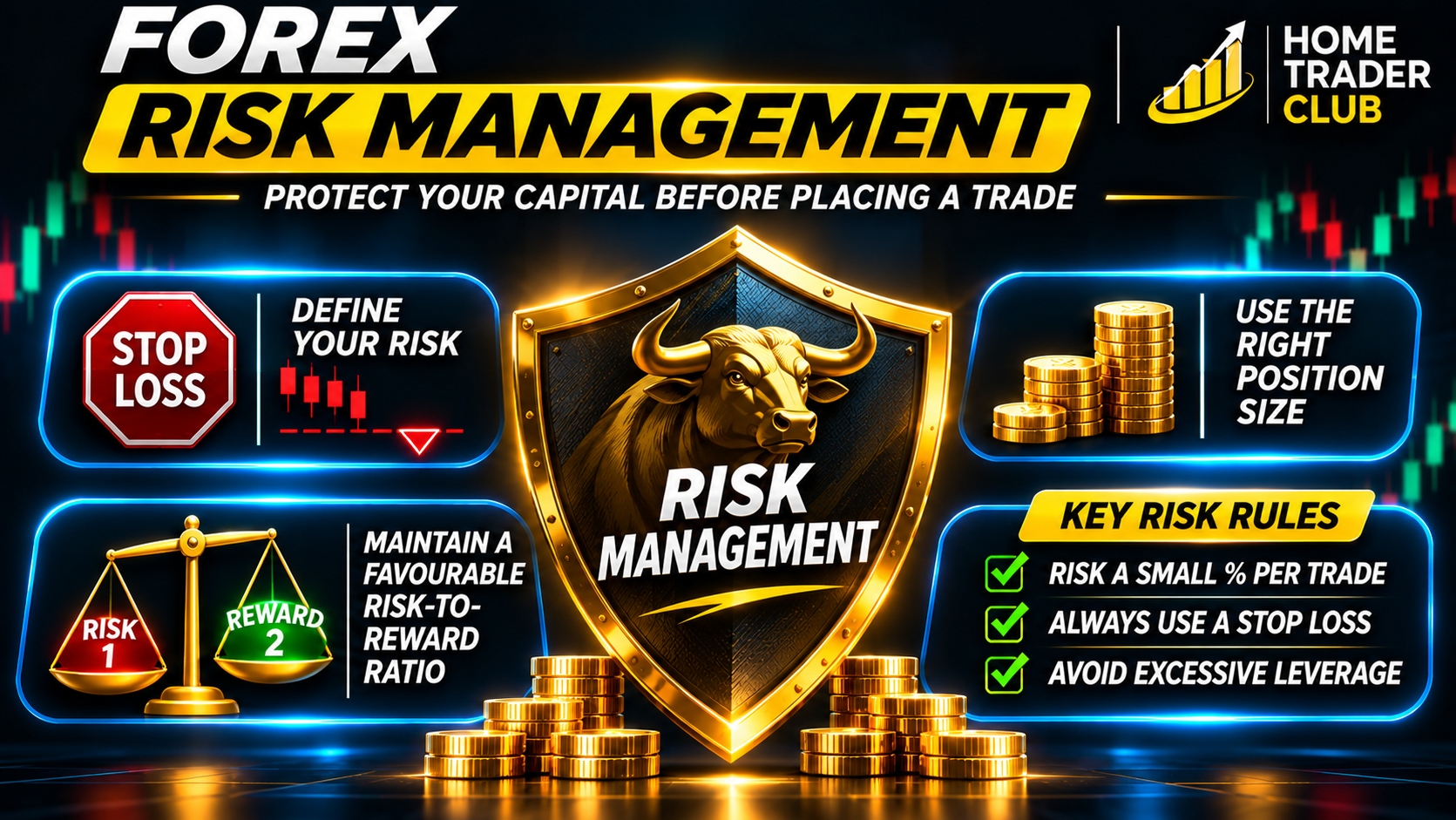
Risk management is arguably one of the most important aspects of successful Forex trading.
Many beginners spend considerable time searching for profitable indicators and strategies while overlooking the importance of protecting their trading capital.
A trading strategy can experience losing trades. Even a well-tested system will not win every time.
Risk management helps ensure that individual losses do not cause disproportionate damage to your account.
One common approach is to limit the amount of account capital exposed to risk on each trade.
Some traders use a small fixed percentage of their account balance or equity as a starting point for calculating position size.
There is no universal percentage that is appropriate for every trader. The important principle is to avoid exposing an excessive portion of your account to one trading decision.
A stop-loss order is designed to close a position when the market reaches a specified price level.
It helps define the intended risk of a trade before entering the market.
However, stop-loss execution is not guaranteed at the exact requested price. Gaps, slippage, and market conditions can result in a different execution price.
A stop loss should be placed according to the logic of your trading strategy, not simply at an arbitrary distance.
The risk-to-reward ratio compares the amount you are prepared to risk with the potential profit you are targeting.
For example, if a trade has a potential loss of 50 units and a potential profit target of 100 units, the risk-to-reward ratio is 1:2.
This means the potential reward is twice the intended risk.
However, a favourable risk-to-reward ratio does not automatically make a trading strategy profitable.
You must also consider the strategy’s win rate, transaction costs, slippage, and consistency over a sufficiently large sample of trades.
Leverage can make relatively small market movements financially significant.
Using excessive leverage may expose your account to rapid losses and increase the possibility of forced position closure.
Beginners should focus on controlling position size rather than trying to maximise market exposure.
Forex trading involves financial risk.
You should never use money required for essential expenses, emergency savings, debt repayments, or other important financial commitments.
Capital preservation should always come before the desire to generate quick profits.
Before trading with real money, spend time practising on a demo account.
A demo account allows you to experience the trading platform using simulated funds.
It provides an opportunity to learn how to:
However, demo trading has limitations.
Because simulated funds are involved, the emotional pressure may be very different from trading with real money.
A trader who performs well on a demo account may still struggle when real financial losses become possible.
Use demo trading to develop technical skills, test your process, and identify weaknesses before considering a transition to a live account.
A trading plan is a written document that explains how you approach the market.
It removes unnecessary guesswork and helps you follow a consistent decision-making process.
Your plan should include the following elements.
Markets you trade
Decide which currency pairs or instruments you intend to monitor.
Trading timeframe
Specify the chart timeframes you use for market analysis and trade execution.
Trading strategy
Define the conditions required before entering a position.
Entry rules
Explain what must happen before you consider buying or selling.
Stop-loss rules
Determine how you identify invalidation levels and define the intended risk.
Take-profit rules
Establish how you manage exits and identify potential profit targets.
Position sizing
Define how you calculate the appropriate trade size based on your account and intended risk.
Trading schedule
Decide when you analyse the market and when you are available to trade.
Review process
Set aside time to evaluate your trading performance and identify areas for improvement.
A trading plan should be practical and easy to follow.
It does not need to contain dozens of complicated rules. A clear and consistently applied process is more useful than a complicated system that you cannot execute properly.
A trading journal is a record of your trading activity.
It helps you understand not only whether a trade made or lost money, but also why you made the decision in the first place.
For every trade, consider recording:
You can also save screenshots of your charts before and after each trade.
Reviewing your journal regularly can reveal repeated mistakes, weak trading conditions, inconsistent position sizing, and emotional decision-making.
For example, you may discover that your trading performance deteriorates when you trade outside your planned sessions or enter positions without waiting for confirmation.
These observations can help you improve your trading process over time.
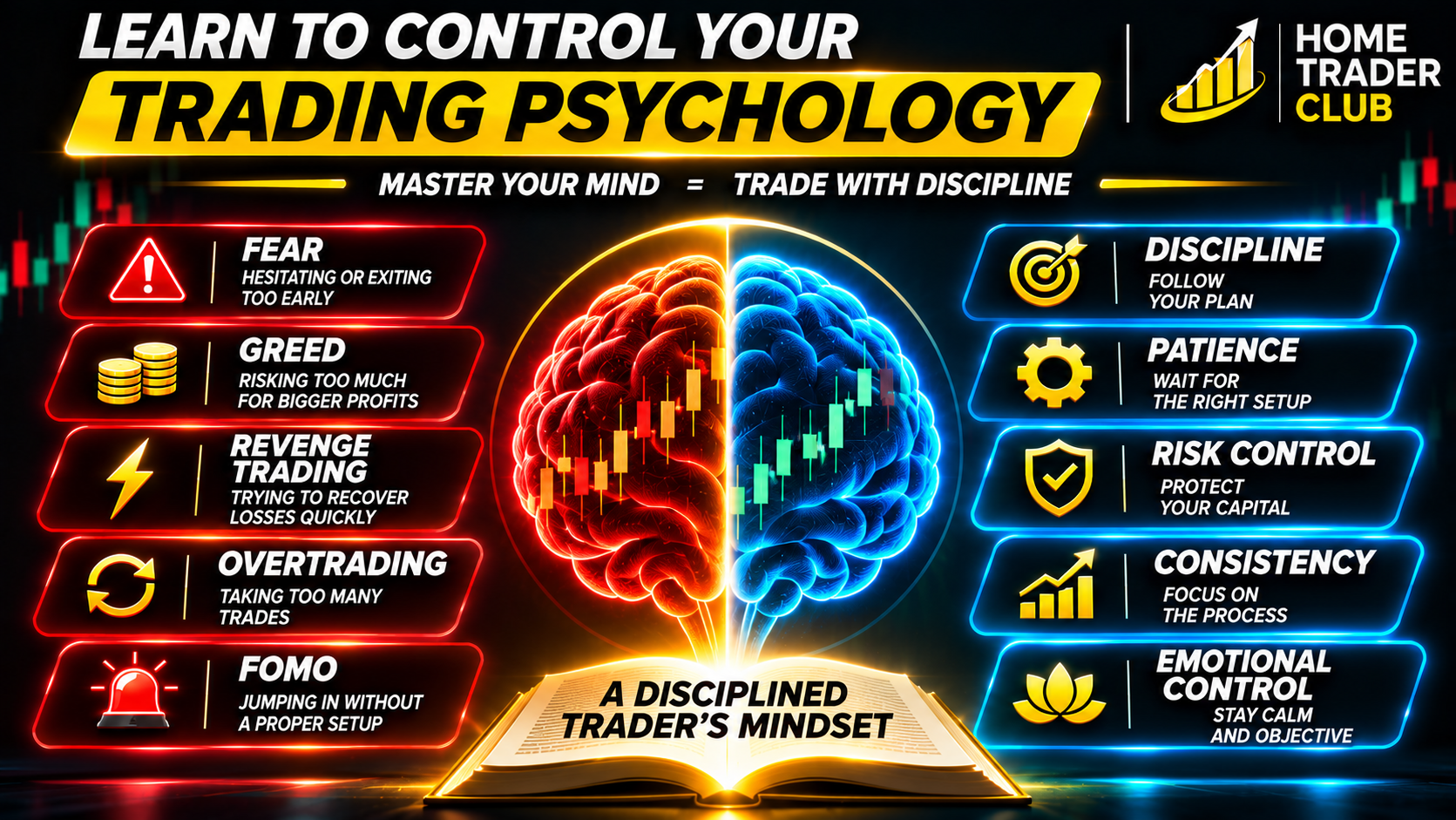
Forex trading is not only a technical and analytical activity. It also requires emotional discipline.
Even traders with a well-defined strategy can make poor decisions when emotions influence their judgement.
Some of the most common psychological challenges include:
Fear can prevent traders from entering valid opportunities or cause them to close positions too early.
Greed can encourage traders to increase position sizes, ignore risk limits, or hold positions beyond their planned exit.
Revenge trading occurs when traders attempt to recover losses quickly by taking impulsive or poorly planned positions.
It often leads to excessive trading and further losses.
Overtrading happens when traders enter too many positions, often because they feel they must always be active in the market.
More trades do not necessarily mean better performance.
FOMO can cause traders to enter the market after a significant move has already happened, without waiting for their planned trading conditions.
The solution is to establish clear rules and follow them consistently.
Accept that losing trades are part of trading. Focus on the quality of your decisions rather than judging yourself solely by individual outcomes.
Understanding common mistakes can help you avoid unnecessary losses during your learning journey.
Here are some of the most important mistakes to watch out for.
Trading without education
Entering the market without understanding currency pairs, leverage, spreads, and risk management creates unnecessary exposure.
Using excessive leverage
Large positions can magnify losses and quickly damage a trading account.
Changing strategies too frequently
Constantly switching between indicators and trading systems makes it difficult to evaluate whether a strategy actually works.
Trading without a stop loss
Failing to define an exit point can expose an account to uncontrolled losses.
Following trading signals blindly
A signal from another trader does not replace your responsibility to understand the trade, its risk, and its suitability.
Ignoring economic news
Major economic releases can create sudden volatility, wider spreads, and unexpected price movements.
Trying to recover losses immediately
Attempting to win back money through impulsive trading often makes the situation worse.
Expecting quick profits
Forex trading is a skill that requires education, practice, and continuous improvement. Treating it as a shortcut to financial success can lead to unrealistic expectations and poor decisions.
If you are starting from zero, the following roadmap can help you organise your learning process.
Learn what Forex is, how currency pairs work, and why exchange rates change.
Understand pips, lots, spreads, leverage, margin, and different order types.
Choose a suitable platform and learn how to use its charts, indicators, and order-management tools.
Learn how to read price charts and understand the economic factors that influence currencies.
Choose a trading style that suits your availability and personality.
Avoid trying to master multiple strategies simultaneously.
Create clear entry, exit, and risk-management rules.
Apply your strategy under simulated conditions and record your results.
Analyze your trading journal and identify recurring mistakes.
Only consider trading real money when you understand the risks and can consistently follow your process.
If you decide to move to a live account, begin with an amount you can afford to lose and conservative position sizing.
The Forex market constantly changes. Continue reviewing your performance, studying market behaviour, and refining your approach without abandoning your rules after every losing trade.
Forex trading can be an interesting and challenging financial activity, but beginners should understand that success does not come from finding one perfect indicator or discovering a secret trading strategy.
It comes from building a strong foundation.
You need to understand how the market works, learn how to analyse price movements, develop a trading strategy, manage risk, and control your emotions.
Most importantly, you must accept that losses are part of trading. Your objective should not be to win every trade but to develop a repeatable process that allows you to make informed decisions while keeping risk under control.
Do not rush the learning process.
Start with the fundamentals, practise on a demo account, maintain a trading journal, and gradually improve your skills.
Remember, becoming a consistent trader is a journey of continuous learning, discipline, and experience.
To Your Trading Success,
Vladimir Ribakov
Internationally Certified Financial Technician (CFTe)
Home Trader Club
Forex and CFD trading involve a high level of risk and may not be suitable for all investors. Leverage can work against you as well as in your favour, and you may lose some or all of your invested capital. Past performance does not guarantee future results. The information in this article is provided for educational purposes only and should not be considered financial or investment advice. Always understand the risks involved and seek independent professional advice where appropriate before making trading decisions.
Forex traders constantly monitor economic reports to understand the health of an economy and anticipate…
Understanding market volatility is an important part of successful trading. Financial markets do not move…
This week, I am watching four markets for potential trading opportunities: EUR/USD, USD/JPY, Gold and…
The Forex market is one of the largest and most liquid financial markets in the…
One of the most important decisions in Forex trading is determining where to place a…
The financial markets are entering another potentially volatile week, with several interesting technical developments creating…