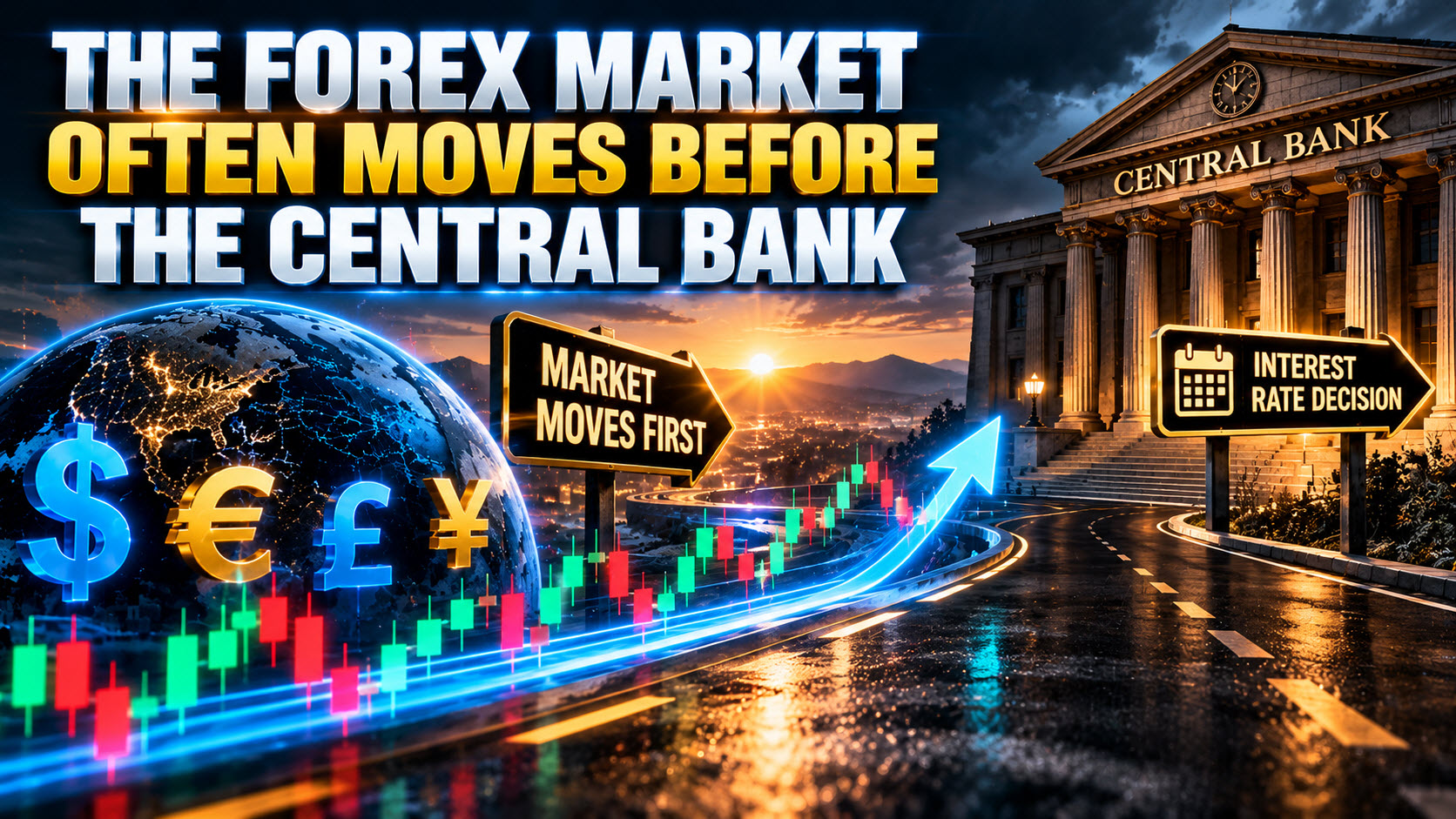
Interest rates are one of the most important fundamental forces in the Forex market.
But there is an important distinction every Forex trader should understand:
Currencies do not move only because central banks change interest rates. They can move because traders expect interest rates to change.
This is why the Forex market can begin moving days, weeks or even months before a central bank actually changes its policy rate.
Markets are forward-looking. Traders and investors continuously assess inflation, employment, economic growth, central bank communication and other economic information to estimate where interest rates may be in the future.
Those expectations can influence financial markets and exchange rates.
Understanding this relationship can help Forex traders explain why currencies sometimes move before major economic announcements—and why an interest-rate decision can occasionally produce a surprisingly small reaction.
We have partnered with AvaTrade, one of the industry’s leading regulated brokers.
When you open and trade with AvaTrade through our partnership, you receive:
If you’re looking to accelerate your trading journey while enjoying premium education, this partnership gives you everything you need under one roof.
If you already have account with them, still follow this link to open separate account with separate email. Once you did that, contact me with the telegram link below and we will give you the access.
Interest rate expectations represent what financial markets believe a central bank is likely to do with interest rates in the future.
For example, traders may expect a central bank to:
These expectations can change whenever new information becomes available.
An inflation report may cause traders to expect higher rates.
Weak employment data may cause expectations for future rate increases to decline.
A central bank speech may cause markets to anticipate rate cuts.
This means the Forex market is constantly reassessing the likely future path of monetary policy.
The market is not only asking, “What is the interest rate today?”
It is asking:
“Where are interest rates likely to be in the future?”
Interest rates can influence the relative attractiveness of financial assets denominated in different currencies.
If markets expect one country’s interest rates to remain relatively higher than another country’s rates, the difference in expected returns can influence capital flows and demand for the currencies involved.
This is one reason interest-rate differentials are important in Forex.
Consider two economies.
Country A: Markets expect interest rates to remain relatively high.
Country B: Markets expect interest rates to decline.
If other factors are broadly comparable, the expected difference in monetary policy can influence the relative attractiveness of the two currencies.
But the important word is:
Expected.
The Forex market does not necessarily wait until the policy decision arrives before considering its implications.
This is one of the most important concepts in fundamental Forex analysis.
Suppose traders increasingly expect a central bank to raise interest rates over the next several months.
They may begin adjusting their expectations and positions before the central bank actually raises rates.
As expectations change, financial markets can respond.
The currency may strengthen.
Bond yields may move.
Capital flows may change.
Other asset prices may adjust.
By the time the central bank officially raises rates, part of the expected move may already be reflected in market prices.
The relationship between expected future interest-rate paths and exchange rates is an important part of monetary-policy transmission.
This explains why a trader should not look only at the next interest-rate decision.
The bigger question is what the market already expects.
This distinction is extremely important.
Imagine the market expects a central bank to raise rates by 25 basis points.
The central bank raises rates by exactly 25 basis points.
At first glance, that sounds bullish for the currency.
But the currency may barely move.
Why?
Because the decision was already expected.
The market had already considered it.
Now consider a different situation.
The market expects rates to remain unchanged.
Instead, the central bank keeps rates unchanged but signals that another increase could be coming.
That may produce a much stronger reaction because expectations have changed.
The important information is therefore not simply the rate decision.
It is the difference between what the market expected and what the central bank communicates about the future.
Interest-rate expectations can change even when a central bank does nothing.
This can happen because of new economic information.
Markets may begin expecting the central bank to maintain restrictive policy for longer.
Traders may reduce expectations for future rate increases.
Markets may anticipate stronger monetary policy.
Expectations for future easing may increase.
Markets may reassess the expected policy path even before the next meeting.
This is why fundamental Forex traders need to follow the broader economic picture rather than watching only central-bank meeting dates.
Monetary policy transmission depends heavily on expectations about the future path of interest rates.
Inflation plays a major role in monetary-policy expectations.
When inflation remains persistently high, markets may expect a central bank to maintain higher interest rates or keep monetary policy restrictive for longer.
When inflation falls toward a central bank’s desired level, markets may begin considering the possibility of lower interest rates.
But the relationship is not automatic.
Central banks consider multiple factors, including economic growth, employment, financial conditions and the persistence of inflation.
This means a single inflation report should not automatically be interpreted as a guaranteed signal for the currency.
Instead, traders should ask:
“How does this inflation data change expectations for future monetary policy?”
That is the more useful fundamental question.
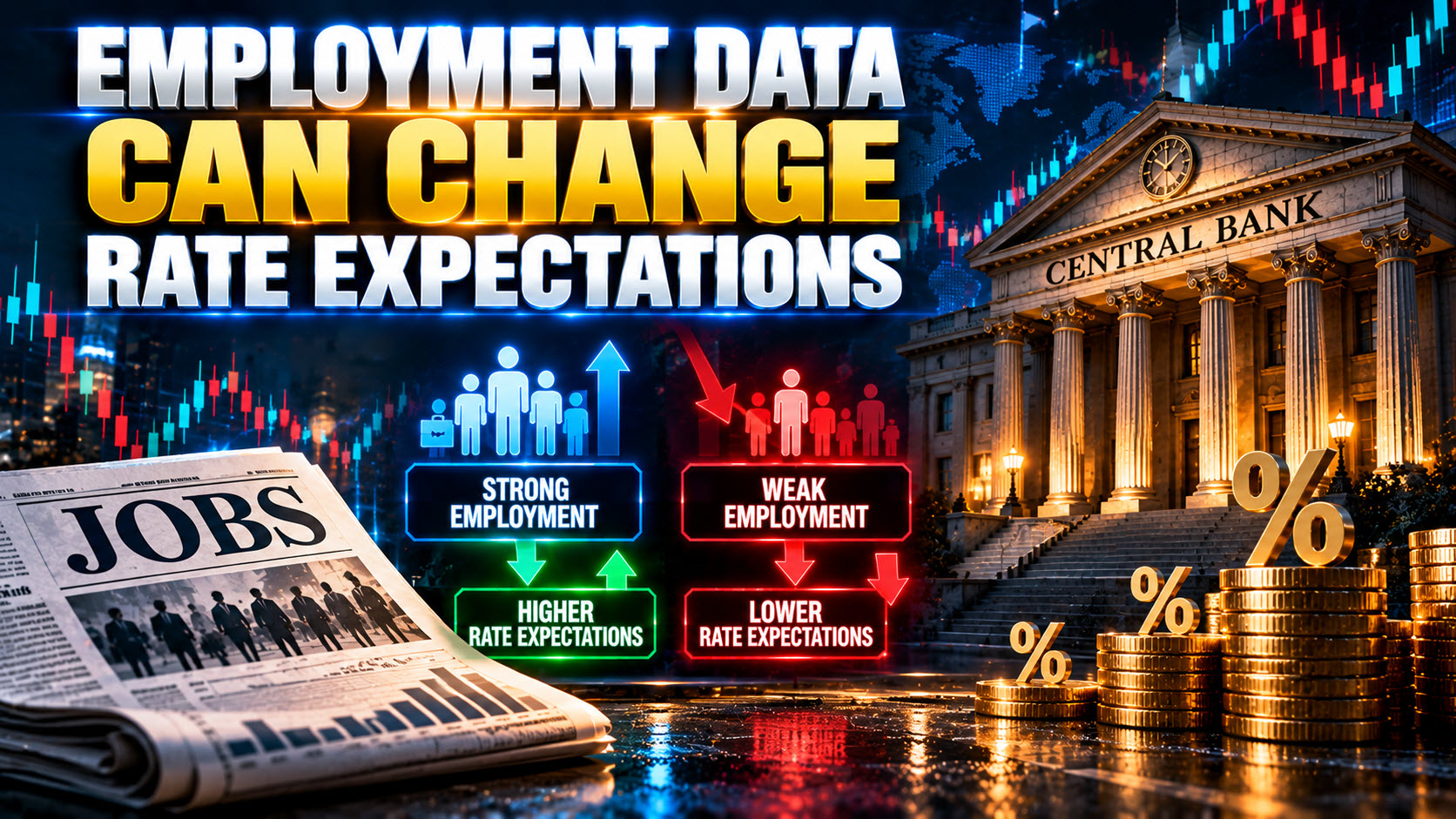
Employment data can also influence expectations about future interest rates.
Strong employment and wage growth can contribute to expectations that economic activity remains resilient and that inflationary pressure may persist.
Weak employment data can have the opposite effect.
But again, context matters.
A single employment report does not determine monetary policy.
The market is constantly comparing new information with previous expectations.
This is why the reaction to employment data can sometimes be very different from what a trader might expect from the headline alone.
Interest-rate expectations are also shaped by what central-bank officials say.
A central bank does not necessarily need to change its interest rate to influence market expectations.
Its communication can provide clues about how policymakers view:
This is why speeches, meeting statements, minutes and press conferences can all matter to Forex traders.
The market listens not only for what policymakers are doing today, but also for clues about what they might do next.
A central bank that appears more concerned about persistent inflation and willing to maintain restrictive policy may be described as hawkish.
A central bank that appears more focused on supporting economic activity and more willing to reduce rates may be described as dovish.
But traders should be careful with these labels.
A central bank can sound hawkish without raising rates.
It can also raise rates while sounding less hawkish about the future.
The important issue is whether the communication changes the market’s expectations.
For example:
Before the announcement: Markets expect three future rate cuts.
After the announcement: Markets expect only one.
Even though the current interest rate did not change, the expected policy path has changed significantly.
That can matter for the currency.
Forex is always a comparison between two currencies.
This means traders should not analyze interest-rate expectations for one country in isolation.
Consider EUR/USD.
You need to think about expectations for both:
Eurozone monetary policy
and
US monetary policy.
Suppose markets become more optimistic about European rates but simultaneously become even more optimistic about US rates.
The euro could still weaken against the dollar.
Why?
Because what matters is the relative change in expectations.
This is one reason currency strength is always relative.
A currency does not need to have the highest interest rate in the world to strengthen.
What matters is how its expected monetary-policy path compares with that of the currency on the other side of the pair.
One reason Forex can move quickly is that expectations can change almost instantly.
Imagine traders expect a central bank to begin cutting rates later in the year.
Then a series of stronger-than-expected economic reports arrives.
Markets begin questioning whether those cuts will happen.
The expected policy path changes.
The currency may react before the central bank says anything new.
The reverse can also happen.
A series of weak economic reports can cause traders to bring expected rate cuts forward.
Again, the currency may move before the central bank actually changes its policy rate.
The market can price a change in expectations long before the official policy change arrives.
This may initially sound confusing.
If lower interest rates generally reduce the relative return associated with a currency, why could a currency strengthen after a rate cut?
Because the market may have expected an even larger cut.
For example:
Expected: 50-basis-point cut
Actual: 25-basis-point cut
The central bank has technically lowered rates.
But the decision is less dovish than the market expected.
Traders may therefore interpret the announcement as relatively supportive of the currency.
This is another example of why fundamental Forex analysis is not simply:
Rate up = currency up
or
Rate down = currency down.
The market reaction depends heavily on expectations.
Interest-rate expectations are not fixed.
They change as new information arrives.
A trader can therefore think about the market as a constantly evolving chain:
Economic Data → Policy Expectations → Interest-Rate Pricing → Currency Demand → Exchange Rate
But the process is not always this simple.
Risk sentiment, capital flows, economic growth, geopolitical developments and other factors can influence the currency at the same time.
Changes in monetary-policy expectations can also interact with positioning and leveraged trading activity, which may amplify exchange-rate moves in some circumstances.
This is why interest-rate expectations should be viewed as a major fundamental driver—not as a standalone forecasting tool.
This is an important warning.
Interest rates matter, but currencies are influenced by multiple forces.
A country could have relatively high interest rates while its currency remains under pressure because traders are concerned about:
Likewise, a currency with relatively low interest rates can sometimes strengthen if expectations about its future policy become more supportive or if other fundamental factors dominate.
Interest rates are important—but context determines how the market interprets them.
You don’t need to become an economist to incorporate interest-rate expectations into your fundamental analysis.
Start with a simple process.
Understand where the central bank currently stands.
Ask whether inflation is rising, falling or remaining persistent.
Look for changes that could influence future monetary policy.
Pay attention to statements, speeches and press conferences.
Ask:
Has the expected future policy path changed?
For a currency pair, examine the expected policy direction of both central banks.
Finally, observe whether the currency is responding in the way the fundamental shift might suggest.
This does not guarantee a correct forecast.
It simply gives you a structured way to think about monetary policy.
One of the biggest mistakes a fundamental trader can make is finding one bullish or bearish factor and immediately turning it into a trade idea.
For example:
“Interest rates are expected to rise, so buy the currency.”
That conclusion may be too simple.
Instead, consider:
This creates a much more complete fundamental picture.
The current interest rate tells you where monetary policy is today.
Interest-rate expectations tell you where markets believe monetary policy may be going.
For Forex traders, the second question can often be more important.
Markets are forward-looking.
They continuously attempt to price future economic and monetary conditions.
That is why currencies can move before central-bank decisions and sometimes barely react when a widely anticipated decision finally arrives.
Interest rates are one of the most important forces in Forex, but understanding them requires looking beyond the current policy rate.
The market is constantly trying to anticipate what central banks will do next.
Inflation, employment, economic growth, central-bank communication and financial-market conditions can all change those expectations.
When expectations change, interest-rate differentials and asset valuations can change as well—and currencies can respond.
The key lesson is simple:
Don’t ask only, “What is the interest rate?”
Ask:
“What does the market expect interest rates to do next?”
And then take it one step further:
“Has that expectation already been priced into the currency?”
That shift—from looking at today’s policy to thinking about tomorrow’s expectations—can make fundamental Forex analysis much more meaningful.
Interest rates matter. But expectations about interest rates can move the market before the rates themselves change.
To Your Trading Success,
Vladimir Ribakov
Internationally Certified Financial Technician (CFTe)
Home Trader Club
Have you ever opened your trading platform, watched the market move, and felt that you…
Employment data is one of the most important economic indicators in Forex fundamental analysis. It…
Welcome back to our weekly Forex forecast at Home Trader Club. This week, we are…
GDP growth is one of the most important indicators of economic health. But does stronger…
When it comes to fundamental Forex analysis, few institutions matter as much as the Federal…
The latest U.S. employment report has delivered a significant warning for the market. With only…