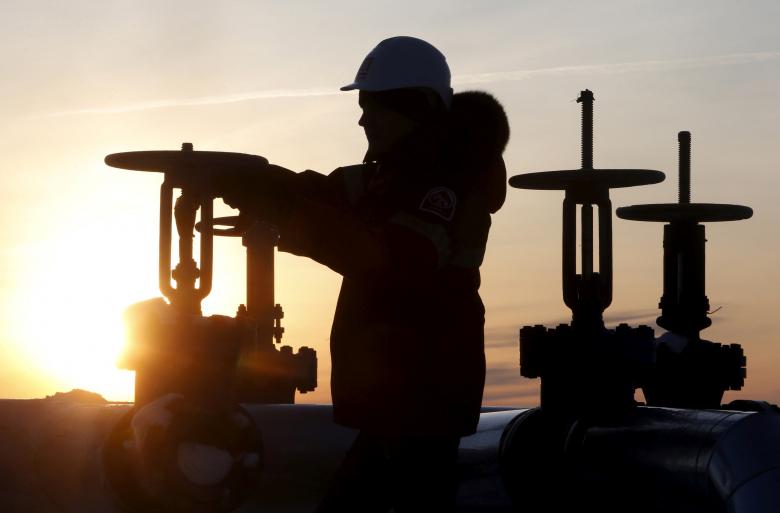
A worker checks the valve of an oil pipe at the Lukoil company owned Imilorskoye oil field outside the Siberian city of Kogalym, Russia, January 25, 2016. REUTERS/Sergei Karpukhin/File Photo
By Ron Bousso
LONDON (Reuters) – The world’s listed oil companies have slashed oil output by 2.4 percent so far this year during one of the industry’s worst downturns as OPEC battles to agree on its first production cut since 2008.
The aggregated production of 109 listed companies that produce more than a third of the world’s oil fell in the third quarter of 2016 by 838,000 barrels per day from a year earlier to 33.88 million bpd, data provided by Morgan Stanley (NYSE:MS) showed.
By comparison, the Organization of the Petroleum Exporting Countries produced 33.64 million bpd in October. OPEC has struggled to agree on a joint production freeze or cut to support oil prices before its Nov. 30 meeting in Vienna.
In the second quarter of 2016, the companies reduced production by nearly 930,000 bpd, according to Morgan Stanley.
The firms include national oil champions of China, Russia and Brazil, international producers such as Exxon Mobil (N:XOM) and Royal Dutch Shell (L:RDSa), as well as U.S. shale oil producers like EOG Resources (N:EOG) and Occidental Petroleum (N:OXY).
The drop in oil companies’ output is particularly compelling given the increase in 2015, when third-quarter production rose by some 1.9 million bpd.
“Clearly, we have seen a large swing in the year-on-year trend in production, from strong growth as recent as a year ago, now to steep decline. This is the outcome of the strong cutbacks in investment,” Morgan Stanley equity analyst Martijn Rats said.
Capital expenditure for the companies combined more than halved from $136 billion in the third quarter of 2014 to $58 billion in the same period this year, according to Rats.
Oil executives and the International Energy Agency have warned that a sharp drop in global investment in oil and gas would result in a supply shortage by the end of the decade.
Large oilfields, such as deepwater developments off the coasts of the United States, Brazil, Africa and Southeast Asia, typically take three to five years and billions in investment to develop.
Cost reductions and increased efficiencies have only partly offset the drop in production as a result of the lower investment. Technological advancements have also helped boost onshore U.S shale production.
“These declines should temporarily soften in 2017 as new fields are coming on-stream in Canada, Brazil, the former Soviet Union and U.S. tight oil probably stabilizes,” Rats said.
“Still, unless investment rebounds relatively soon, this steep downward trend is likely to resume in 2018 and beyond.”
GDP growth is one of the most important indicators of economic health. But does stronger…
When it comes to fundamental Forex analysis, few institutions matter as much as the Federal…
Interest rates are one of the most important fundamental forces in the Forex market. But…
The latest U.S. employment report has delivered a significant warning for the market. With only…
The Forex market does not always offer clear trading opportunities. Sometimes, price moves sharply in…
Open social media for a few minutes and you can easily find someone talking about…
View Comments
You are welcome guys!
Nice article, thanks Vlad.
Thanks for sharing this article!