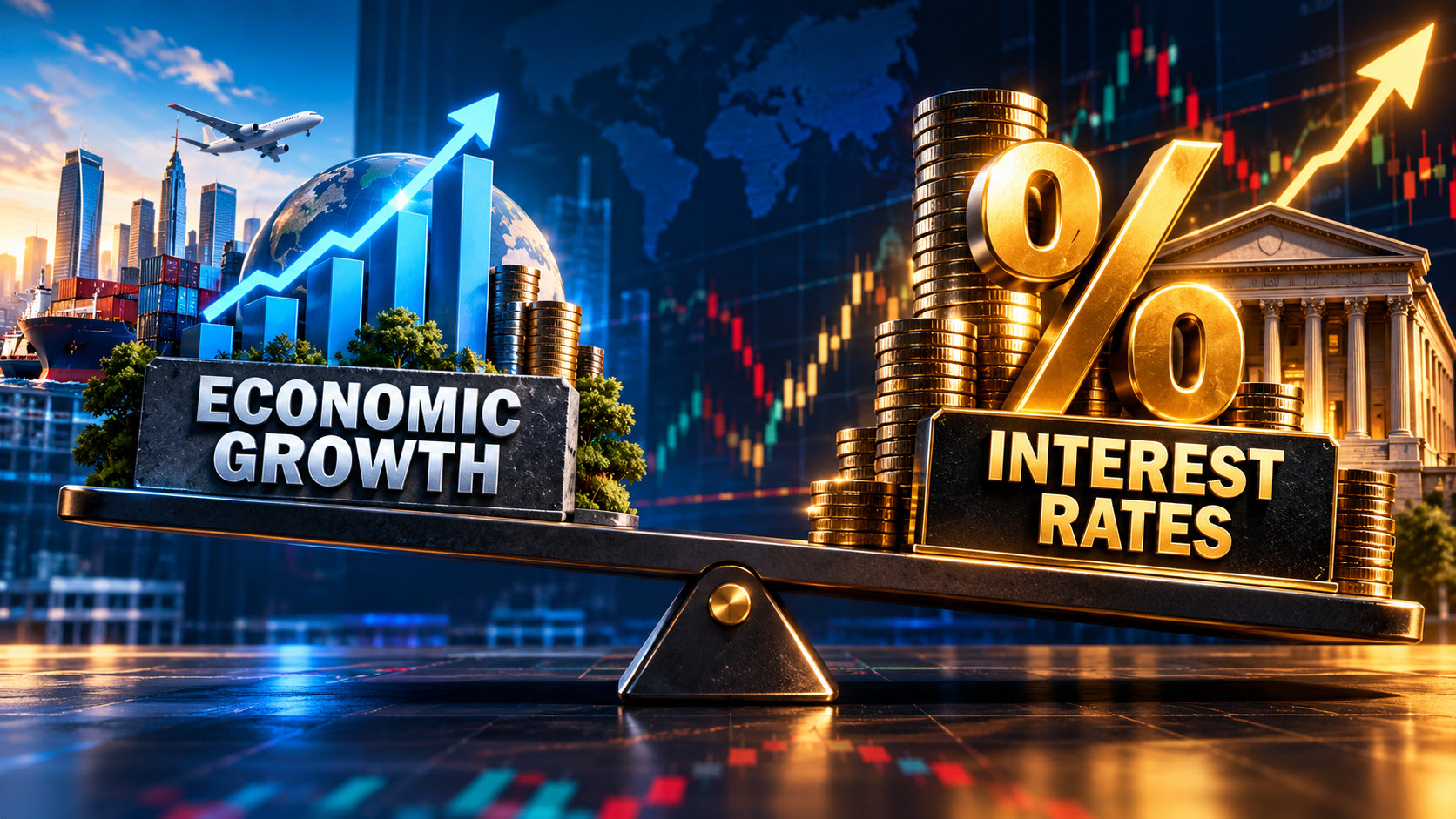
Imagine that a country reports strong economic growth. Businesses are expanding, employment is increasing, consumer spending remains healthy, and economic activity is improving.
You might naturally expect its currency to strengthen.
However, the Forex market sometimes tells a different story.
Despite encouraging economic data, the country’s currency continues to weaken against other currencies.
Why does this happen?
Is the market ignoring the positive economic news? Are traders making irrational decisions? Or is there something more important influencing the exchange rate?
The answer lies in understanding that currency strength depends on more than the performance of a single economy.
Forex markets consider interest rates, inflation, central bank expectations, international capital flows, political and economic risks, and the relative outlook for other countries.
A strong economy can support its currency, but that support is not automatic. If investors expect lower interest rates, inflation erodes purchasing power, capital moves elsewhere, or competing economies become more attractive, the currency may weaken despite positive economic growth.
For Forex traders, understanding this relationship is essential.
In this article, we will examine why a strong economy can have a weak currency, which fundamental factors deserve attention, and how to apply this knowledge when analyzing currency pairs.
One of the most important principles of Forex trading is that every currency pair compares two currencies.
For example, EUR/USD represents the value of the euro relative to the US dollar.
If EUR/USD rises, the euro is strengthening against the dollar, or the dollar is weakening against the euro, or both. If EUR/USD falls, the opposite relationship applies.
This means that analyzing one economy in isolation is not enough.
Imagine that Country A reports economic growth of 3%, while Country B reports growth of 2%.
At first glance, Country A appears to have the stronger economy.
However, suppose Country A’s growth has already been anticipated by investors, while Country B unexpectedly reports improving economic conditions. At the same time, Country B’s central bank signals that interest rates may remain higher for longer.
Investors may revise their expectations in favor of Country B’s currency.
As a result, Country A’s currency could weaken against Country B’s currency even though Country A is experiencing faster economic growth.
The important point is that markets respond to relative conditions, changing expectations, and the information that has not yet been fully reflected in prices.
A strong economy does not automatically produce a strong currency. What matters is how its economic and financial outlook compares with that of other countries.
Interest rates are among the most important factors influencing currency movements.
Central banks use monetary policy to influence borrowing costs, inflation, credit conditions, and economic activity.
When interest rates are relatively attractive, investments denominated in that currency may offer higher potential returns. This can encourage demand for the currency, depending on the associated risks and market conditions.
Now imagine that Country A is experiencing strong economic growth, but inflation is declining and the central bank is expected to reduce interest rates.
Meanwhile, Country B has slower economic growth, but inflation remains persistent and its central bank is expected to maintain relatively high interest rates.
Even though Country A’s economy is growing faster, investors may revise their expectations in favor of Country B’s currency.
Why?
Because financial markets are forward-looking. They consider not only current economic conditions but also how those conditions may influence future monetary policy.
If traders expect Country A’s interest rates to fall while Country B’s rates remain elevated, the relative return outlook may become less attractive for Country A’s currency.
This can place downward pressure on its exchange rate.
However, interest rate differences do not determine currency movements by themselves. Investors also consider inflation, expected future exchange rates, economic risks, and whether the policy outlook is already reflected in market prices.
For Forex traders, the lesson is to analyze the expected direction of monetary policy rather than focusing only on the current policy rate.
Economic growth is generally viewed as a positive development. However, the quality and sustainability of that growth matter.
If an economy expands while inflation remains persistently high, the currency may face pressure.
Inflation reduces the purchasing power of money over time. When domestic prices rise significantly, the currency’s purchasing power can deteriorate.
The relationship between inflation and exchange rates is not immediate or automatic, but persistent inflation can influence how investors assess the currency’s long-term value and the central bank’s policy decisions.
Consider a hypothetical example.
Country A reports strong economic growth, but inflation remains elevated. Businesses face rising costs, households experience pressure on their purchasing power, and uncertainty develops around future monetary policy.
Country B reports more moderate growth, but inflation is stable and the economic outlook is more predictable.
If investors become concerned about Country A’s inflation outlook or the central bank’s ability to manage it, demand for its currency may weaken.
There is an important distinction here.
Higher inflation can sometimes support a currency in the short term if it leads markets to expect higher interest rates. However, the longer-term implications depend on how inflation evolves, how the central bank responds, and how those developments compare with conditions elsewhere.
Therefore, Forex traders should not interpret high inflation as automatically bullish or bearish.
Instead, they should ask:
These questions provide a more complete picture of the relationship between inflation and currency strength.
Another important reason a strong economy can have a weak currency is that markets often anticipate economic developments before official data is released.
Suppose investors expect Country A to report strong employment growth, improving consumer spending, and robust economic activity.
In anticipation, traders may already have purchased the country’s currency.
When the expected data is finally released, the currency may not strengthen further because the information is already reflected in market prices.
If the actual results merely match expectations, some investors may take profits. If the results are strong but weaker than the market had anticipated, the currency may even decline.
This illustrates a critical principle of fundamental analysis:
Good economic news is not necessarily bullish if the market expected something even better.
Imagine the following scenario:
The currency may struggle to rise further because the announcement does not meaningfully improve the existing outlook.
This is why traders should compare actual economic results with expectations rather than judging the data solely by whether the numbers appear positive.
The difference between what the market expected and what actually happened can be more important than the headline itself.
Currencies are also affected by international investment decisions.
Investors move money across borders to seek returns, diversify portfolios, finance business activity, and manage risk.
These movements can influence demand for a currency.
For example, a country may have a growing economy and expanding businesses, but international investors may become concerned about political uncertainty, unpredictable regulation, weak financial markets, or deteriorating investment conditions.
If investors reduce their exposure to that country, capital may flow elsewhere.
Depending on the nature of those transactions, this can create selling pressure on the country’s currency.
Meanwhile, another country with slower economic growth may attract international capital because investors view its financial markets as more stable or its investment opportunities as more attractive relative to the risks.
The result can be a stronger currency despite slower economic growth.
It is important not to assume that every international investment creates the same currency effect. Transactions may be hedged, financed in different currencies, or offset by other flows.
Nevertheless, changes in international capital allocation are an important part of the broader currency picture.
When analyzing a currency, consider whether investors are becoming more or less willing to hold assets denominated in that currency.
A country’s economic data may look impressive while its currency faces other challenges.
Political instability, concerns about government finances, uncertainty surrounding economic policy, or fears about future financial conditions can affect investor confidence.
For example, imagine that Country A reports strong economic growth but also faces increasing uncertainty about its fiscal outlook.
Investors may begin questioning the sustainability of government borrowing or the future direction of economic policy.
Even if current economic activity remains strong, uncertainty about future conditions may weaken demand for the currency.
Similarly, changes in trade policy, geopolitical developments, or concerns about financial stability can influence exchange rates independently of headline growth figures.
The market does not evaluate economic growth in isolation. It evaluates the broader risks associated with holding assets linked to that economy.
However, uncertainty does not always weaken a currency. Some currencies may attract demand during periods of global stress because investors view them as relatively liquid or defensive.
The reaction depends on the circumstances and the currency involved.
For this reason, fundamental analysis should consider both domestic developments and the wider international environment.
Let’s bring these concepts together with a hypothetical example.
Imagine that Country A reports the following developments:
At the same time, Country B reports moderate economic growth, but inflation remains persistent and its central bank signals that interest rates may stay elevated for longer than previously expected.
How might the currency pair react?
Despite its stronger economic growth, Country A’s currency may weaken against Country B’s currency.
There are several possible reasons:
First, declining inflation in Country A may reduce expectations for future interest rates.
Second, Country B’s policy outlook may become relatively more attractive to investors.
Third, Country A’s positive economic performance may already have been reflected in its exchange rate.
Fourth, investors may revise their expectations about the relative returns available in the two economies.
Notice that none of these factors requires Country A’s economy to become weak.
Its economy can remain healthy while its currency loses value relative to Country B’s currency.
This is the distinction that many traders overlook.
A currency can weaken because the outlook for another currency has improved more significantly—not necessarily because its own economy has deteriorated.
Understanding the relationship between economic growth and currency strength is useful only when you apply it systematically.
Here is a practical framework for analyzing a currency pair.
Review the main economic indicators for each country, including growth, employment, inflation, and consumer activity.
Do not focus on a single report. Look for broader patterns and consider whether the data is improving or deteriorating over time.
Identify what the market expects from each central bank.
Are traders anticipating rate increases, rate cuts, or an extended period of unchanged policy?
More importantly, are those expectations changing?
The direction of expectations may provide more useful information than the current interest rate alone.
A positive economic report may have little effect if the market expected an even stronger result.
Look at the difference between the published figure and the expected figure, while also considering revisions to previous data where relevant.
Central banks explain how they interpret economic conditions and what factors may influence future policy.
Compare their latest statements with previous communication to identify changes in their outlook.
Do not assume that one sentence guarantees a particular future policy decision.
Evaluate whether political developments, international capital flows, financial risks, or changes in global sentiment could be influencing the currencies.
These factors can sometimes dominate the impact of an individual economic release.
Fundamental analysis helps you understand possible reasons for currency movements, but it does not predict every price change.
If you decide to trade, define your entry conditions, stop-loss, position size, and acceptable risk in advance.
A strong fundamental argument is not a reason to ignore risk management.
Even traders who understand fundamental analysis can make mistakes when interpreting economic data.
Assuming strong growth guarantees a stronger currency. Growth is only one factor influencing exchange rates.
Ignoring interest rate expectations. The currency may weaken if markets anticipate lower future rates, even while the economy remains healthy.
Focusing on one country instead of the currency pair. Exchange rates reflect the relative outlook for two currencies.
Ignoring market expectations. Positive economic data may already be priced in, limiting its impact on the currency.
Treating inflation as automatically bullish or bearish. Inflation affects currencies through several channels, including monetary policy expectations and purchasing power.
Overlooking political and financial risks. Strong economic activity does not eliminate uncertainty about future conditions.
Entering a trade based only on an economic headline. A headline provides information, but it does not establish a complete trading setup.
Avoiding these mistakes can help you develop a more balanced view of the Forex market.
Why can a strong economy have a weak currency?
Because currency values depend on more than economic growth.
Interest rate expectations, inflation, central bank communication, capital flows, political uncertainty, and the relative outlook for other economies can all influence exchange rates.
A country can report strong growth while its currency weakens because investors expect lower future interest rates, positive news has already been priced in, or another currency has become relatively more attractive.
The most important lesson is to avoid analyzing currencies in isolation.
Compare both economies. Understand the direction of monetary policy expectations. Evaluate actual economic data against forecasts. Consider the wider market environment and always define your risk before entering a trade.
Do not ask only whether an economy is strong. Ask whether its outlook is becoming more attractive relative to the economy behind the other currency.
That is a more useful starting point for Forex fundamental analysis.
To Your Trading Success,
Vladimir Ribakov
Internationally Certified Financial Technician (CFTe)
Home Trader Club
Have you ever opened your trading platform, watched the market move, and felt that you…
Employment data is one of the most important economic indicators in Forex fundamental analysis. It…
Welcome back to our weekly Forex forecast at Home Trader Club. This week, we are…
GDP growth is one of the most important indicators of economic health. But does stronger…
When it comes to fundamental Forex analysis, few institutions matter as much as the Federal…
Interest rates are one of the most important fundamental forces in the Forex market. But…