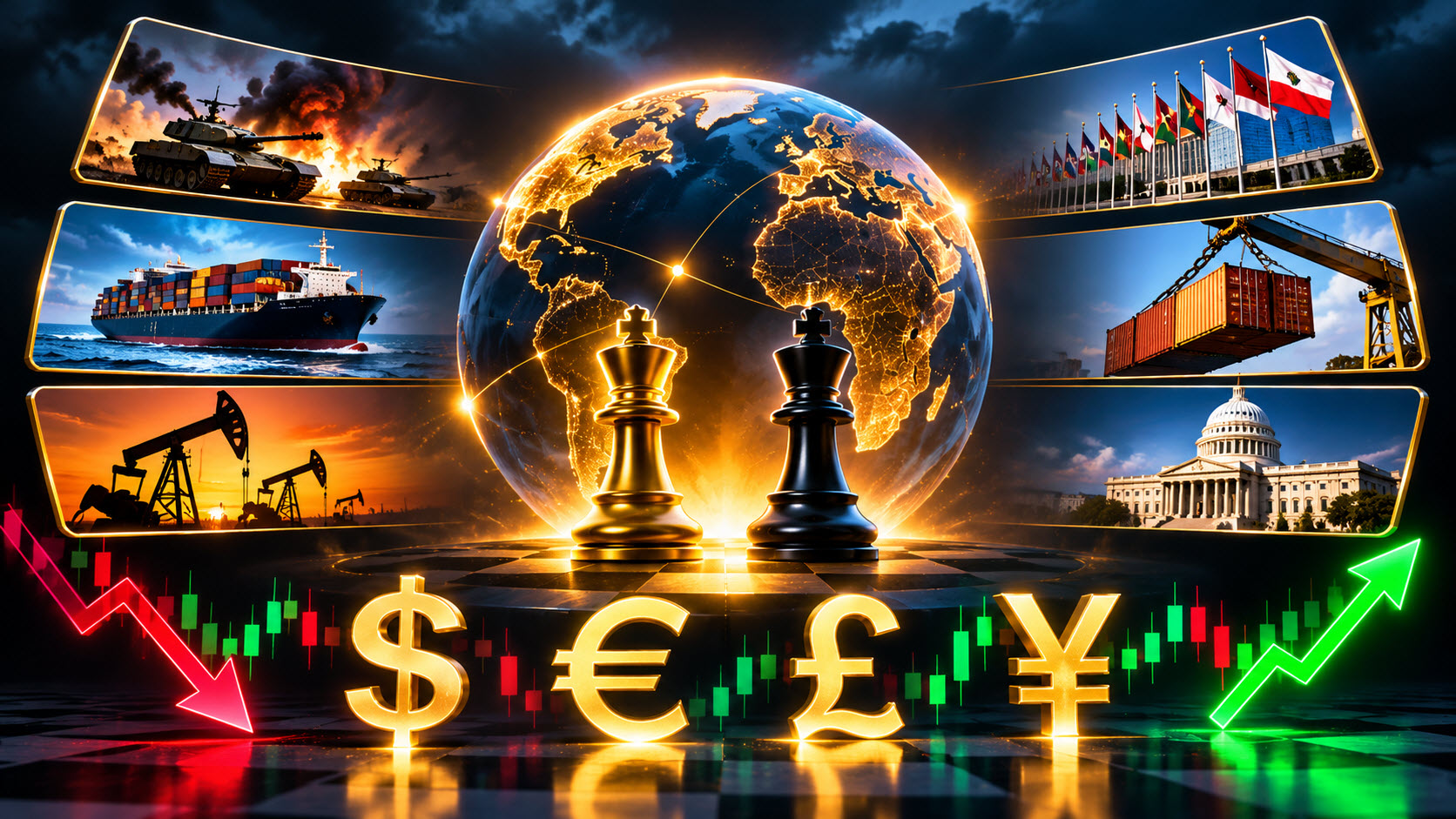
When traders study the Forex market, they often focus on economic indicators such as inflation, employment figures, GDP growth, and central bank interest rates.
However, there is another important factor that can influence currency movements: geopolitics.
Political decisions, international conflicts, trade disputes, elections, sanctions, and diplomatic tensions can all affect the economic outlook of individual countries and the global financial system.
These developments can influence investor confidence, international trade, capital flows, commodity prices, and expectations about future economic conditions. As a result, geopolitical events can create significant movements in currency markets.
For fundamental traders, understanding these developments is an important part of evaluating the broader economic environment.
But how exactly do geopolitical events affect Forex markets? Why do some currencies strengthen during periods of global uncertainty while others weaken? And how can traders incorporate geopolitical developments into their fundamental analysis?
Let’s explore the relationship between geopolitics and the foreign exchange market.
We have partnered with AvaTrade, one of the industry’s leading regulated brokers.
When you open and trade with AvaTrade through our partnership, you receive:
If you’re looking to accelerate your trading journey while enjoying premium education, this partnership gives you everything you need under one roof.
If you already have account with them, still follow this link to open separate account with separate email. Once you did that, contact me with the telegram link below and we will give you the access.
Telegram Channel: https://t.me/vladimirribakovtradingchannel
Geopolitical risk refers to the possibility that political developments, international tensions, government decisions, or conflicts will negatively affect economic conditions and financial markets.
These events can influence individual countries, entire regions, or the global economy.
Some common examples include:
Not every geopolitical event has the same financial impact.
Some developments create only temporary uncertainty, while others can have long-lasting consequences for economic growth, international investment, and currency valuations.
For Forex traders, the important question is not simply whether a political event has occurred. It is how that event changes the economic outlook and the relative attractiveness of the currencies involved.
Currencies are influenced by confidence in the economies and financial systems behind them.
When geopolitical uncertainty increases, investors may reconsider where they want to hold their capital. This can create changes in international investment flows and demand for different currencies.
There are several important channels through which geopolitical developments influence exchange rates.
Investor confidence plays an important role in currency valuations.
Political stability, predictable government policies, and reliable institutions can support confidence in an economy.
However, uncertainty surrounding government decisions, political instability, or international conflict can make investors more cautious.
When confidence deteriorates, international investors may reduce their exposure to the affected economy. This can place downward pressure on its currency.
The strength of this reaction depends on the seriousness of the event, the country’s economic resilience, and how investors assess the potential consequences.
Geopolitical uncertainty can influence where international investors allocate their money.
Investors may reduce exposure to countries facing significant political or economic uncertainty and move capital toward markets they consider more stable.
These movements can influence demand for different currencies.
Capital flows are particularly important because exchange rates reflect the relative demand for one currency against another.
When international investors increase their exposure to an economy, demand for its currency may increase. When investment flows move away from that economy, its currency may face additional pressure.
However, capital movements can be influenced by many factors simultaneously, including interest rates, market liquidity, economic growth expectations, and broader financial conditions.
Political developments can also change expectations about future economic growth.
Uncertainty may discourage businesses from making investment decisions, delay international projects, disrupt commercial activity, or reduce consumer confidence.
If these effects become significant, they can weaken expectations for future economic performance.
Lower growth expectations may influence financial markets by changing expectations about future monetary policy and the relative attractiveness of an economy’s assets.
This can eventually affect its currency.
One of the most important concepts in understanding geopolitical risk is the behaviour of safe-haven currencies.
During periods of heightened uncertainty, investors may prefer currencies associated with relatively stable financial systems, deep financial markets, and strong international liquidity.
The US dollar, Swiss franc, and Japanese yen are commonly regarded as safe-haven currencies.
However, their performance is not identical, and their behaviour can change depending on the circumstances.
The US dollar plays a major role in international trade, financial transactions, and global investment.
Its liquidity and central position in the international financial system can support demand during periods of financial stress.
When geopolitical uncertainty increases, investors may increase their demand for dollar-denominated assets, which can support the US dollar.
However, the dollar is not guaranteed to strengthen during every geopolitical crisis. Domestic economic conditions, Federal Reserve policy expectations, fiscal concerns, and the source of the uncertainty can all influence its performance.
The Swiss franc has traditionally attracted demand during periods of international uncertainty.
Switzerland’s political stability, established financial system, and reputation for economic resilience contribute to its safe-haven characteristics.
When global uncertainty increases, demand for the Swiss franc may rise as investors reassess their exposure to riskier markets.
However, Swiss National Bank policy and domestic economic conditions remain important factors in determining its value.
The Japanese yen has also historically attracted safe-haven demand during periods of market stress.
Its behaviour can be influenced by international investment positions, changes in global risk appetite, and the unwinding of carry trades.
A carry trade involves borrowing in a currency with relatively low funding costs and investing in another currency or asset offering a higher expected return.
When market uncertainty increases, investors may reduce these positions, creating demand for the funding currency.
This is one reason the yen can sometimes strengthen during periods of global financial stress.
Nevertheless, interest-rate differences and domestic economic conditions can influence the direction and magnitude of its movements.
Important: Safe-haven behaviour is not automatic. Traders should not assume that a particular currency will strengthen simply because geopolitical tensions have increased.
Military conflicts and international tensions can have significant economic consequences.
Their impact on currency markets depends on several factors, including the countries involved, the duration of the conflict, the importance of the affected region, and the potential disruption to global trade.
Conflicts can create uncertainty about future economic conditions.
Businesses may delay investments, international companies may reconsider their operations, and investors may reduce exposure to affected economies.
These developments can weaken economic confidence and place pressure on currencies associated with the affected countries.
International conflicts can interrupt the movement of goods, raw materials, and essential commodities.
When important trade routes become difficult to access, businesses may experience higher transportation costs, delays, and supply shortages.
These disruptions can affect economic activity and influence the currencies of countries that depend heavily on international trade.
Geopolitical developments can cause sudden changes in investor expectations.
As market participants reassess risk, currency prices may experience sharp movements.
Liquidity can also become more limited during periods of uncertainty. In such conditions, bid-ask spreads may widen and price movements may become less predictable.
For traders, this means that geopolitical events can affect not only market direction but also trading conditions and execution risk.
Geopolitical risk is not limited to military conflicts.
Trade restrictions, tariffs, and economic sanctions can also have significant consequences for currency markets.
Tariffs are taxes imposed on imported goods.
When governments introduce or increase tariffs, the cost of international trade can change. Businesses may face higher expenses, consumers may experience increased prices, and international supply chains may need to adjust.
These developments can influence inflation expectations, economic growth forecasts, and trade balances.
The effect on currencies depends on the relative impact on the economies involved.
A country introducing tariffs may experience different currency effects depending on whether the measures improve its trade position, increase domestic costs, reduce investment confidence, or trigger retaliation from trading partners.
Economic sanctions can restrict trade, financial transactions, investment, or access to international markets.
For countries heavily dependent on international trade or foreign investment, these restrictions may create significant economic pressure.
Sanctions can affect:
These effects can influence demand for the affected country’s currency and change expectations about its future economic performance.
However, the consequences depend on the scope of the restrictions, the country’s economic structure, and its ability to establish alternative trade and financial relationships.
Commodity prices are another important channel through which geopolitical events can influence Forex markets.
Oil is particularly important because it is a major input for transportation, manufacturing, energy production, and many other economic activities.
When geopolitical tensions threaten important energy-producing regions or transportation routes, oil prices may increase because markets anticipate possible supply disruptions.
This can create different effects for oil-exporting and oil-importing economies.
Countries that export significant quantities of oil may benefit from higher energy prices.
Higher export revenues can improve trade balances, increase government income, and support economic activity.
Under certain conditions, these developments can support the currencies of oil-exporting economies.
However, the relationship is not automatic. Domestic political conditions, production capacity, fiscal policy, and investor confidence also matter.
Countries that depend heavily on imported energy may face higher import costs when oil prices increase.
This can place pressure on trade balances, increase inflationary pressures, and reduce the purchasing power of businesses and consumers.
If these effects become significant, they may weaken the economic outlook and place downward pressure on the currency.
The impact will depend on the country’s ability to absorb higher energy costs and its broader economic conditions.
For fundamental traders, monitoring commodity markets alongside geopolitical developments can provide useful context when evaluating currencies.
Central banks are important because geopolitical events can influence inflation, economic growth, financial stability, and monetary policy expectations.
However, central banks do not respond to every political development in the same way.
Their decisions depend on how geopolitical developments affect the economic outlook and the risks they are responsible for managing.
For example, an energy supply disruption may increase inflationary pressure. At the same time, higher energy costs may reduce consumer spending and economic growth.
This can create a difficult situation for monetary policymakers.
A central bank may need to consider inflation risks while also assessing the impact of higher costs on economic activity.
Geopolitical uncertainty can therefore influence expectations about:
Forex traders should pay attention not only to the geopolitical event itself but also to how central banks assess its economic consequences.
Changes in monetary policy expectations can become an important driver of currency movements.
Understanding geopolitical developments requires more than following political headlines.
Traders need to evaluate the potential economic consequences and determine whether the event is likely to influence currency valuations.
The following framework can help.
Start by identifying which economies are directly or indirectly affected.
Consider their importance in international trade, their dependence on energy imports or exports, and their exposure to foreign investment.
A geopolitical event may affect several countries even when only one is directly involved.
Consider how the development could influence economic growth, inflation, trade, investment, and business confidence.
Avoid assuming that every political development will have the same economic impact.
The consequences depend on the specific circumstances and the ability of affected economies to respond.
Consider whether international investors may increase or reduce their exposure to the affected economies.
Changes in investment demand can influence currency valuations, particularly when uncertainty affects confidence in a country’s financial system.
Evaluate whether the event could change expectations about monetary policy.
Consider the possible implications for inflation, growth, and interest-rate expectations.
These factors can influence currency movements over a longer period.
Forex trading involves comparing one currency against another.
An event that weakens one economy does not automatically mean its currency will fall against every other currency.
The relative economic impact matters.
A useful fundamental analysis should therefore consider the condition of both economies, their monetary policy outlooks, and their exposure to the geopolitical development.
Financial markets constantly adjust to new information.
If investors have already anticipated a geopolitical development, much of its potential impact may already be reflected in currency prices.
When new information becomes available, the market may respond differently from what traders expect.
This is why understanding market expectations is just as important as understanding the event itself.
Geopolitical events can create strong emotional reactions. This makes it important to avoid common mistakes when incorporating political developments into Forex analysis.
Safe-haven currencies may attract demand during periods of uncertainty, but the response is not guaranteed.
Interest-rate expectations, domestic economic conditions, and the nature of the event can influence currency movements.
Not every political headline has a meaningful economic impact.
Some developments are temporary, while others can change long-term economic expectations.
Traders should evaluate the significance of the information instead of reacting to every headline.
A currency pair reflects the relative value of two currencies.
Focusing only on the country directly affected by a geopolitical event can lead to an incomplete assessment.
Always consider the economic and monetary conditions of both economies.
The first reaction to a geopolitical event may be driven by uncertainty and changing investor sentiment.
As additional information becomes available, the market may reassess the situation.
Traders should avoid assuming that the initial price movement will necessarily develop into a sustained trend.
Geopolitical developments can create sudden volatility, gaps, and changing liquidity conditions.
Trading during uncertain periods without considering position size, potential slippage, and execution risk can expose an account to unexpected losses.
Risk management should remain a priority regardless of how convincing a fundamental opinion may appear.
Fundamental analysis helps traders understand why currencies may strengthen or weaken.
Technical analysis helps traders evaluate price structure, trends, momentum, and potential areas of market interest.
Combining both approaches can provide a more complete view of the market.
A fundamental trader can use geopolitical developments to understand the broader economic environment while using technical analysis to evaluate how the market is responding.
For example, fundamental research may indicate that an economy is facing increased uncertainty. Technical analysis can then help assess whether the currency is showing signs of weakness or whether the market has already absorbed the available information.
Neither approach guarantees a successful outcome.
Fundamental analysis can help explain the underlying forces affecting currencies, while technical analysis can provide a structured way to assess price behaviour.
The important point is to avoid treating a political opinion or news headline as an automatic trading signal.
Geopolitical events can have a significant influence on the Forex market because they affect investor confidence, international trade, capital flows, commodity prices, and economic expectations.
From military conflicts and political instability to tariffs and economic sanctions, these developments can create uncertainty and influence the relative value of currencies.
However, their impact is rarely straightforward.
The same geopolitical event can affect different economies in different ways. Some currencies may benefit from safe-haven demand, while others may face pressure from disrupted trade, higher import costs, or reduced investor confidence.
For Forex traders, the key is to look beyond the headlines and understand the economic consequences.
By evaluating the countries involved, monitoring capital flows, understanding commodity exposure, following central bank expectations, and comparing the relative strength of both economies, traders can develop a more complete fundamental view.
Remember, geopolitical events do not provide guaranteed trading opportunities. They are one part of a much broader economic picture.
A disciplined trader uses this information to understand market conditions, evaluate potential risks, and make decisions based on a well-defined trading strategy.
To Your Trading Success,
Vladimir Ribakov
Internationally Certified Financial Technician (CFTe)
Home Trader Club
Risk Disclaimer: Forex trading involves significant financial risk and may not be suitable for every investor. Currency prices can change rapidly in response to economic, political, and geopolitical developments. Always understand the risks involved, use appropriate risk-management practices, and never risk money you cannot afford to lose.
The markets are showing some fascinating technical developments this week, and there are several opportunities…
When Being Right Becomes More Important Than Making Money Every Forex trader wants to make…
Why Doesn't a Strong Economy Always Have a Strong Currency? Imagine that a country reports…
Have you ever opened your trading platform, watched the market move, and felt that you…
Employment data is one of the most important economic indicators in Forex fundamental analysis. It…
Welcome back to our weekly Forex forecast at Home Trader Club. This week, we are…