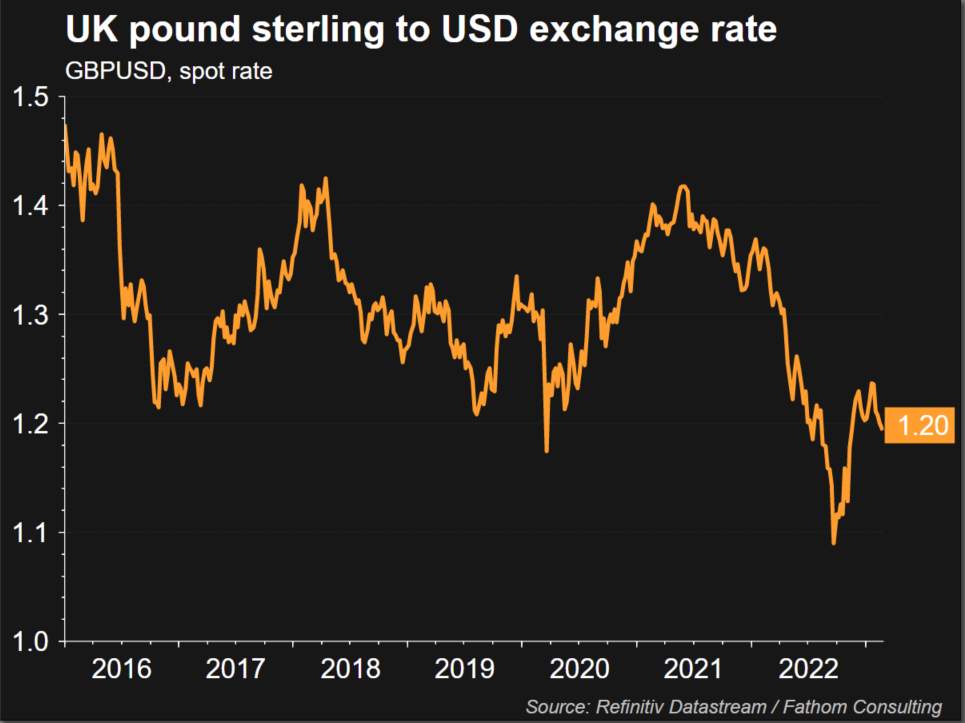
The sterling dipped on Thursday as the dollar rallied and speculation grew that the Bank of England may not hike interest rates any further.
Sterling was last down 0.45% against the dollar at $1.197. Meanwhile the euro was up 0.05% against the pound at 88.72 pence.
Analysts said the dollar and British interest rate outlook were driving the pound.
Bank of England Governor Andrew Bailey on Wednesday raised the prospect that the central bank might not need to raise interest rates again, after hiking them to 4% from just 0.1% in December 2021.
Bailey said “some further increase” in rates may turn out to be appropriate, “but nothing is decided”.
“Bailey’s more dovish talk yesterday, it’s definitely taken some of the wind out of the sails of sterling,” said Ben Laidler, global markets strategist at trading platform eToro.
Expectations for lower interest rates tend to weigh on a currency, by making investments in a country look less attractive than those elsewhere.
Laidler said hopes of a pause received a boost from a BoE survey on Thursday, which showed British business scaled back their plans to increase prices over the coming year in February.
Simon Harvey, head of FX strategy at currency firm Monex Europe, said the data “suggests that inflation expectations are moderating”.
“Although firms are still facing hiring difficulties… they are less willing to overpay for the marginal worker than in previous months,” he added.
Meanwhile, the dollar index, which measures the U.S. currency against six major peers, was last up 0.4% to 104.8.
The dollar was boosted on Thursday by comments from a senior Federal Reserve official suggesting that a 50 basis point rate hike later this month is a possibility. It comes after the dollar climbed 2.8% in February on the back of strong economic data.
Pound traders shrugged off the biggest economic data release of the day, with sterling showing little reaction to a rise in year-on-year euro zone core inflation – which strips out volatile energy and food prices – to a record high of 5.6% in February. Headline inflation cooled, but not by as much as expected.
The pound fell sharply last month, with the rise in the dollar and on concerns about Britain’s weak economy.
Prime Minister Rishi Sunak’s deal with the European Union over Northern Ireland briefly boosted sterling, but it nonetheless dropped 2.4% in February, its worst month since September.
When it comes to fundamental Forex analysis, few institutions matter as much as the Federal…
Interest rates are one of the most important fundamental forces in the Forex market. But…
The latest U.S. employment report has delivered a significant warning for the market. With only…
The Forex market does not always offer clear trading opportunities. Sometimes, price moves sharply in…
Open social media for a few minutes and you can easily find someone talking about…
EURUSD, GBPUSD, USDJPY, Gold and Bitcoin remain at important technical levels as volatility and geopolitical…