Oil is one of the most important commodities in the global economy. It influences transportation costs, manufacturing expenses, inflation, international trade and economic growth. But its impact extends beyond the energy market.
Changes in crude oil prices can also influence the value of national currencies.
For Forex traders, understanding the relationship between oil prices and currency movements can provide valuable insight into fundamental market conditions. Countries that export large amounts of oil may benefit when prices rise, while countries that depend heavily on imported energy can face increasing economic pressure.
However, the relationship is not always straightforward. A rise in oil prices does not automatically strengthen every oil-exporting currency, and falling oil prices do not necessarily benefit every oil-importing economy.
To understand how oil prices affect Forex, traders need to look beyond the price of crude oil and examine the economic forces driving the movement.
In this guide, we will explore how oil prices influence currency markets, why oil exporters and importers react differently, and how Forex traders can incorporate oil market developments into their fundamental analysis.
Crude oil is a major input for many industries. Transportation, aviation, manufacturing, agriculture and logistics all depend directly or indirectly on energy.
When oil prices change significantly, the effects can spread throughout an economy.
For example, rising oil prices can:
These developments can influence investor confidence and the demand for a country’s currency.
The important point for Forex traders is that currencies reflect the relative economic and financial conditions of countries. If an oil price movement significantly improves one country’s economic outlook while weakening another’s, it may influence the exchange rate between their currencies.
This is particularly important when analysing economies that depend heavily on oil exports or imports.
There are several channels through which crude oil prices can affect currency markets. Two of the most important are the trade balance and the wider economic impact of energy costs.
The trade balance measures the difference between the value of a country’s exports and imports.
For an oil-exporting country, higher crude oil prices can increase the value of its energy exports. If export revenues rise significantly, the country’s trade balance and external position may improve.
This can support demand for its currency, particularly when higher export revenues lead to stronger investment and economic activity.
For an oil-importing country, the opposite pressure may occur.
When crude oil becomes more expensive, the country must spend more money purchasing the same amount of energy. This can increase its import bill and put pressure on its trade balance.
If the deterioration is significant and persistent, it may contribute to weakness in the domestic currency.
Oil prices also influence economic activity.
Higher oil prices can encourage investment in energy production, infrastructure and related industries in exporting economies. This may support employment, government revenue and domestic investment.
For importing economies, expensive energy can reduce household purchasing power and increase operating costs for businesses.
The impact can become more significant when companies pass higher costs to consumers or reduce investment because of weaker profit margins.
Forex traders should therefore consider how oil price movements affect the broader economic outlook rather than focusing only on the direction of crude oil.
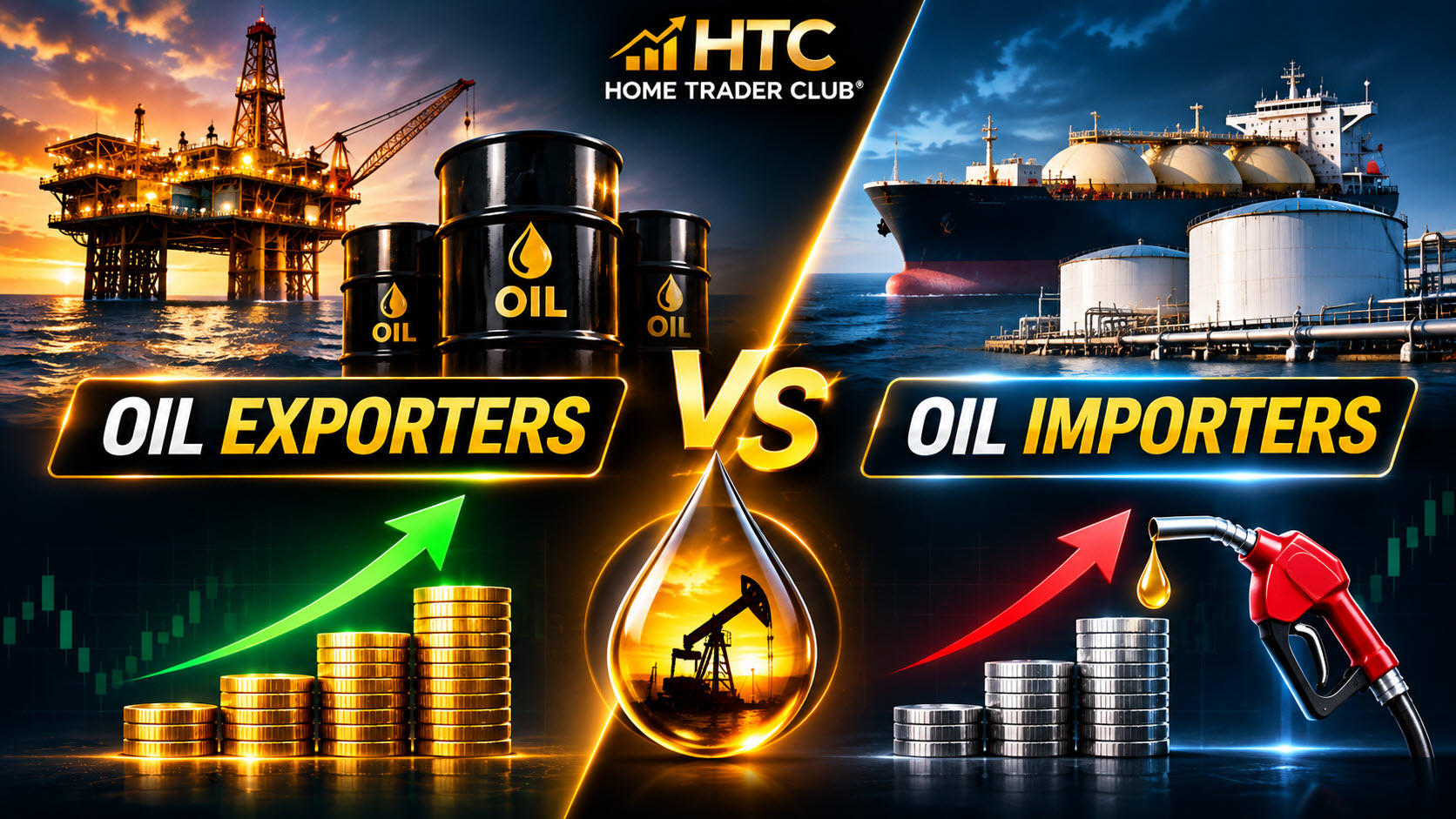
One of the most important concepts in understanding the relationship between oil prices and Forex is the difference between oil exporters and oil importers.
Their economies can respond very differently to the same movement in crude oil prices.
Countries that generate a substantial portion of their export revenue from oil can benefit from rising crude oil prices.
When oil prices increase, these countries may receive more revenue from energy exports, assuming production and export volumes remain relatively stable.
The potential benefits include:
These improvements can support the country’s currency, especially when the exchange rate is flexible and international investors respond positively to the stronger economic outlook.
Examples of oil-exporting economies include Canada and Norway, although their currencies are also influenced by many other economic and financial factors.
It is important to remember that not every oil exporter experiences the same currency reaction. Some countries operate fixed or managed exchange rate systems, which can limit changes in the market value of their currencies.
Oil-importing countries face a different challenge.
When crude oil prices rise, the cost of purchasing energy from international markets increases. This can create pressure on the country’s trade balance and increase domestic production costs.
The consequences may include:
If these pressures become persistent, investors may become less optimistic about the country’s economic outlook.
This can contribute to currency weakness, particularly when the country already has a vulnerable external balance.
The relationship is especially relevant for economies that rely heavily on imported energy.
The key takeaway: Rising oil prices can improve the external position of an oil exporter while putting pressure on an oil importer. However, the final currency reaction depends on the wider economic environment.
Some currencies are often described as commodity currencies because their issuing economies have significant exposure to commodity exports.
The Canadian dollar and Norwegian krone are examples of currencies that can be influenced by energy market developments.
When oil prices rise, energy companies in exporting economies may benefit from stronger revenues. This can support investment, economic activity and expectations about the country’s external position.
However, commodity currencies do not move exclusively according to oil prices.
Their performance can also depend on:
For example, a rise in crude oil prices caused by strong global economic demand may create a different environment from a rise caused by a sudden supply disruption.
The first may reflect stronger global activity, while the second may create uncertainty and increase costs for businesses and consumers.
Forex traders should understand what is driving the commodity price movement before drawing conclusions about a commodity-linked currency.
Another important connection between oil prices and Forex is inflation.
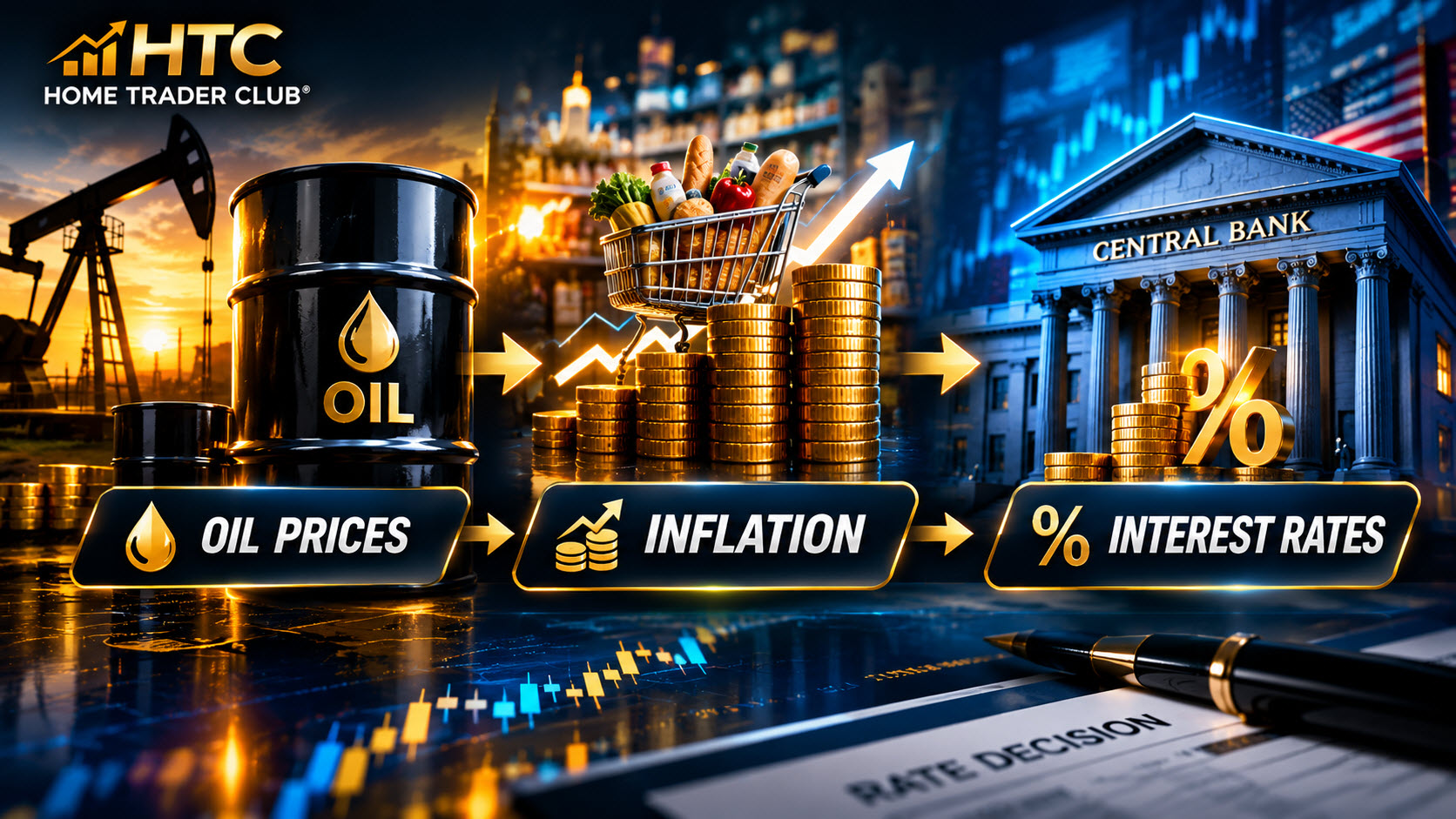
Oil is used throughout the global economy. When crude oil becomes more expensive, businesses may face higher costs for transportation, electricity generation, production and distribution.
Some of these additional costs can eventually be passed on to consumers.
This can contribute to higher inflation.
Central banks monitor inflation because persistent price increases can affect purchasing power and economic stability.
If higher energy prices create broader and sustained inflationary pressure, central banks may face a difficult policy decision.
They may consider maintaining higher interest rates or delaying planned rate cuts to prevent inflation expectations from becoming entrenched.
Higher interest rates can sometimes support a currency by making its financial assets more attractive to international investors.
However, the relationship is not automatic.
If rising oil prices damage economic growth, reduce consumer spending or create financial uncertainty, the negative economic impact may outweigh the potential support from higher interest rates.
For Forex traders, this creates an important distinction:
The market does not react only to the oil price. It reacts to what the oil price means for inflation, economic growth and future monetary policy.
Falling crude oil prices are often viewed as negative for oil-exporting economies.
When oil prices decline, export revenues may fall, particularly if production volumes remain unchanged.
This can reduce government income, weaken the trade balance and affect investment in the energy sector.
If investors expect the economic slowdown to persist, the country’s currency may come under pressure.
However, falling oil prices can have different consequences for oil-importing countries.
Lower energy costs may reduce inflationary pressure, support household spending and improve the trade balance.
Businesses that depend heavily on energy may also benefit from lower operating expenses.
This can create a more favourable economic environment.
But there is an important exception.
What if oil prices fall because global demand is collapsing?
A sharp decline in crude oil prices may reflect concerns about a global economic slowdown or recession. In that situation, oil-importing countries may benefit from cheaper energy but still suffer from weaker exports, reduced investment and declining international demand.
Investors may also move away from risk-sensitive currencies and seek safer assets.
Therefore, falling oil prices are not automatically bullish for every oil-importing currency.
The reason behind the decline matters.
This is one of the most important details Forex traders should understand.
Although higher oil prices can benefit oil-exporting countries, their currencies do not always appreciate.
There are several reasons.
Oil prices can rise for different reasons.
A price increase caused by stronger global demand may indicate improving economic activity. This can support oil exporters through higher export revenues and stronger international trade.
However, a price increase caused by a supply disruption may create a very different situation.
For example, geopolitical tensions or production disruptions can push crude oil prices higher while increasing uncertainty across financial markets.
Investors may respond by reducing exposure to risk-sensitive assets and moving capital towards currencies they consider safer.
In this environment, an oil-exporting country’s currency may weaken even while crude oil prices are rising.
Currencies are also sensitive to changes in interest rate expectations.
If investors believe that another country’s central bank will maintain higher interest rates, that country’s currency may attract stronger demand.
This can offset the positive impact of rising oil prices on an oil-exporting currency.
Some oil-exporting countries manage their exchange rates or maintain currency pegs.
In these cases, higher oil revenues may improve government finances and foreign currency reserves without producing a large appreciation in the market exchange rate.
This is why traders should examine each country’s economic structure and exchange rate regime rather than assuming that all oil exporters react in the same way.
Crude oil is widely priced and traded in US dollars. This makes the relationship between oil prices and the US dollar particularly important.
Historically, oil prices and the US dollar have often shown an inverse relationship. A stronger dollar can make dollar-priced oil more expensive for buyers using other currencies, potentially affecting demand.
However, this relationship is not fixed.
The US economy has become a major energy producer, and changes in its energy production and trade position have influenced the relationship between oil prices and the dollar.
The European Central Bank has highlighted that the historical relationship between oil prices and the US dollar changed after 2020.
This is an important reminder that correlations between financial markets can evolve as economic conditions change.
Forex traders should avoid assuming that a stronger US dollar must always lead to lower oil prices, or that rising oil prices must always weaken the dollar.
Instead, consider the broader factors influencing both markets, including:
The US dollar remains an important part of the oil market, but its influence must be analysed alongside other economic forces.
Understanding the relationship between crude oil and currencies can help traders develop a more complete fundamental market view.
However, oil prices should not be used as a standalone trading signal.
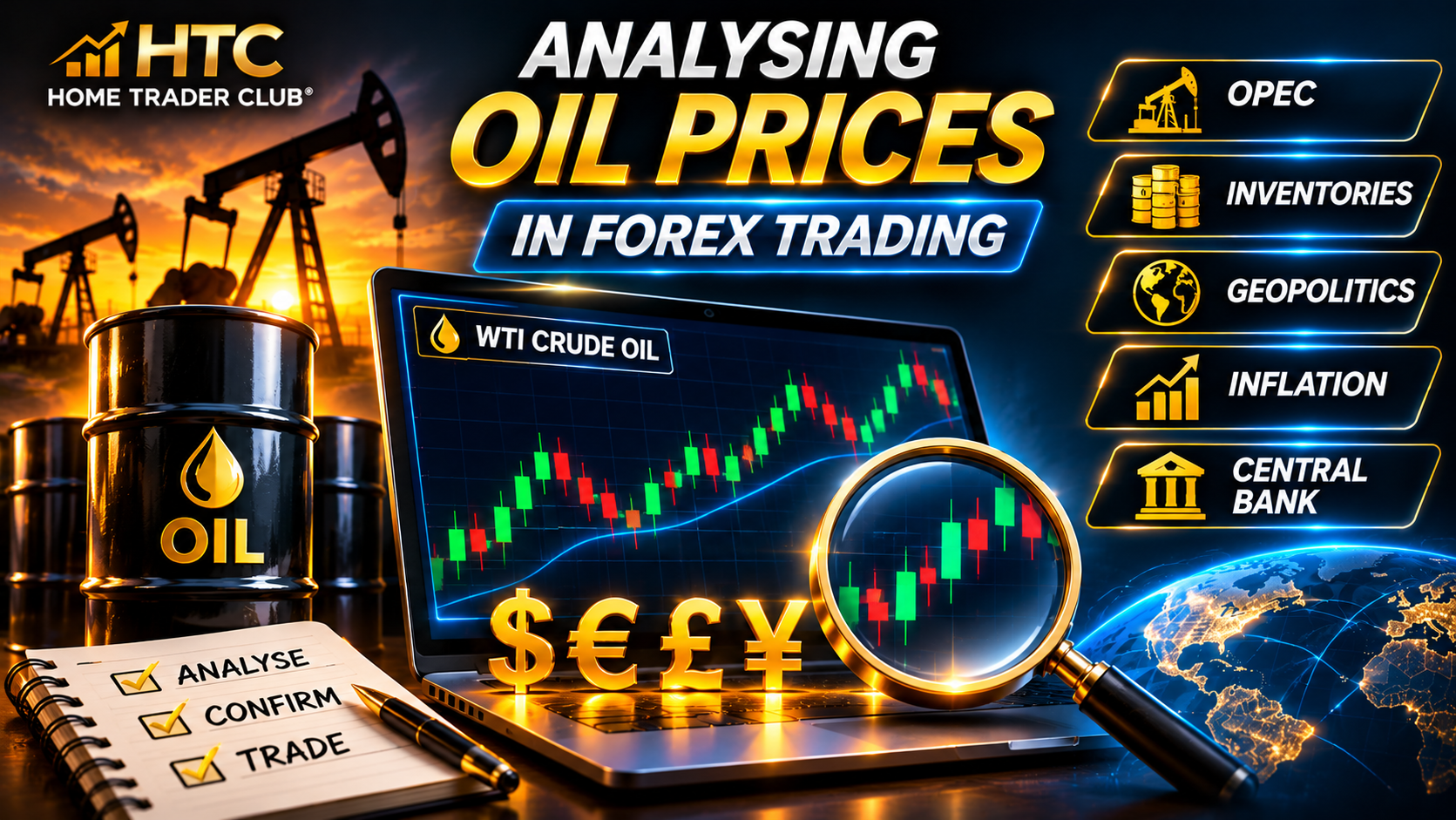
Here are several practical steps traders can follow.
Start by understanding the country’s exposure to energy markets.
Does it generate significant revenue from oil exports, or does it depend heavily on imported crude oil and petroleum products?
This provides the foundation for analysing the possible economic impact of an oil price movement.
Do not focus only on whether crude oil is rising or falling.
Look at the underlying reason.
Is the movement driven by stronger global demand, a production disruption, geopolitical uncertainty or changes in inventory levels?
The source of the movement can influence how financial markets interpret it.
Forex traders should follow major developments that can influence crude oil prices, including:
These events can provide important context for understanding movements in energy markets.
Consider how changing energy costs may affect inflation and monetary policy.
If rising oil prices increase inflation expectations, traders should monitor how central banks respond.
Interest rate expectations can have a significant influence on currency valuations.
Fundamental analysis helps traders understand why a currency may strengthen or weaken.
Technical analysis can help identify potential entry areas, trend direction, support and resistance, and changes in market momentum.
Combining both approaches can provide a more structured trading decision than relying on oil price movements alone.
Do not assume that the relationship between crude oil and a particular currency will remain constant.
Traders can compare historical price movements and observe how a currency has responded to different types of oil market developments.
A rolling correlation can be useful for studying whether the relationship is strengthening, weakening or changing direction.
However, correlation alone does not establish causation and should not be treated as a trading signal.
Even experienced Forex traders can misinterpret the relationship between oil prices and currencies.
Here are some common mistakes to avoid.
Assuming all oil exporters benefit equally: Countries have different production levels, export dependence, fiscal structures and exchange rate systems.
Assuming all oil importers weaken when oil rises: Strong global demand can support broader economic activity and exports, partly offsetting higher energy costs.
Ignoring the reason behind an oil price movement: Supply shocks, demand growth and geopolitical uncertainty can produce different market reactions.
Focusing only on crude oil prices: Inflation, interest rates, economic growth and investor sentiment also influence currency values.
Treating historical correlation as a permanent relationship: The relationship between oil and currencies can change over time.
Entering trades without confirmation: A fundamental observation should be combined with a clear trading plan, appropriate risk management and technical confirmation.
Oil prices can have a meaningful influence on currency markets because energy costs affect international trade, inflation, economic growth and monetary policy.
Oil-exporting countries may benefit from higher crude oil prices through stronger export revenues, while oil-importing countries can face pressure from rising energy costs and deteriorating external balances.
However, the relationship is more complex than simply buying the currency of an oil exporter when crude oil rises or selling the currency of an oil importer when it falls.
The reason behind the oil price movement, the country’s economic structure, central bank expectations and broader market sentiment all matter.
For Forex traders, the most effective approach is to treat oil prices as one part of a wider fundamental analysis framework.
By understanding how energy markets interact with economic conditions and currency valuations, traders can develop a more informed view of the forces driving the Forex market.
To Your Trading Success,
Vladimir Ribakov
Internationally Certified Financial Technician (CFTe)
Home Trader Club
Risk Disclaimer: Forex and CFD trading involve significant risk and may not be suitable for all investors. Leverage can magnify both profits and losses. The information in this article is provided for educational purposes only and should not be considered investment advice. Always conduct your own research and apply appropriate risk management before making trading decisions.
Forex trading attracts millions of people around the world because it offers access to one…
Forex traders constantly monitor economic reports to understand the health of an economy and anticipate…
Understanding market volatility is an important part of successful trading. Financial markets do not move…
This week, I am watching four markets for potential trading opportunities: EUR/USD, USD/JPY, Gold and…
The Forex market is one of the largest and most liquid financial markets in the…
One of the most important decisions in Forex trading is determining where to place a…