
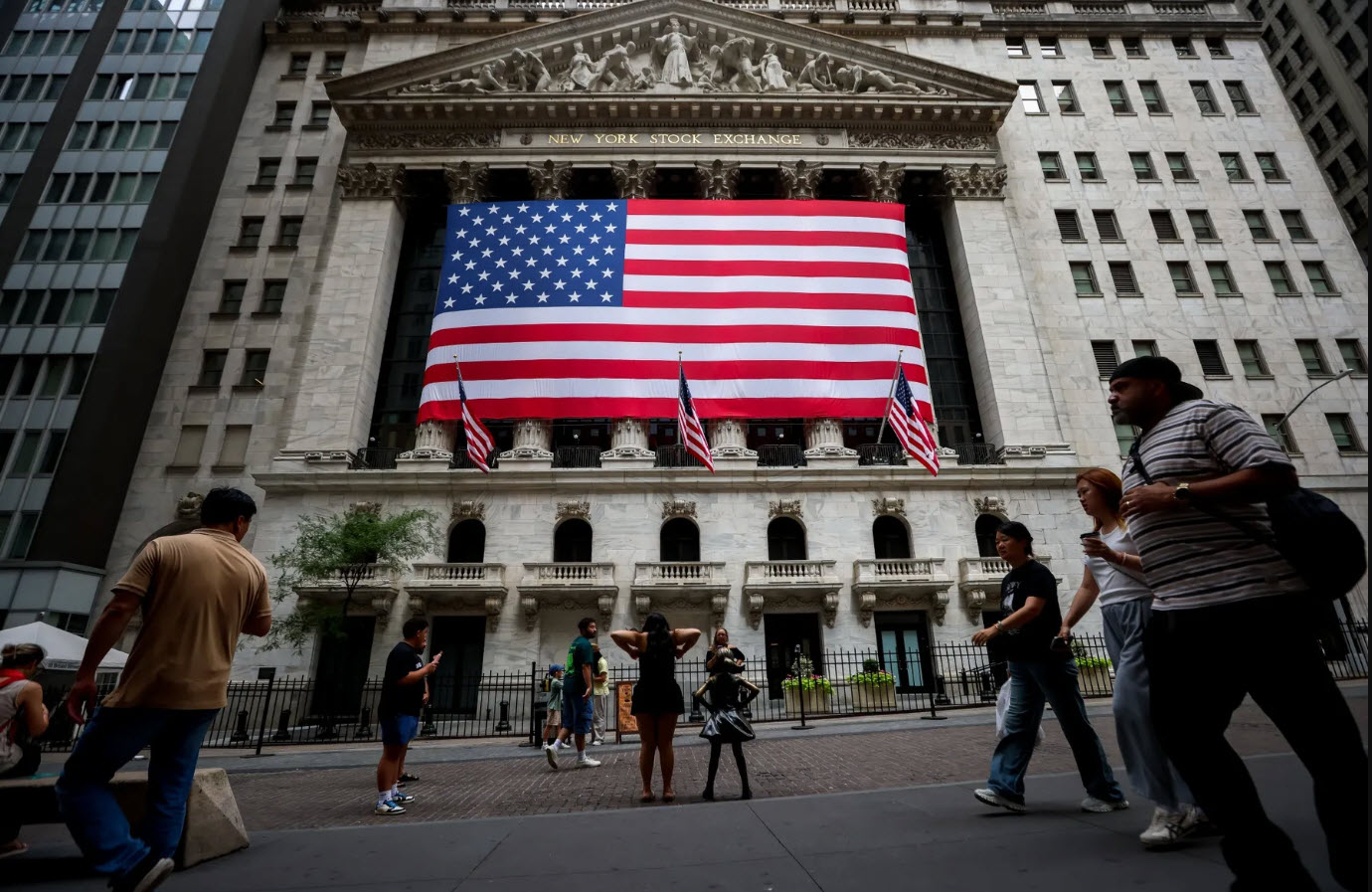



Stocks rose after a better-than-estimated retail sales report and a drop in jobless claims pointed to economic resilience. The dollar bounced a day after speculation about the fate of Federal Reserve Chair Jerome Powell rattled financial markets. Treasuries wavered.
The S&P 500 hovered near its all-time highs. The greenback resumed its month-to-date climb while bond yields were little changed. Money markets are pricing fewer than two Fed rate cuts this year, down from the possibility of three at the start of the month.
US retail sales saw a broad advance, potentially tempering some concerns about a retrenchment in consumer spending. Separate data showed applications for US unemployment benefits declined for a fifth straight week to the lowest level since mid-April, showing a solid job market.
“The consumer came back to life in June,” said David Russell at TradeStation. “Other data like initial jobless claims and Philly Fed also painted the picture of a strong economy. While it’s good for growth overall, it makes it harder to justify rate cuts.”
In such an environment, Russell says that could also help put a floor under the US dollar following a big selloff in the first half of the year.
To Neil Dutta at Renaissance Macro Research, while retail sales beat estimates, enthusiasm ought to be tempered somewhat given the pick-up in consumer goods prices over the month.
Speculation over Fed Chair Jerome Powell’s future rattled markets on Wednesday before President Donald Trump downplayed the prospect of replacing him. Trump, who has long pushed for lower interest rates, has made no secret of his frustration with the Fed Chair.
The value of retail purchases, not adjusted for inflation, increased 0.6% after declines in the prior two months. That exceeded nearly all estimates in a Bloomberg survey of economists. Excluding cars, sales climbed 0.5%.
“A blowout retail sales number shows that consumers are still spending and are keeping the economy growing,” said Chris Zaccarelli at Northlight Asset Management. “There has been a lot of talk about tariffs and the stock market back to all-time highs, but there has been less talk about the economy at full employment and a consumer who continues to spend.”
Although valuations are high, Zaccarelli notes that as long as the economy continues to expand and unemployment remains low, then people will continue to spend and the flywheel can keep generating higher profits, which is the engine for higher stock prices.
“Consumers seem to be over the tariff shock in April and are back at it with spending,” said Jamie Cox at Harris Financial Group. “Now we just need to see if the Federal Reserve has enough inflation data to communicate more clearly that September will restart the rate cutting cycle.”
Estelle Ou at Bloomberg Economics says that despite the solid retail-sales report, given price increases in several goods categories, it’s difficult to untangle whether most of the rebound is due to price increases or solid underlying demand.
“We think the former is more likely, given low business sentiment and signs of weakness in other discretionary services spending,” she noted.
Fed Governor Adriana Kugler said the US central bank should keep holding interest rates steady “for some time,” citing accelerating inflation as tariffs start to boost prices.
Corporate Highlights:
- United Airlines Holdings Inc. narrowed its profit range for this year, saying the outlook has become more predictable than in the first six months, a period punctuated by flight disruptions, trade tensions and fighting in the Middle East.
- PepsiCo Inc. maintained its annual outlook and reported sales growth that beat Wall Street estimates, citing strong international growth.
- President Donald Trump said in a Truth Social post that Coca-Cola Co. has agreed to use cane sugar in Coke beverages sold in the US.
- Uber Technologies Inc. is teaming up with electric vehicle maker Lucid Group Inc. and self-driving tech startup Nuro to launch a robotaxi fleet.
- U.S. Bancorp reported net interest income that missed analysts’ estimates in the first earnings report under new Chief Executive Officer Gunjan Kedia.
- General Electric Co. boosted its full-year financial guidance and topped Wall Street’s profit estimates for the second quarter after rebounding demand in the aviation market softened the impact of a global trade war.
- Roblox Corp. is adding new safety features, including an age-estimation tool that relies on video selfies, in an effort to better protect its kid-heavy user base.
- Novartis AG announced disappointing sales for a key psoriasis drug and the looming retirement of its respected finance chief, which overshadowed a modest outlook raise.
- Taiwan Semiconductor Manufacturing Co. raised its outlook for 2025 revenue growth, shoring up investors’ confidence in the momentum of the global AI spending spree.
Some of the main moves in markets:
Stocks
- The S&P 500 rose 0.2% as of 9:45 a.m. New York time
- The Nasdaq 100 rose 0.2%
- The Dow Jones Industrial Average rose 0.5%
- The Stoxx Europe 600 rose 0.9%
- The MSCI World Index rose 0.3%
Currencies
- The Bloomberg Dollar Spot Index rose 0.4%
- The euro fell 0.4% to $1.1591
- The British pound fell 0.1% to $1.3405
- The Japanese yen fell 0.5% to 148.55 per dollar
Cryptocurrencies
- Bitcoin fell 1.9% to $117,684.39
- Ether fell 0.1% to $3,378.3
Bonds
- The yield on 10-year Treasuries declined two basis points to 4.43%
- Germany’s 10-year yield declined one basis point to 2.67%
- Britain’s 10-year yield was little changed at 4.65%
- The yield on 2-year Treasuries was little changed at 3.89%
- The yield on 30-year Treasuries declined three basis points to 4.98%
Commodities
- West Texas Intermediate crude rose 0.3% to $66.61 a barrel
- Spot gold fell 0.9% to $3,315.71 an ounce