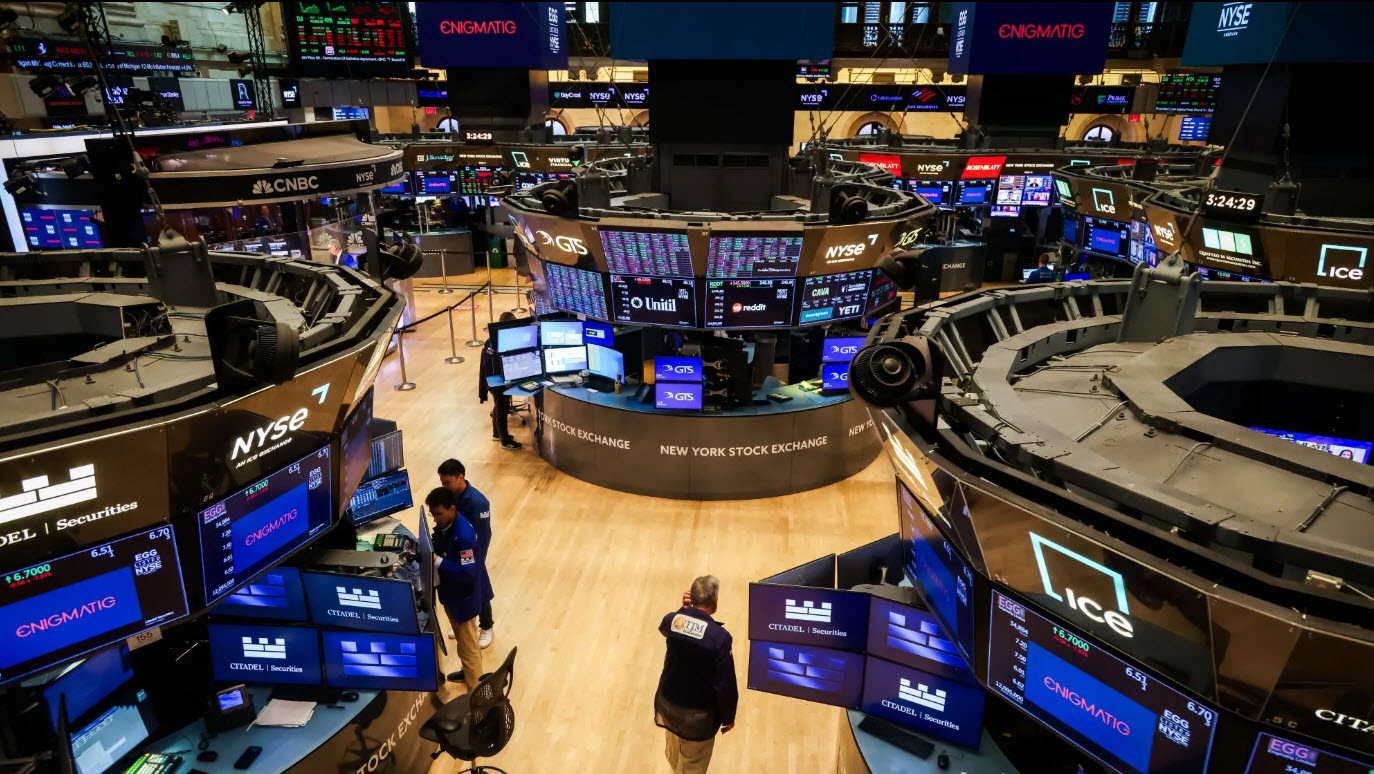



Wall Street’s relentless surge from April’s meltdown keeps showing signs that the stock market is overheated, spurring calls for a breather at a time when the classic dip-buying strategy stays firmly in place.
Nobody needs to look hard to find warnings that the market looks frothy after a 36% surge from April’s nadir pushed valuations to levels associated with prior periods of exuberance. While the AI euphoria has kept the party going for equities, recent chatter about a bubble forming in the group that has powered the bull market has drawn the attention from investors around the world.
“While the ongoing excitement for AI and technology stocks continues to propel the market to new highs, we believe it is prudent to be vigilant in stocks that appear short-term stretched to the upside,” said Craig Johnson at Piper Sandler.
Underlying market breadth is showing early signs of fatigue, Johnson notes, which may lead to a consolidation phase as investors shift their attention toward the upcoming earnings season.
The S&P 500 edged lower, hovering near 6,740. The yield on 10-year Treasuries rose two basis points to 4.14%. That’s ahead of a $22 billion 30-year bond sale. The dollar wavered. Silver topped $50, the highest since the Hunt brothers squeeze in the 1980s.
“It always seems like a sucker’s bet to put any money into the market when it’s trading at all-time highs,” said Bespoke Investment Group strategists. “As the seemingly intelligent pundits will say, the easy money has been made (even though they were never out there a year ago saying the easy money is about to be made).”
Since 1953, when the five-day trading week in its current form started, however, the S&P 500’s historical returns following a close at all-time highs are only slightly less positive than its average return for all periods since 1953, Bespoke said.
“The best strategy for passive investors, especially, is not to overthink things,” the strategists noted.
One of the main reasons AI bubble talk is misplaced is that the leading spenders continue to enjoy increased earnings power, according to Daniel Skelly, head of Morgan Stanley’s Wealth Management Market Research & Strategy Team.
“These aren’t the dot-com companies of a quarter-century ago that didn’t have earnings, or even viable business models,” he said. “That doesn’t mean the market won’t have setbacks, though. Investors may want to take a look at quality dividend-growth stocks—particularly in healthcare, financials, and telecom. They’ve been out of favor for a while, but they could be a decent hedge if the market experiences a consolidation in the near term.”
Global stocks are at record highs, but positioning data from JPMorgan Chase & Co. suggests some investors including hedge funds are still holding back.
The equity beta of monthly reporting Macro hedge funds — an indicator of their exposure — remains modestly negative despite becoming slightly less so in recent months, the team led by Nikolaos Panigirtzoglou said.
“This suggests that speculative investors’ exposure to US equities is not particularly elevated and in principle has room to rise,” they said.
Some light profit-taking is understandable ahead of earnings season, but sentiment is still broadly positive, according to Fawad Razaqzada at City Index and Forex.com.
“Active traders continue to buy the dips, keeping momentum alive. You can see this in the shallow retracements and the steady string of record highs across the major indices. In this environment, looking for bearish setups feels counterintuitive – the market simply isn’t giving short-sellers much to work with,” he said.
To Razaqzada, the recent signals don’t necessarily point to an imminent selloff, but they do suggest that markets may need a breather – either through sideways consolidation or a modest pullback.
“For now, though, the underlying message remains the same: the trend is your friend. If you’re already long, there’s no reason to panic. If you’re not, patience may be the better play – wait for a pullback, then consider buying the dip.
Corporate Highlights:
- The US has approved several billion dollars worth of Nvidia Corp. chip exports to the United Arab Emirates, an initial step in implementing a controversial deal that could serve as a blueprint for American AI statecraft.
- Google’s cloud unit is launching an artificial intelligence platform called Gemini Enterprise that it hopes will reach everyday workers, setting up a deeper competition with Microsoft Corp. and OpenAI for business tools.
- US auto safety regulators are investigating Tesla Inc. over incidents in which its vehicles drove through red lights and violated other traffic laws while using the company’s partial-automation software.
- Delta Air Lines Inc. predicted continued strong demand into next year after reporting better-than-expected earnings for the third quarter, helped by leisure travelers splurging on premium seats and a rebound in corporate travel.
- PepsiCo Inc. reported stronger than expected net revenue as its US beverage unit showed signs of a turnaround.
- Costco Wholesale Corp. rose after the warehouse club reported comparable sales growth that beat analyst estimates for September, helped by a rise in both foot traffic and amount spent per customer.
- US-listed rare earth stocks climbed after China unveiled new restrictions on exports ahead of a meeting this month between Donald Trump and Xi Jinping.
- Ferrari NV shares plunged after the carmaker issued cautious forecasts that disappointed investors, marring a coming-out party for the company’s first electric vehicle.
- ASML Holding NV named Marco Pieters chief technology officer of the chip-equipment company, plugging a vital gap in management at Europe’s most-valuable technology firm
- Orsted A/S will cut about 2,000 jobs — roughly a quarter of the workforce — as the offshore-wind company narrows its focus to Europe after completing a massive share sale to shore up funds.
- EssilorLuxottica Chief Executive Officer Francesco Milleri says he’s positioning the world’s biggest eyewear company to be leader in the emerging category of AI glasses, which he sees potentially replacing smartphones as the next consumer-tech blockbuster.
- Novo Nordisk A/S agreed to buy Akero Therapeutics Inc. for as much as $5.2 billion to expand its portfolio in a type of liver disease that’s linked to obesity.
- Taiwan Semiconductor Manufacturing Co. reported a 30% increase in its third-quarter sales as major US tech companies continued to make multibillion-dollar bets on AI.
- Tata Consultancy Services Ltd. reported a 1.4% increase in quarterly earnings on sluggish demand for IT services, as it braces for the impact of changes in a widely used US visa program.
Some of the main moves in markets:
Stocks
- The S&P 500 fell 0.2% as of 10:03 a.m. New York time
- The Nasdaq 100 fell 0.2%
- The Dow Jones Industrial Average fell 0.3%
- The Stoxx Europe 600 fell 0.3%
- The MSCI World Index fell 0.2%
- Bloomberg Magnificent 7 Total Return Index fell 0.5%
- The Russell 2000 Index fell 0.5%
Currencies
- The Bloomberg Dollar Spot Index rose 0.1%
- The euro fell 0.3% to $1.1595
- The British pound fell 0.4% to $1.3357
- The Japanese yen fell 0.2% to 152.95 per dollar
Cryptocurrencies
- Bitcoin fell 0.6% to $122,194.78
- Ether fell 3.4% to $4,351
Bonds
- The yield on 10-year Treasuries advanced two basis points to 4.14%
- Germany’s 10-year yield advanced two basis points to 2.70%
- Britain’s 10-year yield advanced three basis points to 4.74%
- The yield on 2-year Treasuries advanced one basis point to 3.59%
- The yield on 30-year Treasuries advanced two basis points to 4.73%
Commodities
- West Texas Intermediate crude fell 0.4% to $62.31 a barrel
- Spot gold fell 0.5% to $4,023.09 an ounce