


When you open a Forex trade, you may be focused on one thing:
Will price move in my direction?
But there is another question every trader should understand:
How much does it cost me to enter and exit this trade?
One of the main trading costs in Forex is the spread.
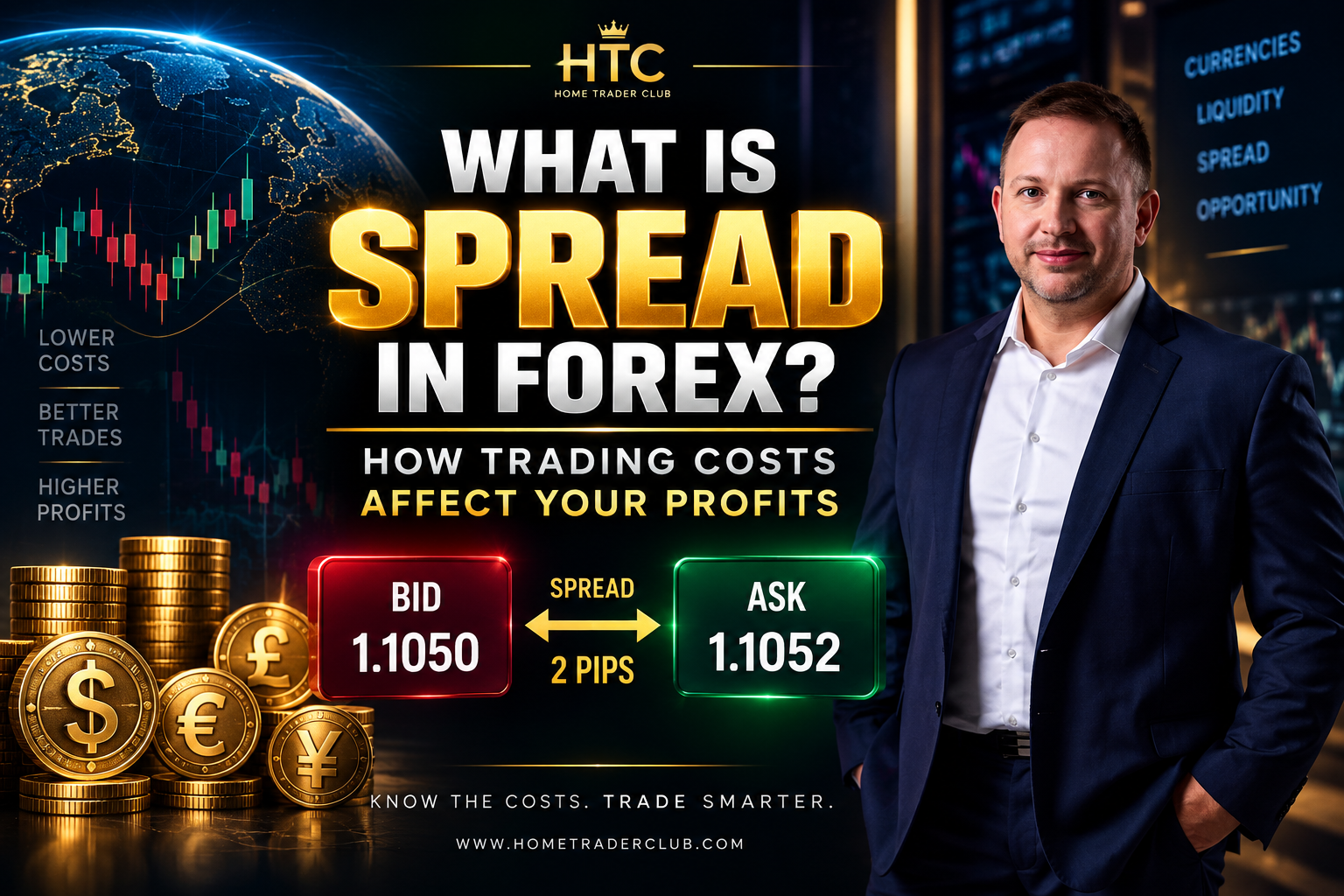
The spread is the difference between the bid price and the ask price of a currency pair. It is normally measured in pips and represents a cost built into the quoted trading price.
For a trader taking only a few positions, a small spread may seem insignificant.
But if you trade frequently, use larger position sizes, or target relatively small price movements, trading costs can become much more important.
Understanding the Forex spread can therefore help you evaluate trades more realistically and avoid ignoring a cost that affects your results.
- 1 Join the Home Trader Club
- 2 What Is the Spread in Forex?
- 3 Why Does Forex Have a Spread?
- 4 A Simple Forex Spread Example
- 5 What Is a Tight Spread?
- 6 What Is a Wide Spread?
- 7 Why Do Forex Spreads Change?
- 8 When Are Forex Spreads Usually Most Attractive?
- 9 Why Major Currency Pairs Often Have Tighter Spreads
- 10 How the Spread Affects Your Profit
- 11 A Simple Cost Example
- 12 Spread vs Commission
- 13 Spread Is Not the Only Cost of Forex Trading
- 14 Why Scalpers Need to Pay Special Attention to Spread
- 15 Don’t Choose a Currency Pair Only Because It Has a Low Spread
- 16 Watch Spreads Around Major News
- 17 How to Reduce the Impact of Trading Costs
- 18 The Spread and Your Trading Strategy
- 19 A Simple Rule for Forex Traders
- 20 Final Thoughts
 Join the Home Trader Club
Want to access the tools, systems, and real-time education we use daily?
With AvaTrade Broker’s support, you can now enjoy up to one full year of access to the Home Trader Club — including:
-
All professional trading systems
-
Access to our new project, the Home Trader Club trade copier, where our traders trade and you can copy.
-
Real-time trade ideas and setups
-
Full access to our course library and trading marketplace
 Join here: https://tracking.avapartner.com/dR0AAA
What Is the Spread in Forex?

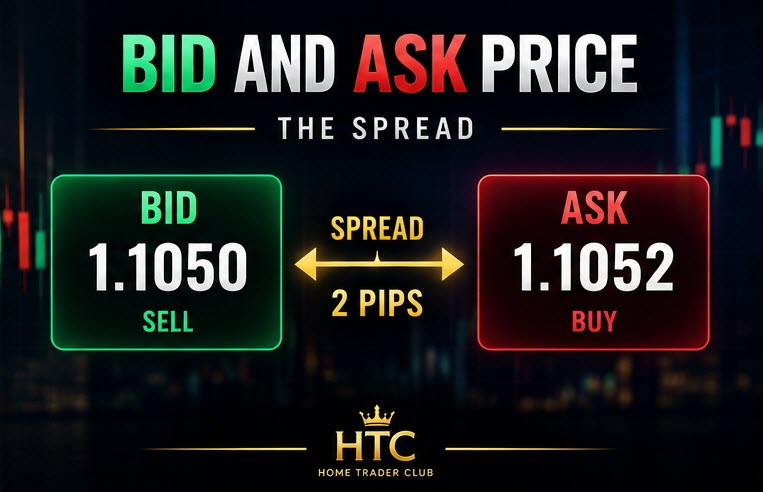
Every Forex quote contains two prices:
- Bid price — the price at which you can sell
- Ask price — the price at which you can buy
The difference between these two prices is called the spread.
For example, imagine EUR/USD is quoted as:
1.1050 / 1.1052
The difference is:
1.1052 − 1.1050 = 0.0002
For a standard non-JPY Forex quote, that represents a 2-pip spread.
In simple terms:
Spread = Ask Price − Bid Price
The exact way your broker displays prices can vary, but the underlying concept remains the same.
Why Does Forex Have a Spread?
The Forex market involves buyers and sellers constantly interacting through liquidity providers, brokers, banks, and other market participants.
The bid and ask prices are not identical.
There is a gap between what buyers are willing to pay and what sellers are willing to accept.
That gap is the spread.
For traders, this means that when you open a position, the market generally needs to move far enough in your favour to overcome the spread before the trade becomes profitable.
For example, if you buy EUR/USD with a 2-pip spread, price needs to move sufficiently in your favour to overcome that initial trading cost.
This is why the spread matters even when your analysis is correct.
A Simple Forex Spread Example
Let’s make it practical.
Suppose your broker quotes EUR/USD at:
Bid: 1.1000
Ask: 1.1002
The spread is:
1.1002 − 1.1000 = 0.0002 = 2 pips
If you want to buy EUR/USD, you enter at the ask price.
If you want to sell EUR/USD, you enter at the bid price.
That difference is important because you do not enter the market at the same price at which the opposite side of the quote is available.
The spread is therefore one of the costs you need to account for when evaluating a trade
What Is a Tight Spread?
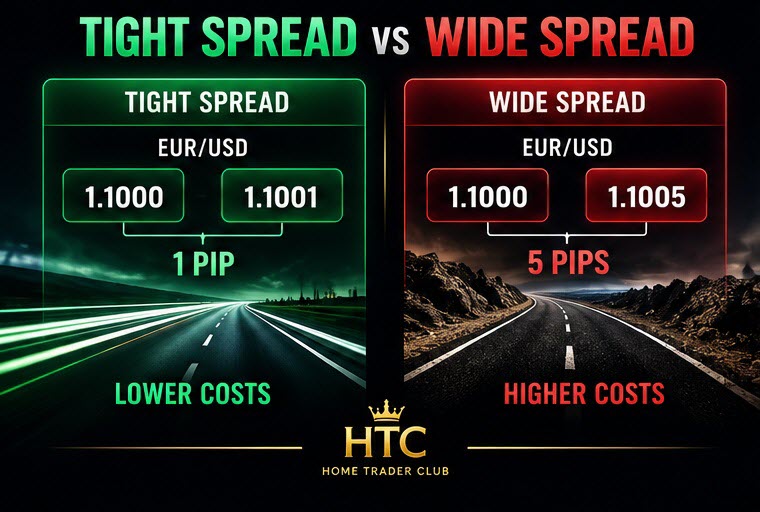
A tight spread means there is a relatively small difference between the bid and ask prices.
For example:
Bid: 1.1000
Ask: 1.1001
Spread:
1 pip
A smaller spread generally means less price movement is required to overcome that particular transaction cost.
This can be especially relevant to traders who enter and exit frequently.
However, don’t make the mistake of assuming that the broker advertising the smallest spread will automatically give you the lowest overall trading cost.
You need to consider the complete cost structure.
What Is a Wide Spread?
A wide spread means the difference between the bid and ask prices is larger.
For example:
Bid: 1.1000
Ask: 1.1005
The spread is:
5 pips
That means the trade starts with a larger spread-related disadvantage than a trade with a 1-pip spread.
Wide spreads can become particularly important when markets are experiencing lower liquidity or unusually high volatility. Spreads can change as market conditions change.
Why Do Forex Spreads Change?
Forex spreads are not necessarily constant.
They can widen or tighten depending on market conditions.
Two important factors are:
Liquidity
When there is strong market liquidity, spreads are often tighter.
When liquidity becomes thinner, spreads can widen.
Volatility
During periods of rapid price movement, spreads can become wider.
This can happen around major economic announcements or unexpected market events.
For example, an important central-bank announcement can cause currency prices to move rapidly.
The spread available immediately before the announcement may not be the same as the spread available during the announcement.
Major news and increased market volatility can contribute to changes in Forex spreads.
When Are Forex Spreads Usually Most Attractive?
There is no universal spread that remains constant throughout the day.
However, spreads often become more competitive when there is strong liquidity.
This is one reason major Forex trading sessions matter.
During periods when major financial centres are active, more market participants may be involved.
The London-New York overlap is particularly important because it can bring substantial activity and liquidity to the market.
But remember:
High liquidity does not guarantee a specific spread.
Your broker, account type, currency pair, market conditions, and execution environment all matter.
Always look at the actual spread available on your trading platform.
Why Major Currency Pairs Often Have Tighter Spreads
Major currency pairs such as:
- EUR/USD
- GBP/USD
- USD/JPY
- USD/CHF
are among the most actively traded currency pairs.
Higher trading activity and liquidity can contribute to tighter spreads compared with less-liquid currency pairs.
By contrast, some exotic or emerging-market currency pairs can have wider spreads.
This doesn’t automatically make major pairs better.
It simply means that trading costs can differ significantly from one currency pair to another.
How the Spread Affects Your Profit
This is where the spread becomes particularly important.
Imagine you trade EUR/USD with a 2-pip spread.
Suppose your strategy is designed to capture a relatively small move.
If your target is only 10 pips, a 2-pip spread represents a much larger proportion of the potential movement than it would for a strategy targeting 100 pips.
This is why short-term traders and scalpers can be particularly sensitive to transaction costs.
The smaller your expected price movement, the more important it becomes to understand the cost of entering and exiting.
A Simple Cost Example
Suppose a trader uses a position where the pip value is:
$10 per pip
And the spread is:
2 pips
The approximate spread-related cost is:
2 × $10 = $20
So the trader is dealing with approximately $20 of spread cost for that position under this simplified example.
If the same trader takes 20 similar trades:
20 × $20 = $400
That is why a cost that looks small on one trade can become significant when repeated many times.
The exact monetary impact depends on the currency pair, position size, account currency, and broker’s pricing.
Spread vs Commission
Not every Forex trading account uses exactly the same pricing structure.
Some brokers primarily incorporate their trading cost into the spread.
Others may offer a lower spread but charge a separate commission.
Some account structures combine both.
Therefore, comparing brokers based only on the advertised spread can be misleading.
Imagine:
Broker A: 1.5-pip spread, no separate commission
Broker B: 0.2-pip spread + commission
The second broker may appear cheaper when you look only at the spread.
But the actual cost depends on the commission and position size.
The correct comparison is:
Total trading cost — not just the headline spread.
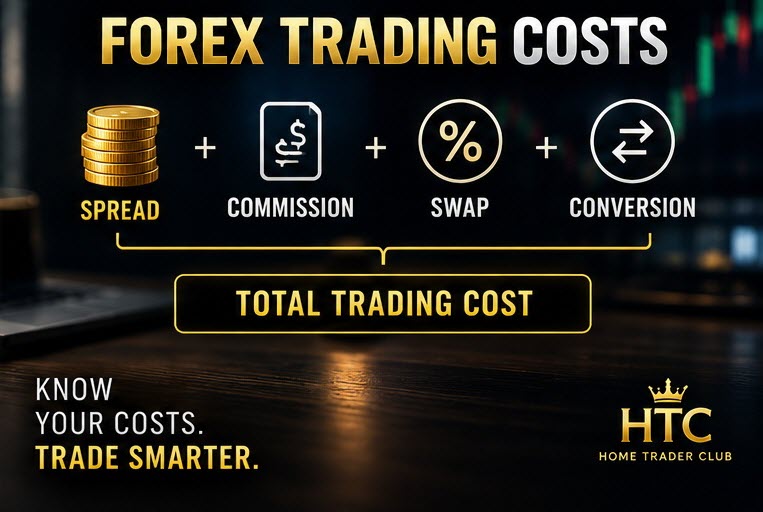
Spread Is Not the Only Cost of Forex Trading
Another important point is that the spread is only one potential trading cost.
Depending on your broker, account, instrument, and how long you hold a position, you may also encounter:
- Commission
- Overnight financing or swap
- Currency conversion costs
- Other account or transaction charges
For example, overnight funding can become relevant when positions are held beyond the broker’s daily cutoff.
This means you should evaluate the complete cost of trading rather than focusing on one number.
Why Scalpers Need to Pay Special Attention to Spread
Imagine two traders.
Trader A
Targets:
100 pips
Spread:
1.5 pips
Trader B
Targets:
8 pips
Spread:
1.5 pips
The same spread exists, but its relative importance is very different.
For Trader A, 1.5 pips represents a relatively small portion of the intended movement.
For Trader B, it represents a much larger portion.
This is one reason short-term strategies need particularly careful attention to execution costs.
A strategy that looks profitable before trading costs are included may produce very different results after realistic costs are accounted for.
Don’t Choose a Currency Pair Only Because It Has a Low Spread
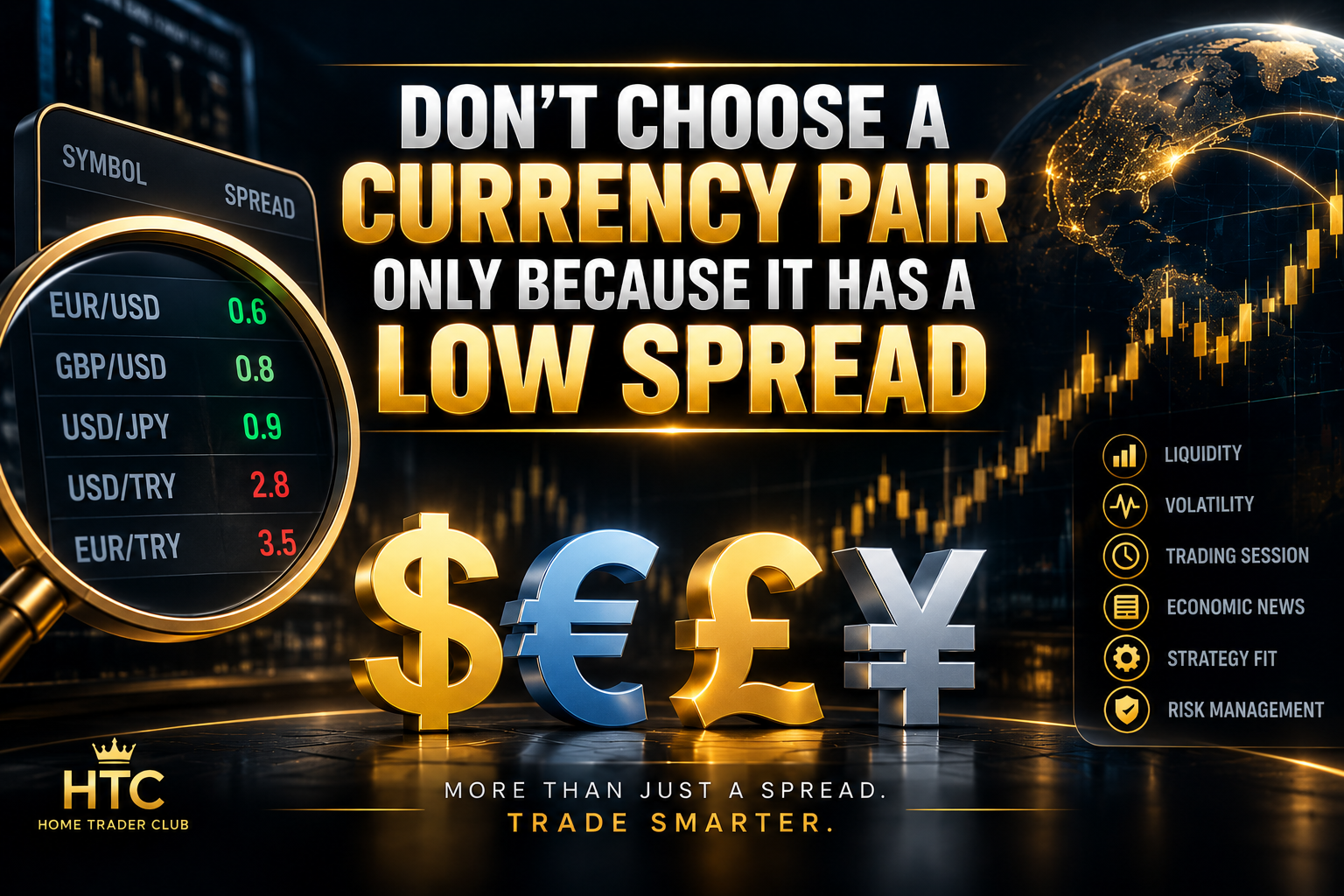
A low spread is useful.
But it should never be the only reason you choose a currency pair.
Your decision should also consider:
- Liquidity
- Volatility
- Trading session
- Strategy compatibility
- Economic news
- Execution conditions
- Risk management
A currency pair with a very attractive spread may still be completely unsuitable for your strategy.
The objective isn’t simply to find the smallest spread.
It is to find a trading environment where your strategy has a logical advantage and the overall costs are reasonable.
Watch Spreads Around Major News
This deserves special attention.
Suppose you are preparing to trade EUR/USD immediately before a major economic announcement.
The market may appear calm.
Then the announcement is released.
Price moves rapidly.
Liquidity conditions change.
The spread may widen.
If you enter without considering this possibility, your actual trading conditions may be very different from what you expected.
This is why traders should know the major economic events affecting the currencies they trade.
Sometimes the best decision is simply to wait for conditions to stabilize.
How to Reduce the Impact of Trading Costs
You don’t need to obsess over every fraction of a pip.
Instead, develop a few good habits.
1. Understand your broker’s pricing
Know whether your account uses spreads, commissions, or both.
2. Monitor actual spreads
Don’t rely only on the advertised minimum spread.
Look at what is actually available during the hours you trade.
3. Avoid unnecessary trading
Every new position creates another opportunity for transaction costs to accumulate.
4. Consider your trading timeframe
Very short-term strategies can be much more sensitive to spread.
5. Be careful around major news
Spreads can change quickly when market conditions become unstable.
6. Compare total costs
A low advertised spread doesn’t necessarily mean the lowest overall cost.
The Spread and Your Trading Strategy
Different trading strategies react differently to transaction costs.
A swing trader holding a position for several days may care about the spread, but the initial spread may represent a smaller proportion of the overall expected price movement.
A scalper taking multiple trades for small targets may be far more sensitive to a difference of even a fraction of a pip.
This doesn’t mean one strategy is better.
It means trading costs should be considered when designing and evaluating a strategy.
If your strategy depends on capturing very small movements, execution costs deserve particular attention.
A Simple Rule for Forex Traders
Here’s a simple rule worth remembering:
Don’t ask only how much you can make from a trade. Ask how much it costs to take the trade.
A strategy can have good entries and still struggle if its trading costs are consistently too high.
When you understand spreads, commissions, and other costs, you can evaluate your trading performance more realistically.
Your goal isn’t to eliminate every trading cost.
That isn’t realistic.
Your goal is to understand the costs and make sure they are appropriate for your strategy.
Final Thoughts
The Forex spread may look like a tiny number on your trading platform.
But tiny costs can become meaningful when they are repeated hundreds of times.
Understanding the difference between the bid and ask prices helps you understand what you are actually paying to enter the market.
Remember the key points:
Spread = Ask − Bid
Tighter spreads generally mean lower spread costs, while wider spreads increase the amount of price movement needed to overcome the cost.
Spreads can change with liquidity and volatility.
Major news events can affect market conditions.
And your overall trading cost may include more than just the spread.
Most importantly, don’t evaluate a trading strategy only by its winning trades.
Consider the full cost of doing business in the market.
A professional trader understands both the opportunity and the cost.
To Your Trading Success,
Vladimir Ribakov
Internationally Certified Financial Technician
Home Trader Club