



When traders first learn fundamental analysis, one of the easiest assumptions to make is:
Good economic news = stronger currency.
Bad economic news = weaker currency.
It sounds logical, but Forex markets are rarely that simple.
A currency can fall after a stronger-than-expected economic report, or rise after disappointing data. This does not necessarily mean the market is behaving irrationally. It often means traders are reacting to something deeper than the headline number.
Forex prices reflect expectations, interest-rate outlooks, positioning, risk sentiment, and the information already built into the price.
Understanding this is essential for anyone who wants to use fundamental analysis effectively.
- 1 1. The Forex Market Trades Expectations
- 2 2. Actual vs. Forecast Matters
- 3 3. Good News May Already Be Priced In
- 4 4. Interest-Rate Expectations Can Override the Headline
- 5 5. Central Bank Expectations Matter
- 6 6. Hawkish and Dovish Expectations
- 7 7. Market Positioning Can Change the Reaction
- 8 8. Risk Sentiment Can Dominate Fundamentals
- 9 9. Multiple Economic Factors Can Send Conflicting Signals
- 10 10. The Initial Reaction Is Not Always the Final Reaction
- 11 11. Why “Good” and “Bad” Are Not Enough
- 12 12. A Better Way to Read Economic News
- 13 13. Fundamental Analysis Is About Context
- 14 14. Common Mistakes Traders Make With Economic News
- 15 15. A Simple Fundamental Analysis Framework
- 16 Final Thoughts
1. The Forex Market Trades Expectations
One of the most important principles of fundamental analysis is that financial markets are forward-looking.
Traders are not only asking:
“Is this economic report good or bad?”
They are asking:
“Is this result better or worse than what the market expected, and what does it mean for the future?”
A strong economic report may already have been widely anticipated. If traders were expecting very strong data, the actual release may not provide enough new information to encourage further buying.
In some situations, traders may even sell the currency after good news because the result was already reflected in the price.
This is one reason why simply reading an economic headline and immediately deciding whether to buy or sell can be dangerous.
2. Actual vs. Forecast Matters
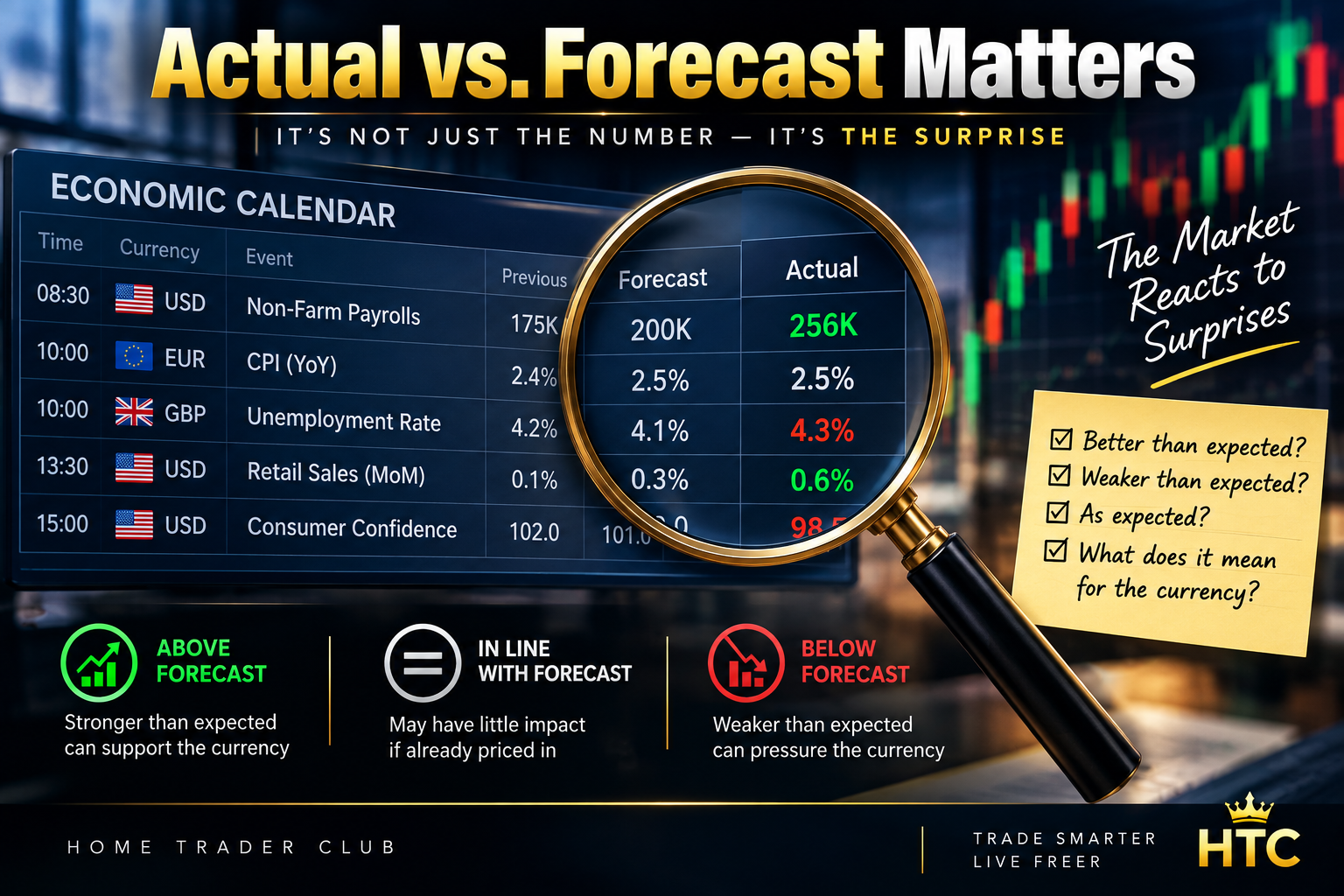
When an economic indicator is released, traders generally compare three numbers:
- Previous – the previous reported figure
- Forecast – what economists and analysts expected
- Actual – the newly released figure
The comparison between the actual result and the forecast is often particularly important.
A report can be objectively strong but still disappoint the market if traders expected something even stronger.
Likewise, a report can look weak in isolation but support a currency if it is significantly better than the market had anticipated.
This is why fundamental traders should avoid categorising data simply as “good” or “bad.”
Instead, ask:
How did the result compare with expectations?
3. Good News May Already Be Priced In
Markets constantly adjust before economic data is released.
If traders strongly expect a positive economic development, they may begin buying the currency ahead of the announcement. By the time the data arrives, much of that expectation may already be reflected in the exchange rate.
When the actual number confirms what traders already expected, there may be little reason for additional buying.
This is commonly described as the news being “priced in.”
In some cases, traders who bought the currency before the release may use the announcement as an opportunity to take profits.
The result can be a currency decline despite apparently positive economic news.
4. Interest-Rate Expectations Can Override the Headline
One of the biggest drivers of currency markets is the expected path of interest rates.
Central banks use monetary policy to influence economic conditions. When traders believe interest rates may remain higher, or rise, a currency can receive support because higher expected returns on that currency’s assets can increase demand.
But the relationship is not automatic.
A strong economic report may not strengthen a currency if traders believe it will have little effect on future monetary policy.
For example, if the central bank has already made it clear that one particular economic report will not significantly change its policy outlook, traders may pay less attention to the headline result.
The key question becomes:
What does this data change about future interest rates?
That question is often more important than whether the data itself appears positive.
5. Central Bank Expectations Matter

Economic data does not exist in isolation.
Traders constantly try to understand how central banks will interpret incoming information.
Inflation, employment, economic growth, consumer spending and other indicators can influence expectations about future monetary policy.
If traders believe strong economic data will encourage a central bank to maintain a restrictive policy, the currency may benefit.
But if the central bank is already expected to maintain its policy regardless of the latest report, the market reaction may be limited.
Central-bank communication can therefore become just as important as the economic data itself.
Statements, speeches, meeting minutes and policy guidance can change how traders interpret an economic release.
6. Hawkish and Dovish Expectations
Fundamental traders often use the terms hawkish and dovish when discussing monetary policy.
A hawkish outlook generally suggests that a central bank is more concerned about inflation and may favour tighter monetary policy or higher interest rates.
A dovish outlook generally suggests a greater willingness to support economic activity through easier monetary policy or lower interest rates.
Economic data can change these expectations.
Strong inflation data may initially appear positive for an economy, but traders may interpret it through the central bank’s reaction function. If the data increases expectations for tighter policy, the currency may strengthen.
On the other hand, strong economic data that does not materially change the expected policy path may produce a much smaller reaction.
This is why fundamental analysis is not simply about identifying whether an indicator is positive or negative.
It is about understanding what the information means for monetary policy and future expectations.
7. Market Positioning Can Change the Reaction
Another important factor is positioning.
Before a major economic release, traders may already have established large positions based on their expectations.
If many traders are already positioned for a stronger currency, even positive news may fail to generate additional buying.
Instead, traders may begin closing profitable positions.
This can create what is commonly called profit-taking.
In such situations, the currency may fall even though the economic report appears favourable.
The market is not necessarily saying that the economic news is bad.
It may simply be saying that there are not enough new buyers left to push the price higher.
8. Risk Sentiment Can Dominate Fundamentals
Currencies are also influenced by broader market sentiment.
At times, traders become more willing to take risk. At other times, they become more cautious and seek safety.
During periods of heightened uncertainty, geopolitical tension, financial stress or market instability, investors may move toward currencies traditionally viewed as safer or reduce exposure to risk-sensitive assets.
This can overwhelm the effect of an individual economic release.
As a result, a currency may receive positive domestic economic news but still decline because broader market flows are moving in the opposite direction.
This is another reason fundamental analysis should consider the wider market environment, rather than focusing on one economic number.
9. Multiple Economic Factors Can Send Conflicting Signals
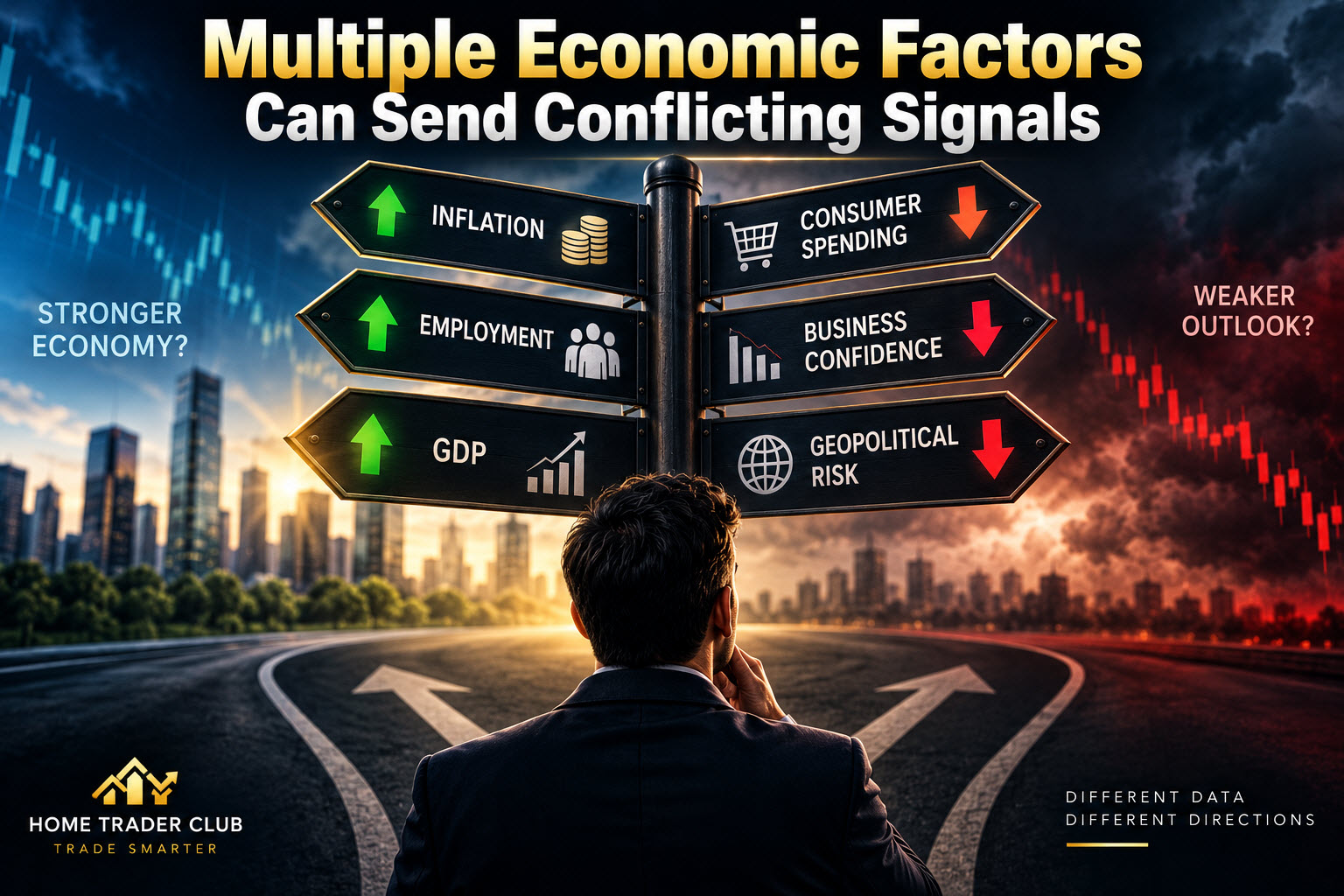
An economy is made up of many interconnected factors.
Inflation may be rising while economic growth is slowing.
Employment may remain strong while consumer spending weakens.
GDP may improve while business confidence deteriorates.
One economic report therefore rarely tells the entire story.
Traders must consider the broader fundamental picture.
A strong economic release may initially look bullish, but if other developments suggest that the economy is weakening or that the central bank is likely to become more accommodative, the currency may still struggle.
Fundamental analysis works best when individual pieces of information are viewed as part of a larger picture.
10. The Initial Reaction Is Not Always the Final Reaction
Economic releases can produce significant volatility.
The first market reaction may be driven by automated trading systems, liquidity conditions, positioning and traders reacting to the headline number.
As more participants analyse the details, the market can reassess the information.
This can lead to:
Initial move → Reassessment → Reversal or continuation
For this reason, traders should be careful about assuming that the first few minutes after a release represent the market’s final fundamental interpretation.
A strong headline can generate an initial currency rally, followed by a reversal once traders consider the wider implications.
The opposite can also happen.
This is particularly important around major economic releases, when volatility can increase rapidly.
11. Why “Good” and “Bad” Are Not Enough
A better way to think about fundamental news is to move away from simple labels.
Instead of saying:
“The news is good, so the currency should rise.”
Ask several questions:
What was expected?
Was the market already positioned for a strong result?
What was actually reported?
Was the result above, below, or close to expectations?
What does it change?
Does the release meaningfully change expectations for future economic conditions?
What does it mean for interest rates?
Could the information influence the central bank’s future decisions?
What has already been priced in?
Was the market already anticipating this outcome?
How is the market positioned?
Are traders heavily positioned in one direction?
What is happening elsewhere?
Is broader risk sentiment supporting or opposing the currency?
These questions provide a much more complete view than the headline alone.
12. A Better Way to Read Economic News
If you use fundamental analysis in your Forex trading, develop the habit of looking beyond the headline.
Before a major release, understand:
- What indicator is being released
- Why the market cares about it
- What the current forecast is
- What the previous result was
- What traders are expecting from the central bank
- Whether the market is already strongly positioned for a particular outcome
After the release, compare the actual result with expectations and consider whether it changes the broader fundamental outlook.
Most importantly, do not assume that the market must move in the direction suggested by the headline.
The market is constantly processing information.
13. Fundamental Analysis Is About Context
The biggest lesson is that economic data should always be viewed in context.
A strong number does not automatically create a bullish currency environment.
A weak number does not automatically create a bearish one.
What matters is how the information changes the market’s expectations.
This is particularly important because currency prices are relative. Forex always involves one currency against another.
A currency may receive positive economic news, but if the other currency in the pair receives even more supportive developments, the exchange rate can still move lower.
Therefore, fundamental analysis should consider both sides of the currency pair.
14. Common Mistakes Traders Make With Economic News

Mistake 1: Trading the headline
Seeing “better-than-expected” and immediately buying is an oversimplification.
Mistake 2: Ignoring the forecast
The forecast provides important information about what the market was already expecting.
Mistake 3: Assuming good news must produce a rally
Markets react to surprises and changing expectations, not simply positive headlines.
Mistake 4: Ignoring interest rates
Economic data often matters because of what it could mean for future monetary policy.
Mistake 5: Forgetting that news can be priced in
If everyone already expects the outcome, the release may not provide enough new information to move the market higher.
Mistake 6: Judging the market by the first reaction
The initial move can change as traders digest the complete information.
15. A Simple Fundamental Analysis Framework
When an important economic release approaches, use this simple framework:
1. EXPECTATION
What does the market expect?
2. RESULT
What was actually reported?
3. SURPRISE
How different was the result from expectations?
4. POLICY IMPACT
Could this change interest-rate or central-bank expectations?
5. POSITIONING
What might traders already have priced in?
6. MARKET CONTEXT
What is happening with risk sentiment and the other currency in the pair?
7. PRICE RESPONSE
How is the market actually reacting?
This framework helps prevent the common mistake of treating fundamental analysis as a simple good-news/bad-news system.
Final Thoughts
The Forex market does not simply reward traders who know whether an economic report is positive or negative.
It rewards traders who understand what the information means in context.
Good economic news can sometimes cause a currency to fall because the result was already priced in, because it was not strong enough relative to expectations, because interest-rate expectations moved in another direction, because traders were taking profits, or because broader market forces were stronger than the individual release.
This is why fundamental analysis requires more than reading economic headlines.
Look at expectations. Look at the actual result. Consider monetary policy. Understand positioning. Watch the broader market environment. Then observe how price responds.
The goal is not to predict exactly how the market will react to every economic release.
The goal is to understand why the market may react differently from what the headline appears to suggest.
That deeper understanding can help you become a more patient and informed Forex trader.
To Your Trading Success,
Vladimir Ribakov
Internationally Certified Financial Technician
Home Trader Club