



Central banks do more than change interest rates. They also influence financial markets through the words they use, the economic outlook they communicate, and the signals they provide about future monetary policy.
For Forex traders, understanding this language is an important part of fundamental analysis.
You may hear analysts describe a central bank as “hawkish” or “dovish.” These terms are often used to explain why a currency strengthens or weakens after an interest rate decision, policy statement, or central bank speech.
But what do they actually mean?
And why can a few carefully chosen words move the Forex market, even when the central bank leaves interest rates unchanged?
Let’s break it down.
- 1 What Does Hawkish Mean in Forex?
- 2 What Does Dovish Mean in Forex?
- 3 Hawkish vs Dovish: The Key Difference
- 4 Why Central Bank Language Matters
- 5 Interest Rate Expectations and Currency Strength
- 6 A Central Bank Does Not Need to Raise Rates to Sound Hawkish
- 7 A Rate Decision and Its Language Can Send Different Signals
- 8 What Is Forward Guidance?
- 9 Why the Same Words Can Produce Different Market Reactions
- 10 The Importance of Comparing Two Central Banks
- 11 Market Expectations Matter More Than Labels
- 12 Central Bank Speeches Between Meetings
- 13 Common Mistakes Traders Make With Central Bank Language
- 14 A Simple Framework for Reading Central Bank Communication
- 15 Fundamental Analysis Is About Understanding the Message
- 16 Final Thoughts
What Does Hawkish Mean in Forex?
A hawkish central bank stance generally indicates a greater willingness to tighten monetary policy.
This may involve raising interest rates, keeping rates higher for longer, or communicating that additional tightening could be necessary.
Central banks may adopt a hawkish tone when inflation is too high, remains persistent, or is not declining as expected.
A hawkish message can suggest that policymakers are placing greater emphasis on controlling inflation, even if tighter monetary conditions create challenges for economic growth.
Common hawkish expressions may include:
- Inflation remains too high.
- Further policy tightening may be necessary.
- Interest rates may need to remain restrictive.
- Inflationary pressures remain persistent.
- The central bank is prepared to act if needed.
These phrases do not automatically mean an interest rate increase is coming. Their significance depends on the wider policy statement, the economic outlook, and what markets had previously expected.
What Does Dovish Mean in Forex?
A dovish central bank stance generally indicates a greater willingness to ease monetary policy or avoid further tightening.
This may involve cutting interest rates, preparing markets for future rate reductions, or expressing concern about slowing economic activity.
A dovish tone may emerge when inflation is moving closer to the central bank’s objective, economic growth is weakening, or policymakers believe that monetary conditions are already sufficiently restrictive.
Common dovish expressions may include:
- Inflationary pressures are easing.
- Economic activity is losing momentum.
- The current policy stance is restrictive.
- The outlook has become more uncertain.
- The central bank will carefully assess the need for further tightening.
Dovish language does not guarantee an immediate rate cut. It indicates a possible shift in the direction or emphasis of monetary policy.
The important point is to understand what the central bank is communicating about its future decisions.
Hawkish vs Dovish: The Key Difference
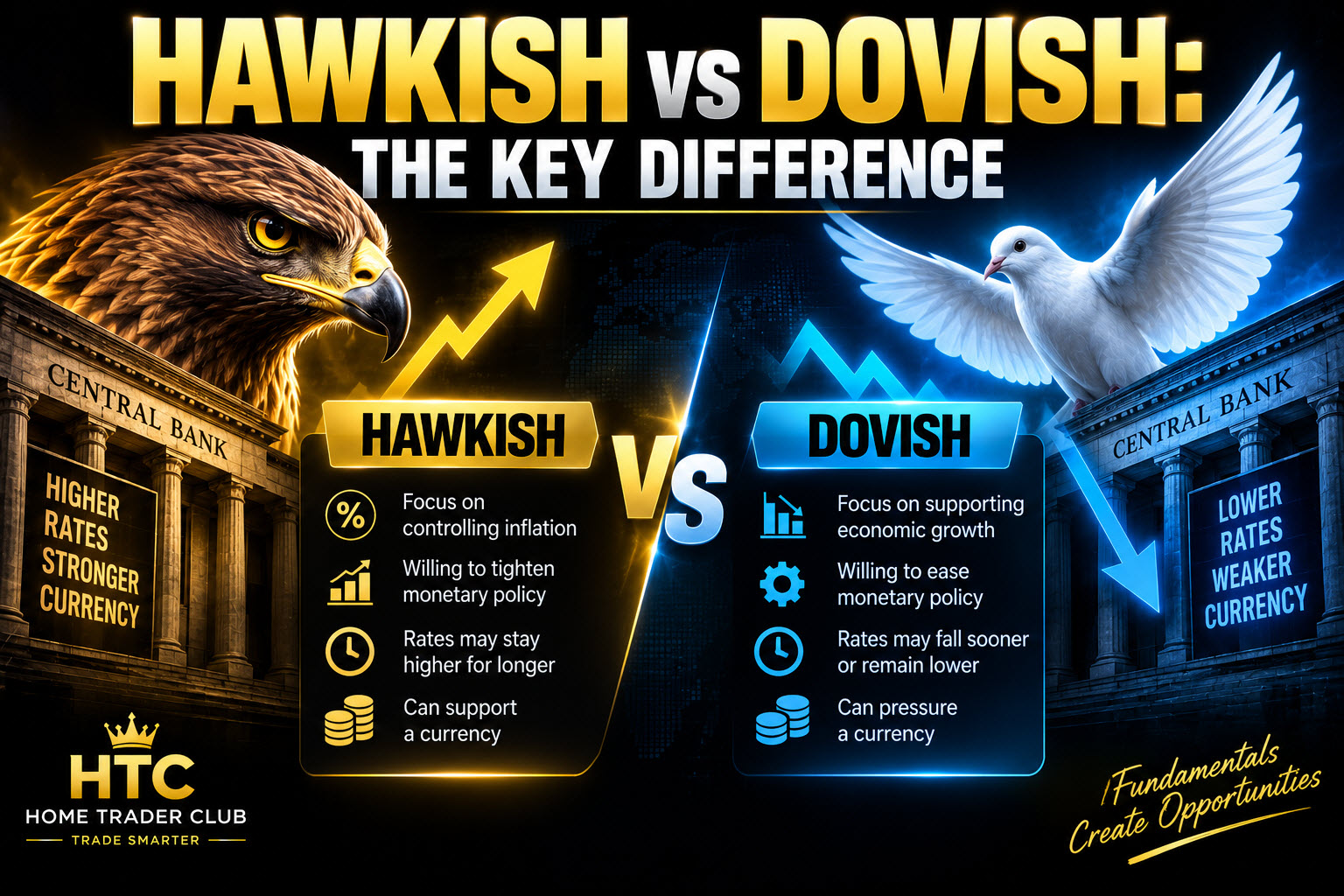
The main difference is the direction in which monetary policy may be moving.
| Hawkish | Dovish |
|---|---|
| More emphasis on controlling inflation | More emphasis on easing or supporting activity |
| Greater willingness to tighten policy | Greater willingness to ease policy |
| Rates may stay higher for longer | Rates may fall sooner or remain lower |
| Can support a currency through higher rate expectations | Can pressure a currency through lower rate expectations |
These are general tendencies, not guaranteed market outcomes.
A currency’s reaction also depends on the policies and expectations of the other central bank in the currency pair.
Why Central Bank Language Matters
Central banks influence markets not only through their current interest rates, but also through their communication.
Their statements help investors understand how policymakers interpret inflation, employment, economic growth, and other developments.
This information can change expectations about future interest rates.
The European Central Bank has explained that changes in communication tone can influence financial markets and help guide expectations about monetary policy.
For Forex traders, this matters because currency prices respond to changing expectations about the relative outlook for two economies.
If investors begin to expect one central bank to maintain higher interest rates than another, the expected difference between those policy paths may influence the relevant exchange rate.
The market is not simply reacting to what a central bank has done. It is also responding to what traders believe the central bank may do next.
Interest Rate Expectations and Currency Strength
Interest rates are an important part of currency valuation.
When investors expect a country’s interest rates to remain relatively attractive compared with those of another country, demand for that currency may increase.
However, the relationship is not automatic.
Currency movements are affected by many factors, including:
- Expected interest rate differences
- Inflation and economic growth
- Investor positioning
- Global risk sentiment
- Developments in other countries
- What the market has already priced in
A hawkish statement may support a currency if it causes markets to anticipate a tighter policy path than previously expected.
A dovish statement may weigh on a currency if it leads markets to anticipate lower rates or earlier easing.
But if the message was already expected, the currency reaction may be limited—or even move in the opposite direction.
A Central Bank Does Not Need to Raise Rates to Sound Hawkish
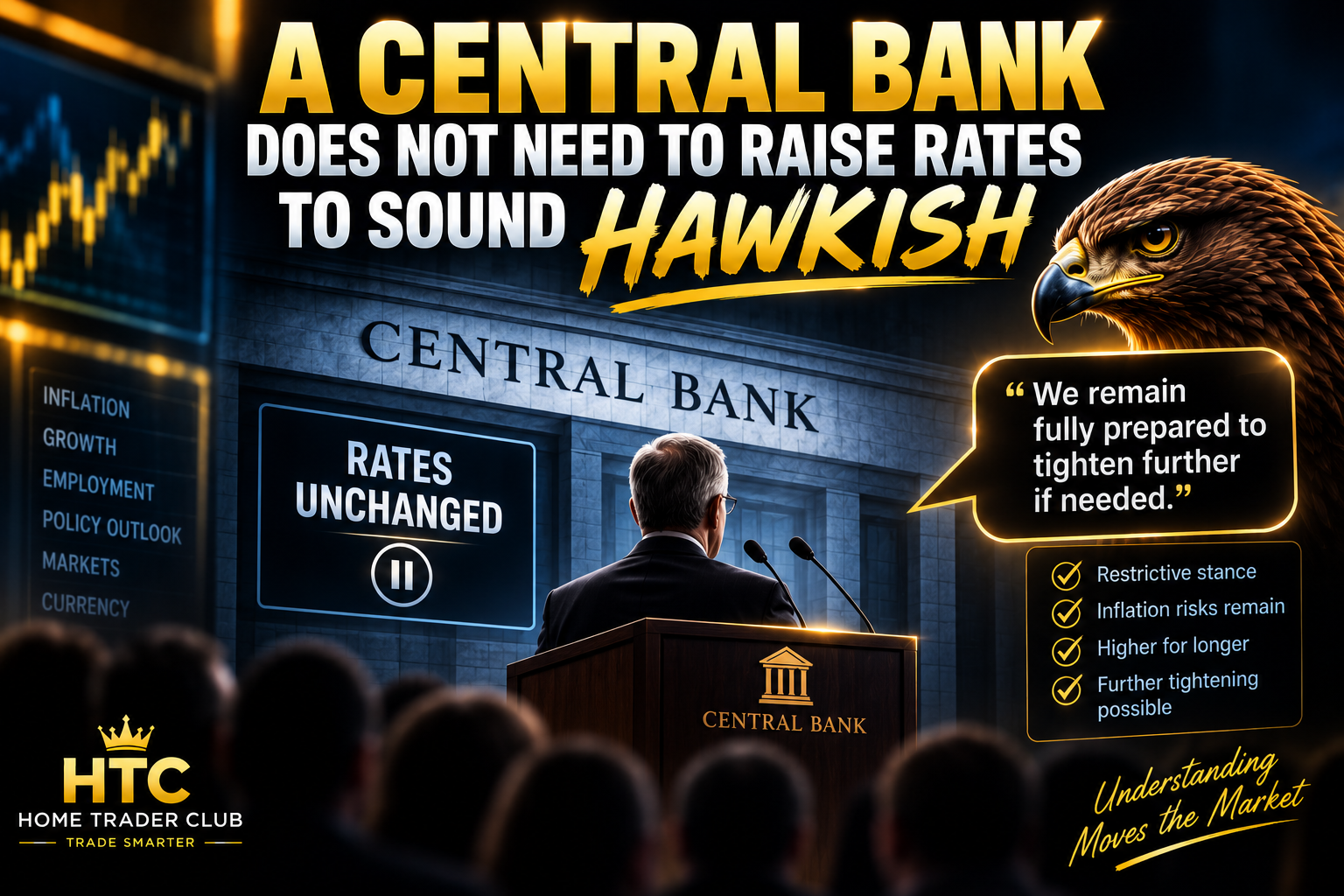
One common misunderstanding is that a central bank is hawkish only when it raises interest rates.
That is not correct.
A central bank can leave rates unchanged while communicating that further tightening remains possible or that rates may need to stay restrictive for an extended period.
Such a message may lead markets to revise their expectations about future policy.
Likewise, a central bank can cut rates while sounding relatively cautious about further reductions.
The actual decision and the communication surrounding it are related, but they are not the same thing.
For traders, both deserve attention.
A Rate Decision and Its Language Can Send Different Signals
A central bank announcement contains several layers of information.
The decision tells markets what policymakers have done today.
The statement explains why they made that decision.
The economic projections provide insight into how policymakers view inflation, growth, and other important variables.
The press conference may offer additional details about the risks policymakers are monitoring and the conditions that could influence future decisions.
These elements can reinforce one another—or send different signals.
For example, an unchanged interest rate decision may be accompanied by more hawkish language than markets expected. Alternatively, a rate increase may be accompanied by cautious comments suggesting that policymakers are nearing the end of a tightening cycle.
That is why traders should avoid judging an announcement by the rate decision alone.
What Is Forward Guidance?
Forward guidance refers to communication intended to help the public and financial markets understand how a central bank may approach future monetary policy.
It can include statements about the conditions that could lead to rate changes, the outlook for inflation, or the factors policymakers will monitor before making their next decision.
Forward guidance can be explicit or conditional.
A central bank may communicate that policy will depend on incoming data, or it may indicate that certain economic developments would make a particular policy response more likely.
This information can influence market expectations before any actual rate change takes place.
However, forward guidance is not always a promise. Many central banks emphasize that future decisions depend on economic conditions and may change as new information becomes available.
Why the Same Words Can Produce Different Market Reactions
The meaning of a central bank statement depends on context.
A phrase that sounds hawkish in isolation may be less significant if policymakers have already communicated the same message several times.
Likewise, a cautious statement may be interpreted as dovish if markets had expected a more restrictive message.
The key questions are:
- Is the central bank’s tone changing?
- Is the message different from what markets expected?
- Does it change expectations for future interest rates?
- Is the central bank more concerned about inflation or economic weakness?
- How does its outlook compare with that of the other central bank?
The European Central Bank’s research on monetary policy communication highlights the importance of changes in tone and how they may influence expectations beyond the immediate policy decision.
In other words, traders need to understand not just the words themselves, but what has changed.
The Importance of Comparing Two Central Banks
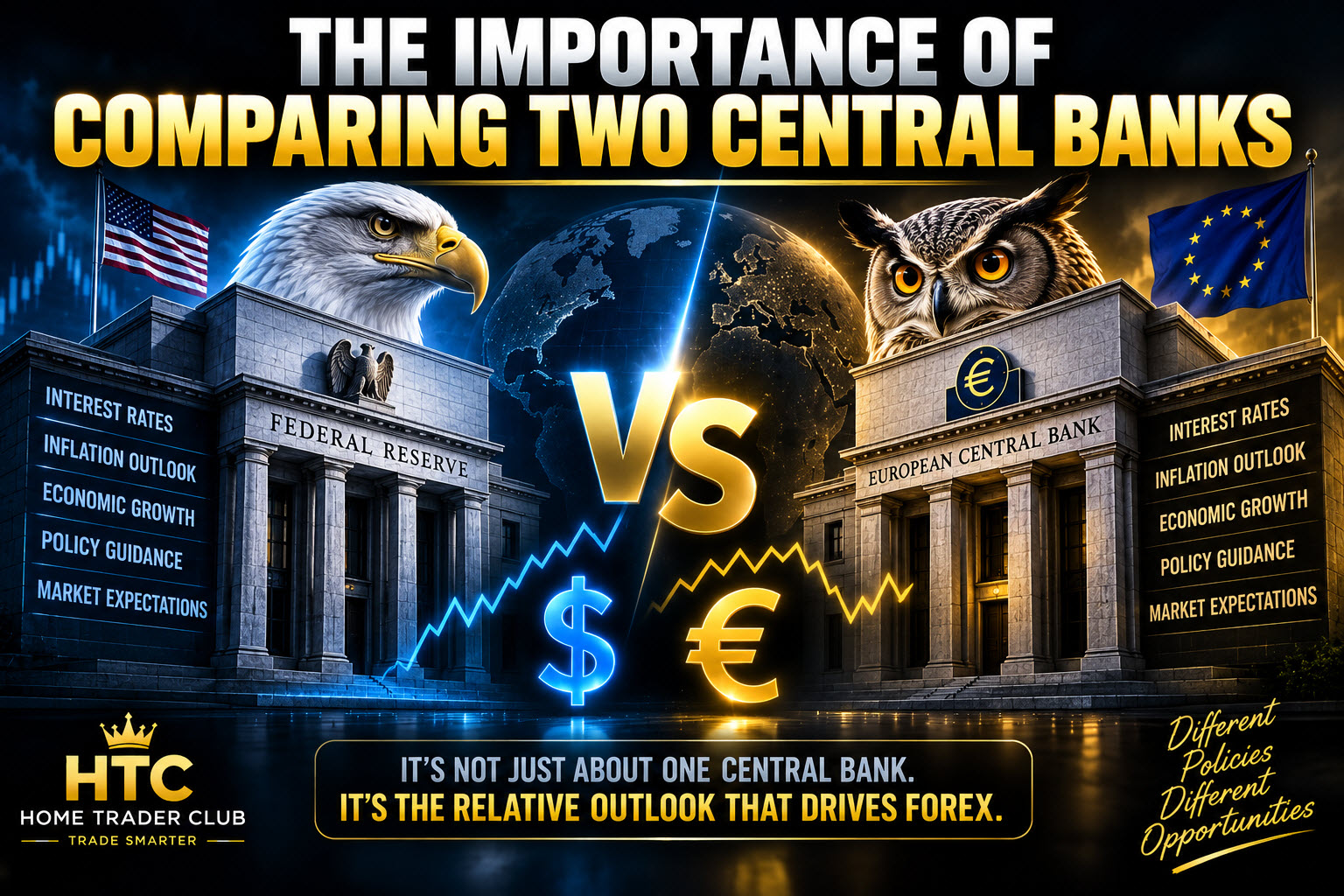
Forex trading involves currency pairs.
When trading EUR/USD, for example, you are evaluating the euro relative to the US dollar—not the euro in isolation.
If the European Central Bank sounds hawkish, that may support the euro. But if the Federal Reserve is communicating an even more restrictive policy outlook, the dollar may still strengthen against it.
The same principle applies to other currency pairs.
A useful fundamental analysis process compares:
- The current policy stance of each central bank.
- The expected direction of future interest rates.
- Recent changes in their communication.
- The inflation and growth outlooks behind those policies.
- How much of that information markets may already have priced in.
The relative outlook is often more informative than focusing on one central bank alone.
Market Expectations Matter More Than Labels
Calling a central bank “hawkish” or “dovish” is only the starting point.
The next question is whether its message is more or less restrictive than markets anticipated.
A hawkish message can fail to strengthen a currency if investors were expecting something even more hawkish.
A dovish message can fail to weaken a currency if markets had already anticipated a much more accommodative stance.
This is one reason Forex prices can move unexpectedly after major announcements.
The market reaction reflects the difference between expectations and new information—not simply whether the statement sounds positive or negative.
Central Bank Speeches Between Meetings
Central bank communication does not happen only on policy announcement days.
Governors, presidents, and other policymakers may deliver speeches, give interviews, or answer questions between meetings.
These communications can provide insight into how policymakers interpret new economic data and whether their views are changing.
A speech may reinforce the existing policy outlook, introduce a new concern, or clarify an earlier statement.
However, traders should be careful not to treat every comment as a change in official policy.
Individual policymakers may express different views, and a single speech may not represent the position of the entire policy committee.
The significance of a comment depends on who made it, the context in which it was delivered, and whether it changes the broader policy outlook.
Common Mistakes Traders Make With Central Bank Language

1. Assuming hawkish always means bullish
A hawkish tone may support a currency, but it does not guarantee appreciation. Expectations, positioning, and developments elsewhere can influence the reaction.
2. Assuming dovish always means bearish
A dovish tone may pressure a currency, but the market may already have anticipated it. Other economic or financial developments may also offset the effect.
3. Focusing only on the headline
A headline may summarize a rate decision but miss important details in the statement, projections, or press conference.
4. Treating every comment as a policy commitment
Central banks often communicate uncertainty and data dependence. Conditional language should not be interpreted as a guaranteed future action.
5. Ignoring the other currency in the pair
A currency’s direction depends partly on how its policy outlook compares with that of the other currency.
6. Reacting before understanding the message
The first market movement may reflect only part of the announcement. Traders who react immediately without understanding the context may misread the broader policy signal.
A Simple Framework for Reading Central Bank Communication
When a major central bank announcement or speech takes place, use a structured approach.
Step 1: Identify the policy decision.
Did the central bank raise rates, cut rates, or leave them unchanged?
Step 2: Read the explanation.
What does the central bank say about inflation, growth, employment, and the balance of risks?
Step 3: Assess the tone.
Does the communication suggest a more hawkish, more dovish, or broadly unchanged stance?
Step 4: Compare it with expectations.
Was the message more restrictive or more accommodative than markets had anticipated?
Step 5: Consider the other central bank.
How does the policy outlook compare with the central bank responsible for the other currency in the pair?
Step 6: Observe the market reaction.
Does price action appear consistent with the policy interpretation, or are other forces influencing the market?
Step 7: Apply your trading plan.
Do not abandon your strategy simply because a central bank announcement creates volatility. Consider whether the event changes your market outlook and whether your setup still meets your trading rules.
Fundamental Analysis Is About Understanding the Message
Central bank language can provide valuable information about the future direction of monetary policy.
But it should never be interpreted in isolation.
Hawkish and dovish are useful descriptions of policy tone. They are not direct trading signals, and they do not guarantee that a currency will move in a particular direction.
The important work is understanding how the message compares with expectations, what it implies for future interest rates, and how it changes the relative outlook for the currencies you are trading.
That is where fundamental analysis becomes more meaningful.
Final Thoughts
Central banks influence Forex markets through both their decisions and their communication.
A hawkish tone generally signals a greater willingness to tighten monetary policy, while a dovish tone generally signals a greater willingness to ease or avoid further tightening.
However, the currency reaction depends on more than these labels.
Markets consider what was expected, what has changed, and how the policy outlook compares with that of other economies.
As a Forex trader, your goal is not to react to every central bank headline. It is to understand the message, assess its relevance, and incorporate that information into a disciplined trading process.
Listen to the words. Understand the expectations. Trade with a plan.
To Your Trading Success,
Vladimir Ribakov
Internationally Certified Financial Technician
Home Trader Club