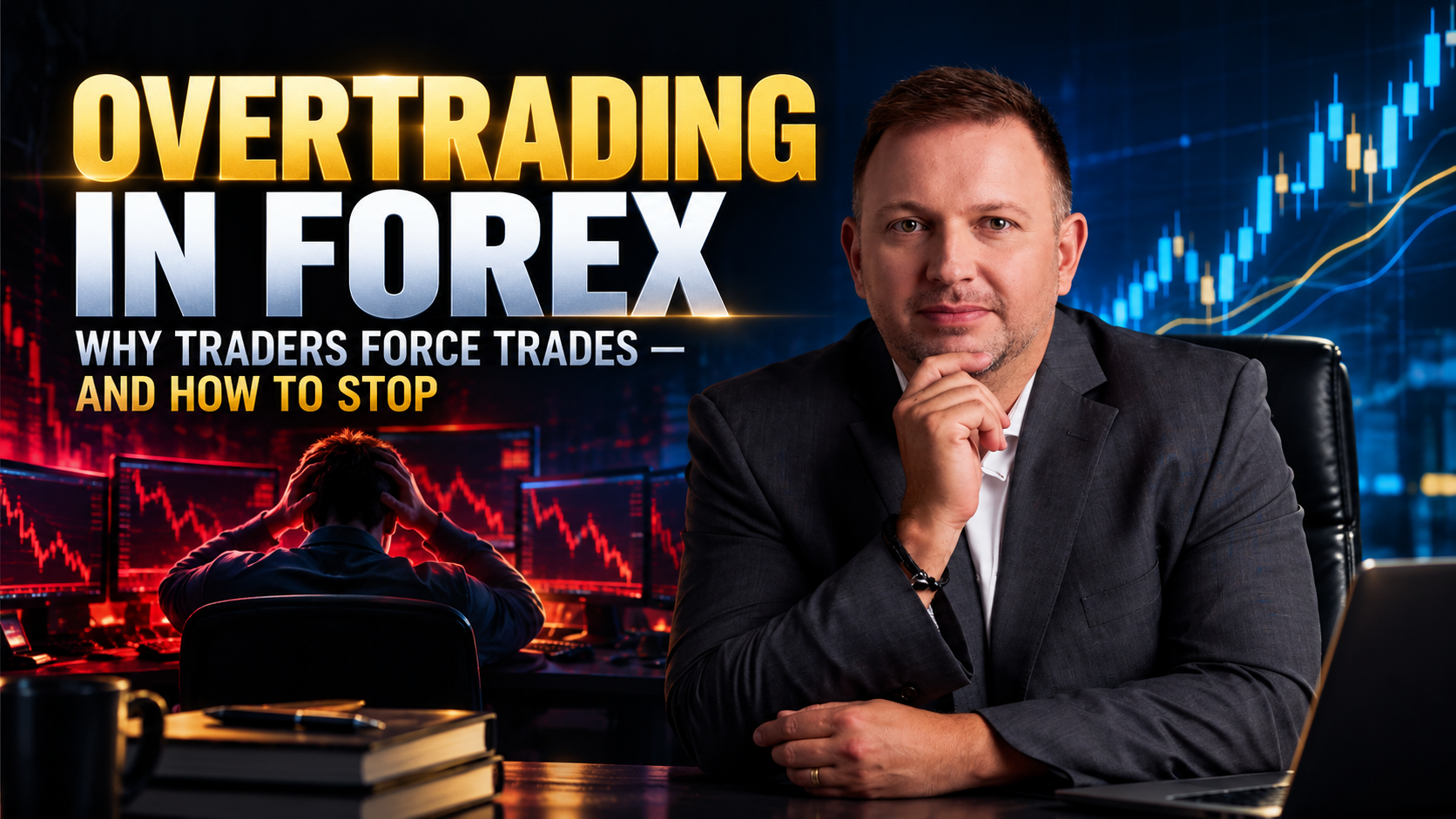



Have you ever opened your trading platform, watched the market move, and felt that you had to enter a trade?
Perhaps you have been waiting for hours without finding a good setup. Price starts moving, and you feel uncomfortable sitting on the sidelines. You begin looking for opportunities on different currency pairs, switch between timeframes, and eventually find a reason to enter the market.
The trade may not meet all your rules. Your entry might be late, your stop-loss placement may be unclear, or the risk-to-reward ratio may be less attractive than usual.
Yet you enter anyway.
Why?
Because doing nothing feels like wasting time.
This is one of the hidden psychological traps in Forex trading. Many traders understand technical analysis, know how to identify support and resistance, and have a trading strategy. However, they struggle to remain patient when the market does not offer a suitable opportunity.
The result is overtrading in Forex: entering too many trades, taking low-quality setups, or trading simply because the desire to participate becomes stronger than the discipline to wait.
Successful trading is not about finding a reason to enter the market every day. It is about recognizing when the conditions justify taking a risk—and when they do not.
In this article, we will explore why traders force trades, how this behavior damages performance, and what you can do to develop greater patience and discipline.
- 1 Trade with AvaTrade and Unlock Unlimited Home Trader Club Access
- 2 1. Why Traders Feel the Need to Trade
- 3 2. The Psychology of Forced Trading
- 4 3. How Forced Trading Damages Your Results
- 5 4. A Practical Example: Trading Without a Valid Setup
-
6
5. How to Stop Overtrading in Forex
- 6.1 Step 1: Define your entry conditions before opening a trade
- 6.2 Step 2: Establish a maximum number of trades
- 6.3 Step 3: Use alerts instead of watching charts constantly
- 6.4 Step 4: Set a rule for emotional trading
- 6.5 Step 5: Keep a record of missed trades and skipped trades
- 6.6 Step 6: Evaluate discipline separately from profitability
- 7 6. Is It Bad to Have Days With No Trades?
- 8 7. Change Your Definition of a Successful Trading Day
- 9 8. The Professional Mindset: Patience Is Part of the Strategy
- 10 Final Thoughts
Trade with AvaTrade and Unlock Unlimited Home Trader Club Access
We have partnered with AvaTrade, one of the industry’s leading regulated brokers.
When you open and trade with AvaTrade through our partnership, you receive:
- Unlimited access to Home Trader Club
- Real-time trading education
- Daily and swing trading opportunities
- Our complete educational library
- Access to our Trade Copier Project
- Members-only trading community
If you’re looking to accelerate your trading journey while enjoying premium education, this partnership gives you everything you need under one roof.
If you already have account with them, still follow this link to open separate account with separate email. Once you did that, contact me with the telegram link below and we will give you the access.
Telegram Channel: https://t.me/vladimirribakovtradingchannel
1. Why Traders Feel the Need to Trade
Trading creates a unique psychological challenge.
When you analyze the market, you want your knowledge to produce results. You spend time studying charts, identifying patterns, and preparing trading plans. Naturally, you expect to take action.
But the market does not care how much time you have invested in your analysis.
A perfect setup may appear within minutes, or you may wait several days without finding one that meets your criteria.
This creates a conflict between your expectations and the market’s behavior.
The desire to feel productive
Many traders associate activity with progress. If they spend several hours analyzing charts without placing a trade, they may feel that the session has been unproductive.
This belief can push them to lower their standards.
Instead of asking, “Is this a high-quality trading opportunity?” they start asking, “Can I find a trade here?”
That small change in thinking can have significant consequences.
Trading is not a task where more activity automatically produces better results. Every unnecessary trade introduces additional exposure to market risk, transaction costs, and emotional decision-making.
Your job is not to keep your trading platform busy. Your job is to make sound decisions.
2. The Psychology of Forced Trading
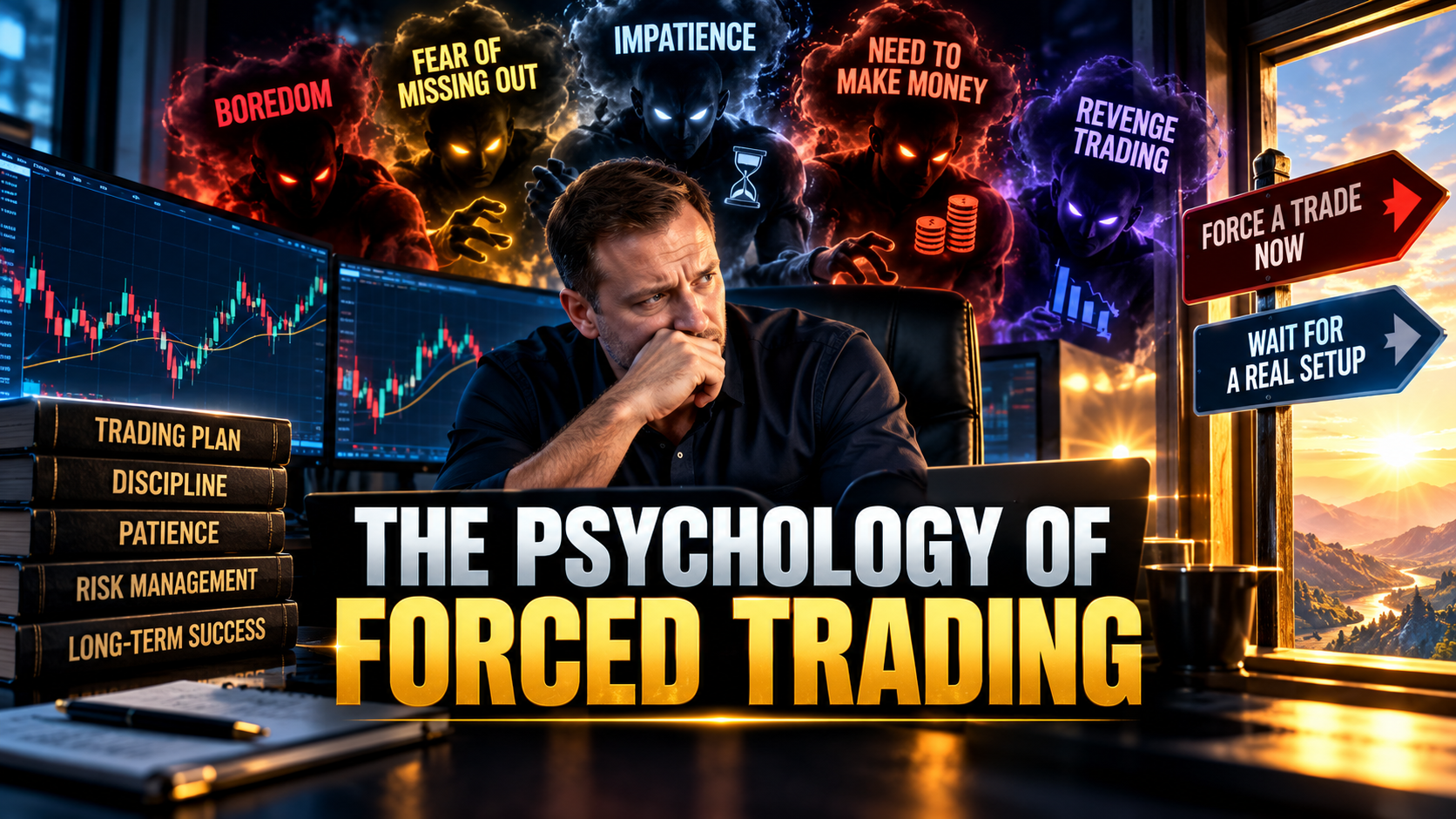
Several psychological factors can make traders enter the market when they should be waiting.
Boredom
Watching price move without participating can feel frustrating. Traders may become tired of waiting and begin searching for something to trade.
They might switch from EUR/USD to GBP/USD, then to gold, and finally to another instrument, hoping to find an exciting opportunity.
The problem is that boredom is not a trading signal.
A market that looks interesting does not automatically offer a favorable setup. If your entry criteria are not satisfied, entering simply to relieve boredom is a form of emotional trading.
Fear of missing out
Fear of missing out, commonly known as FOMO, occurs when traders see a strong price movement and worry that they will miss a profitable opportunity.
Imagine that EUR/USD suddenly moves higher. You did not plan to buy, but the movement looks powerful.
You enter after a large bullish candle because you fear the market will continue rising without you.
Unfortunately, price may retrace shortly after your entry. You have purchased near a temporary high because the fear of missing the move overpowered your trading rules.
Remember this principle: missing a trade is not the same as losing money.
You cannot capture every market movement, and you do not need to. Your objective is to participate in opportunities that fit your strategy, not to chase every move that appears on your screen.
The need to recover lost time or money
After a quiet session or a losing trade, some traders feel pressure to make something happen.
They may increase their trading frequency, search for more aggressive entries, or abandon their normal confirmation requirements.
After a loss, this behavior can develop into revenge trading.
After a period without trades, it may simply look like impatience.
In both cases, the underlying problem is similar: the trader allows an emotional need to influence the decision to enter.
A new trade should be justified by the market, not by your desire to recover money, compensate for inactivity, or feel productive.
3. How Forced Trading Damages Your Results
Forced trading does not guarantee that every additional trade will lose. Some low-quality trades will be profitable.
That is precisely why this behavior can be difficult to recognize.
The damage often becomes clearer when you evaluate the quality of your decisions over a larger sample of trades.
You abandon your trading strategy
Suppose your strategy requires a clear trend, a pullback into a predefined zone, and confirmation before entry.
On a quiet day, the market moves sideways. You become impatient and enter before confirmation because the price appears close enough to your preferred zone.
Even if the trade wins, you have not followed your strategy.
Repeatedly rewarding yourself for breaking your rules can make it easier to repeat the same behavior. Eventually, your trading plan becomes flexible whenever your emotions demand an exception.
You increase trading costs
Every additional trade may involve spreads, commissions, or other trading costs, depending on your account and instrument.
These costs can reduce your net performance, particularly when you repeatedly enter and exit positions without a strong reason.
A trading strategy must generate sufficient performance after costs, not merely produce occasional winning trades.
You create unnecessary emotional pressure
The more positions you open, the more decisions you may need to manage.
You may start checking charts constantly, moving stop-loss orders, closing trades prematurely, or entering additional positions to compensate for earlier decisions.
This can create a cycle in which one unnecessary trade leads to another.
Reducing low-quality trades can help simplify your decision-making and make it easier to follow your plan.
4. A Practical Example: Trading Without a Valid Setup
Imagine you are analyzing EUR/USD on the four-hour chart.
Your trading plan requires:
- A clearly defined market direction.
- A pullback toward an important price zone.
- Confirmation before entering.
- A logical stop-loss level.
- A potential reward that justifies the risk.
Today, the market is moving sideways. Price has not reached your preferred zone, and there is no convincing confirmation.
You have two choices.
Choice A: Force a trade
You enter because price appears to be moving in a promising direction. Your entry is not supported by your usual confirmation rules, and the stop-loss placement is less clear than normal.
The trade may win or lose, but the decision was not based on your complete strategy.
Choice B: Wait
You record the current market conditions and continue monitoring the setup according to your plan. If price reaches your zone and confirms your criteria, you consider entering. If it never does, you finish the session without a trade.
Choice B may feel less exciting, but it protects the consistency of your decision-making.
The important point is not that waiting always produces a better financial outcome on that particular day. It is that you are applying the same rules you intended to follow over the long term.
A disciplined trader evaluates the quality of the decision, not just the outcome of a single trade.
5. How to Stop Overtrading in Forex
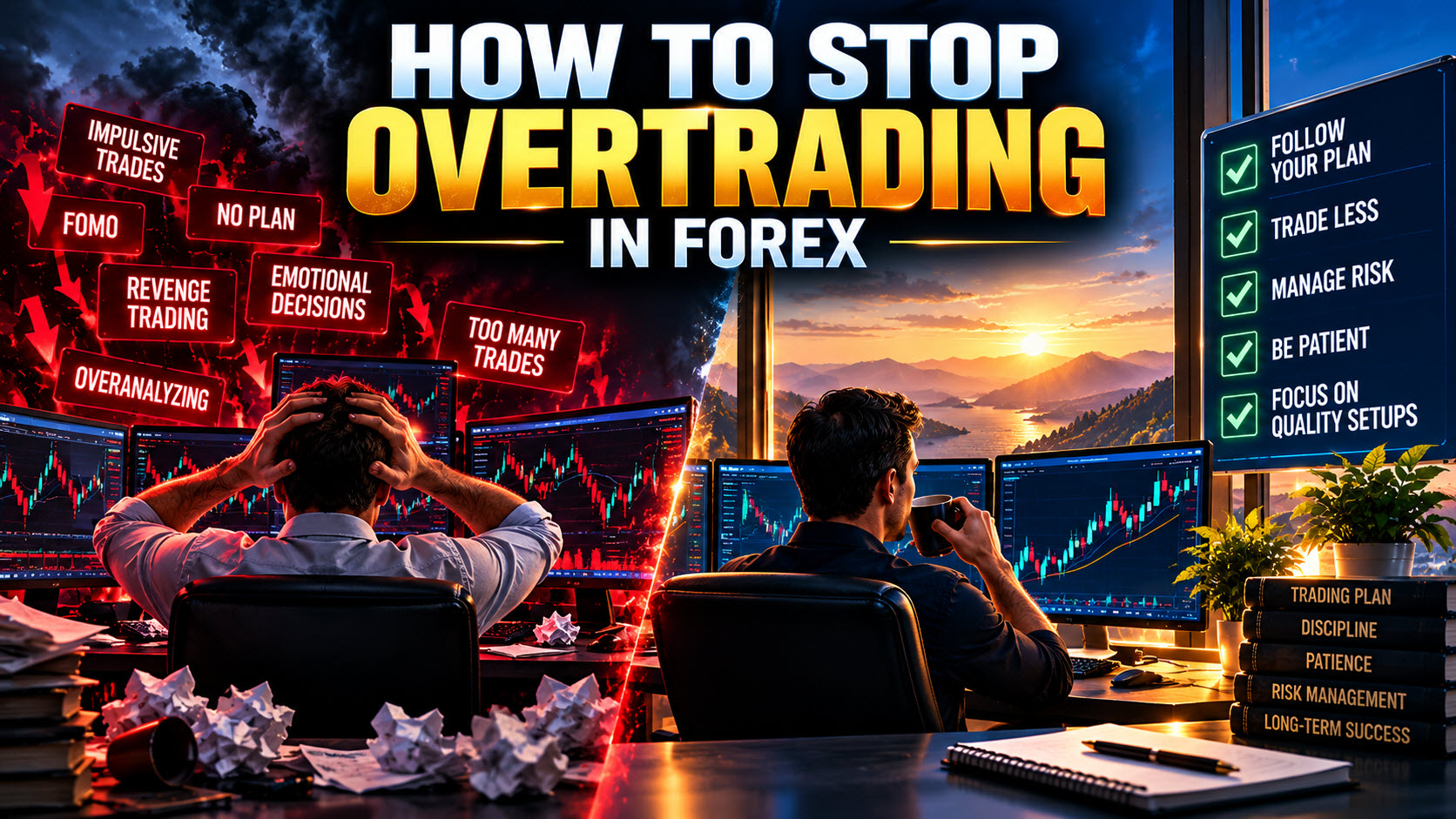
You do not need to eliminate every emotional reaction to become a disciplined trader. You need a process that prevents those emotions from controlling your actions.
Here are six practical steps.
Step 1: Define your entry conditions before opening a trade
Your trading plan should specify what must happen before you enter the market.
Depending on your strategy, these conditions may include trend direction, support or resistance, a pullback, price action confirmation, and an acceptable risk-to-reward ratio.
Write your requirements clearly.
Before entering a position, ask yourself:
- Does this setup meet my predefined criteria?
- Is the entry price reasonable?
- Can I identify a logical stop-loss level?
- Does the potential reward justify the risk?
- Would I take this trade if I had not watched the market all day?
If the setup does not meet your rules, do not create new rules to justify it.
Step 2: Establish a maximum number of trades
Consider setting a maximum number of trades per session or day, provided that it suits your strategy and trading frequency.
This limit is not a target you must reach.
If your limit is three trades and you find only one valid setup, taking one trade is sufficient. If you find none, taking zero trades is also acceptable.
The purpose of a limit is to prevent unnecessary activity, not to encourage you to use every available opportunity.
Step 3: Use alerts instead of watching charts constantly
Constant chart watching can increase the temptation to react to every price movement.
Instead, identify important price levels in advance and use price alerts where your trading platform supports them.
You can then focus on other activities until price approaches an area worth analyzing.
An alert is a reminder to evaluate the market, not an instruction to enter a trade.
This approach can reduce the psychological pressure to participate in every small movement.
Step 4: Set a rule for emotional trading
Before entering a trade, pause if you notice thoughts such as:
- “I have been waiting too long.”
- “I need to make money today.”
- “The market is moving without me.”
- “I cannot finish the day without a trade.”
- “I need to recover my previous loss.”
These thoughts do not automatically mean that the trade is invalid. However, they are warning signs that your motivation may be emotional rather than strategic.
Take a short break and review the setup against your written rules.
If the trade does not qualify, skip it.
Step 5: Keep a record of missed trades and skipped trades
A trading journal should not record only the positions you open. It can also document opportunities you deliberately avoid.
For each session, record:
- Whether a valid setup appeared.
- Whether you entered according to your rules.
- Whether you felt bored, impatient, or afraid of missing out.
- Whether you forced a trade.
- Whether you correctly avoided a low-quality setup.
Review these notes regularly.
You may discover that your worst decisions occur after long periods of waiting, following a loss, or after seeing another currency pair make a strong move.
Identifying these patterns gives you a practical way to improve your behavior.
Step 6: Evaluate discipline separately from profitability
A profitable trade can result from a poor decision. A losing trade can result from a well-executed setup.
This distinction is essential.
If you judge every decision only by whether it made money, you may accidentally reinforce bad habits when they happen to produce short-term profits.
Instead, evaluate two separate questions:
- Did I follow my trading plan?
- What was the financial outcome?
Over time, this separation helps you focus on the quality and consistency of your process rather than reacting emotionally to individual results.
6. Is It Bad to Have Days With No Trades?
No. A day without a trade is not automatically a bad trading day.
Some market conditions may not suit your strategy. Price may remain trapped in a range, volatility may be unusually low, or the market may fail to provide the confirmation you require.
Your strategy does not need to work in every market condition.
For example, a trader who specializes in trend-following setups may reasonably decide not to trade during unclear, directionless conditions. Another trader using a range-trading strategy may find opportunities in the same market.
The correct decision depends on the trader’s predefined method and the conditions it is designed to handle.
There is an important distinction between avoiding a trade because your criteria are not satisfied and avoiding a valid trade because you are afraid.
The first can demonstrate discipline. The second may indicate that fear is interfering with execution.
Your objective is not to trade less at any cost. It is to trade selectively, according to a tested strategy.
7. Change Your Definition of a Successful Trading Day
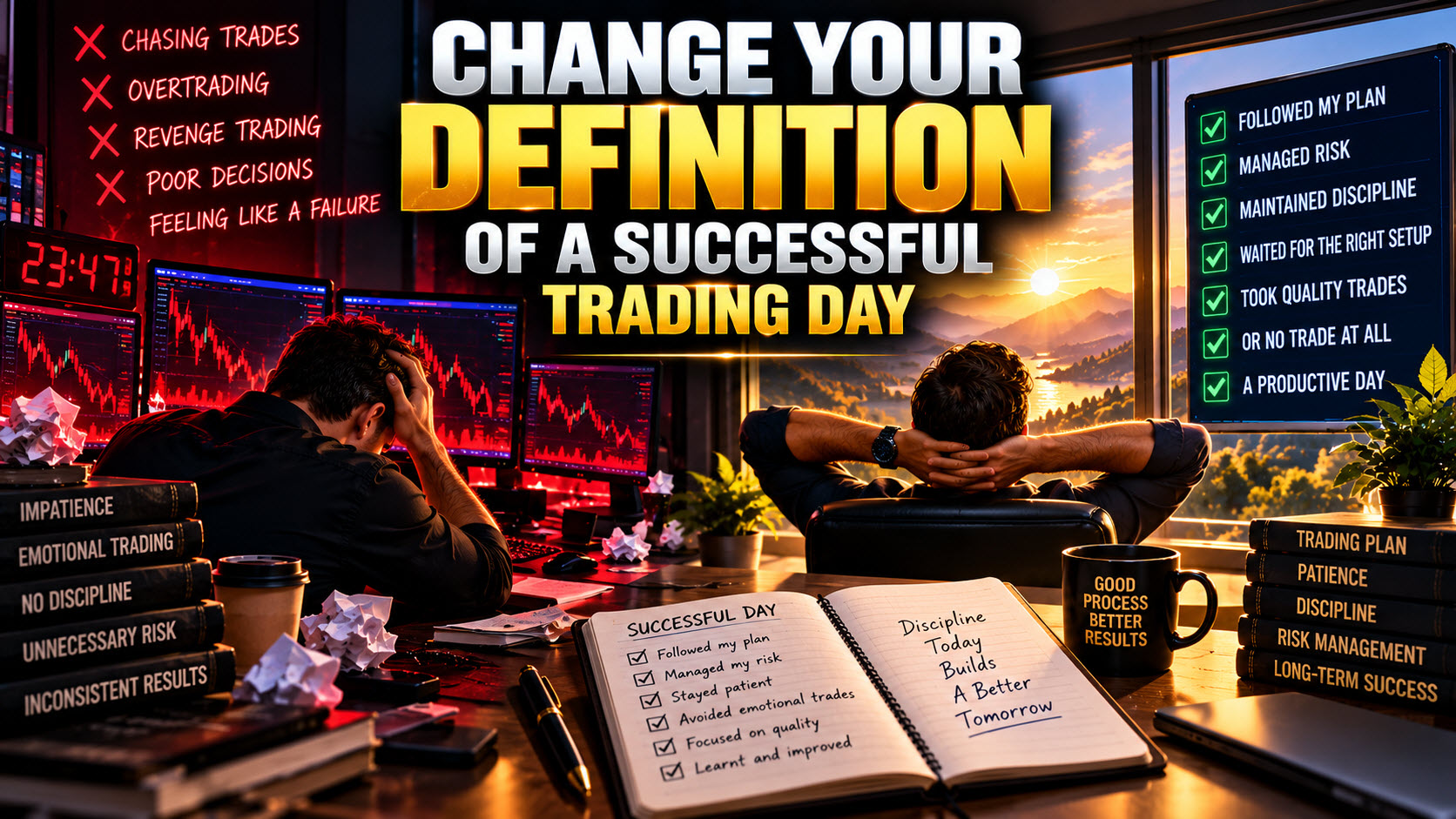
One of the most effective ways to reduce forced trading is to change how you measure progress.
If you define success only as making money, every quiet session may feel like failure. That pressure can push you toward unnecessary risk.
Instead, measure your performance using behaviors you can control.
A successful session might mean:
- You followed your entry criteria.
- You respected your risk limits.
- You avoided chasing price.
- You accepted that no valid setup was available.
- You stopped trading when your predefined conditions required it.
These behaviors do not guarantee profitability. A strategy still needs to demonstrate a genuine edge through appropriate testing and execution.
However, they help you maintain a consistent process and avoid allowing short-term emotions to dictate your decisions.
Remember that the market offers opportunities on its own schedule. Your responsibility is to recognize the opportunities that fit your strategy.
8. The Professional Mindset: Patience Is Part of the Strategy
Many traders treat patience as a personality trait. In practice, it can be developed through clear rules and consistent habits.
You do not need to sit in front of a chart all day proving that you are serious about trading. Nor do you need to enter a position to justify the time you spent analyzing the market.
Your analysis has value even when it leads to the conclusion that the conditions are not suitable.
Think of your trading plan as a filter.
The market produces countless price movements, but only some will meet your requirements. Your job is to identify those opportunities and ignore the rest.
A trader who follows a selective process may take fewer trades than someone who reacts to every movement. The number of trades alone, however, does not determine who will perform better. Results depend on the strategy’s edge, costs, risk management, and execution.
The goal is to avoid unnecessary risk while preserving the ability to act decisively when a valid opportunity appears.
You do not get paid for being active in the market. Your goal is to make decisions that are justified by your strategy.
Final Thoughts
Overtrading in Forex often begins with a seemingly harmless thought: “I should be doing something.”
That thought can lead to boredom-driven entries, fear of missing out, unnecessary transaction costs, and repeated departures from your trading plan.
The solution is not simply to tell yourself to be patient. You need clear entry criteria, predefined risk limits, a trading journal, and a process for recognizing emotional decisions before they become trades.
Most importantly, stop treating a day without a trade as a wasted day.
If your strategy did not provide a valid opportunity and you respected your rules, you may have made exactly the right decision.
There will always be another market movement. There will always be another currency pair to analyze. You do not need to participate in every opportunity to pursue your long-term trading goals.
Wait for your setup. Follow your rules. Protect your capital. Let the market come to you.
To Your Trading Success,
Vladimir Ribakov
Internationally Certified Financial Technician (CFTe)
Home Trader Club