



One of the most important skills in Forex trading is knowing how much to trade. Many traders spend hours analyzing EUR/USD, GBP/USD, Gold or other markets, searching for the perfect entry. But they often overlook one of the most important decisions: position sizing.
Choosing the right Forex lot size is not about how confident you feel about a trade. It should be based on your account size, the amount you are willing to risk, your stop-loss distance and the pip value of the currency pair.
In other words:
Your analysis determines the trade. Your stop loss defines the invalidation point. Your risk management determines the position size.
This guide explains how Forex position sizing works, how to calculate the correct lot size, and the mistakes you should avoid.
Important: This article is for educational purposes only. Forex and leveraged trading involve substantial risk. Position sizing can control planned exposure, but it cannot eliminate market risk, slippage or losses.
- 1 What Is Forex Position Sizing?
- 2 Why Position Sizing Matters in Forex
- 3 The Forex Position Sizing Formula
- 4 Forex Lot Size Calculation Example
- 5 Step 1: Determine Your Account Size
- 6 Step 2: Decide Your Maximum Risk
- 7 Step 3: Determine Your Stop Loss
- 8 Step 4: Calculate the Stop-Loss Distance
- 9 Step 5: Understand Pip Value
- 10 Standard, Mini and Micro Forex Lots
- 11 How Stop-Loss Distance Changes Your Lot Size
- 12 Position Sizing vs. Leverage
- 13 Common Forex Position Sizing Mistakes
- 14 A Simple Forex Position Sizing Checklist
- 15 Position Sizing and Trading Psychology
- 16 Final Thoughts on Forex Position Sizing
What Is Forex Position Sizing?
Forex position sizing is the process of calculating how large a trade should be based on your predefined risk.
Instead of saying:
“I always trade 0.10 lots.”
you should be able to say:
“I know how much I am willing to risk, where my stop loss belongs, and I have calculated the position size accordingly.”
This distinction is extremely important.
A 0.10-lot trade with a 20-pip stop does not carry the same monetary risk as a 0.10-lot trade with an 80-pip stop.
Therefore, using the same lot size on every trade does not necessarily mean you are taking the same risk.
Why Position Sizing Matters in Forex
Forex is a leveraged market, which means relatively small amounts of capital can control much larger positions. While leverage can increase potential returns, it can also magnify losses.
This makes position sizing particularly important.
Good position sizing can help you:
- Control your risk per trade
- Avoid oversized positions
- Reduce the impact of losing streaks
- Keep your trading more consistent
- Prevent emotions from determining your lot size
- Protect your trading capital from unnecessary exposure
The goal is not to eliminate losing trades.
No strategy can do that.
The goal is to make sure that when a trade goes against you, the loss remains within the limits of your trading plan.
The Forex Position Sizing Formula
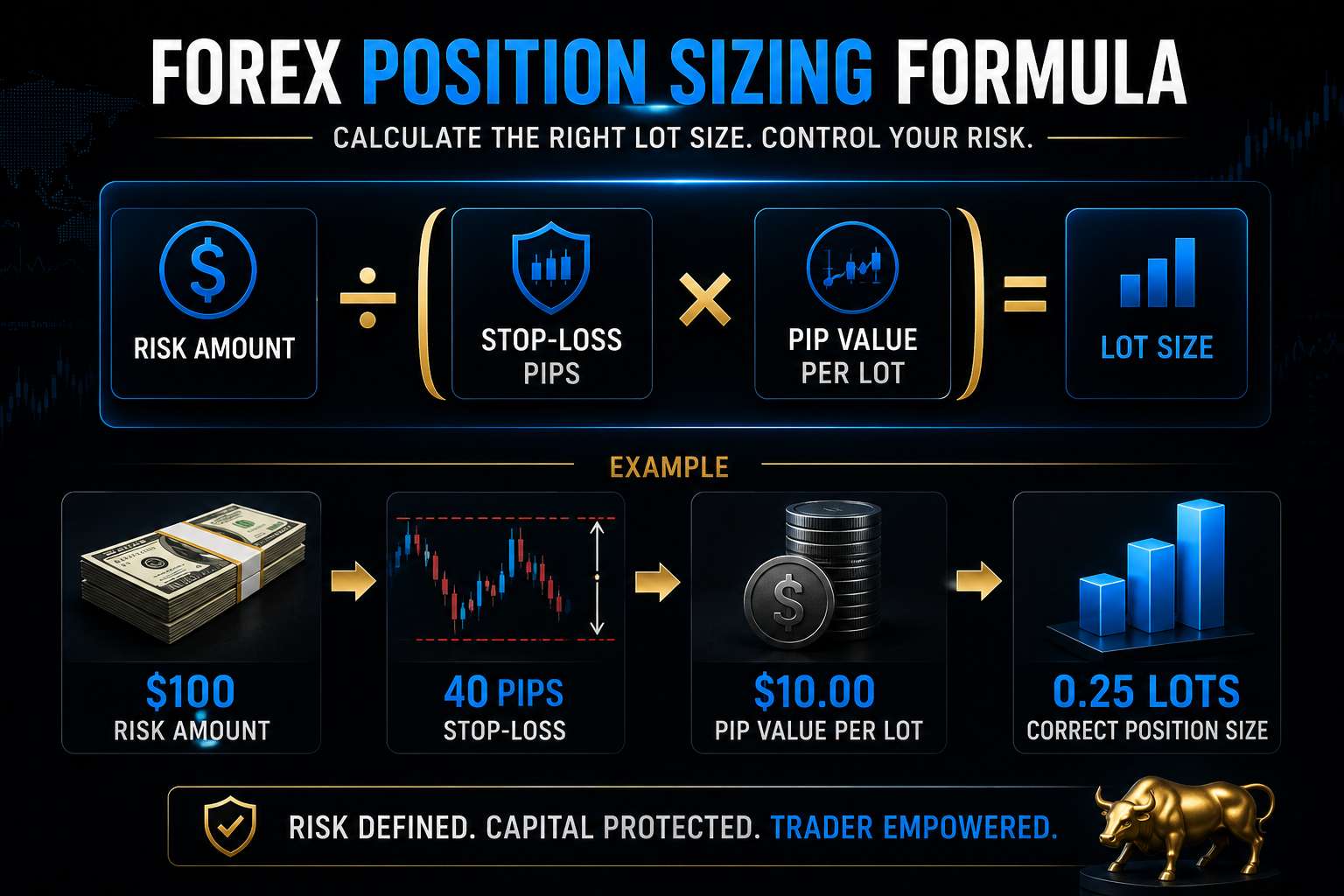
Note: Pip value varies depending on the currency pair, position size, exchange rate and account currency. A standard lot is commonly 100,000 units, but the actual pip value needs to be calculated/verified for the particular instrument and account.
A commonly used position-sizing formula is:
Lot Size = Risk Amount ÷ (Stop-Loss Distance × Pip Value per Lot)
Before using this formula, calculate your risk amount:
Risk Amount = Account Equity × Risk Percentage
You therefore need four key pieces of information:
- Your account equity
- Your planned risk percentage
- Your stop-loss distance in pips
- The pip value for the currency pair and position size
Let’s look at a simple example.
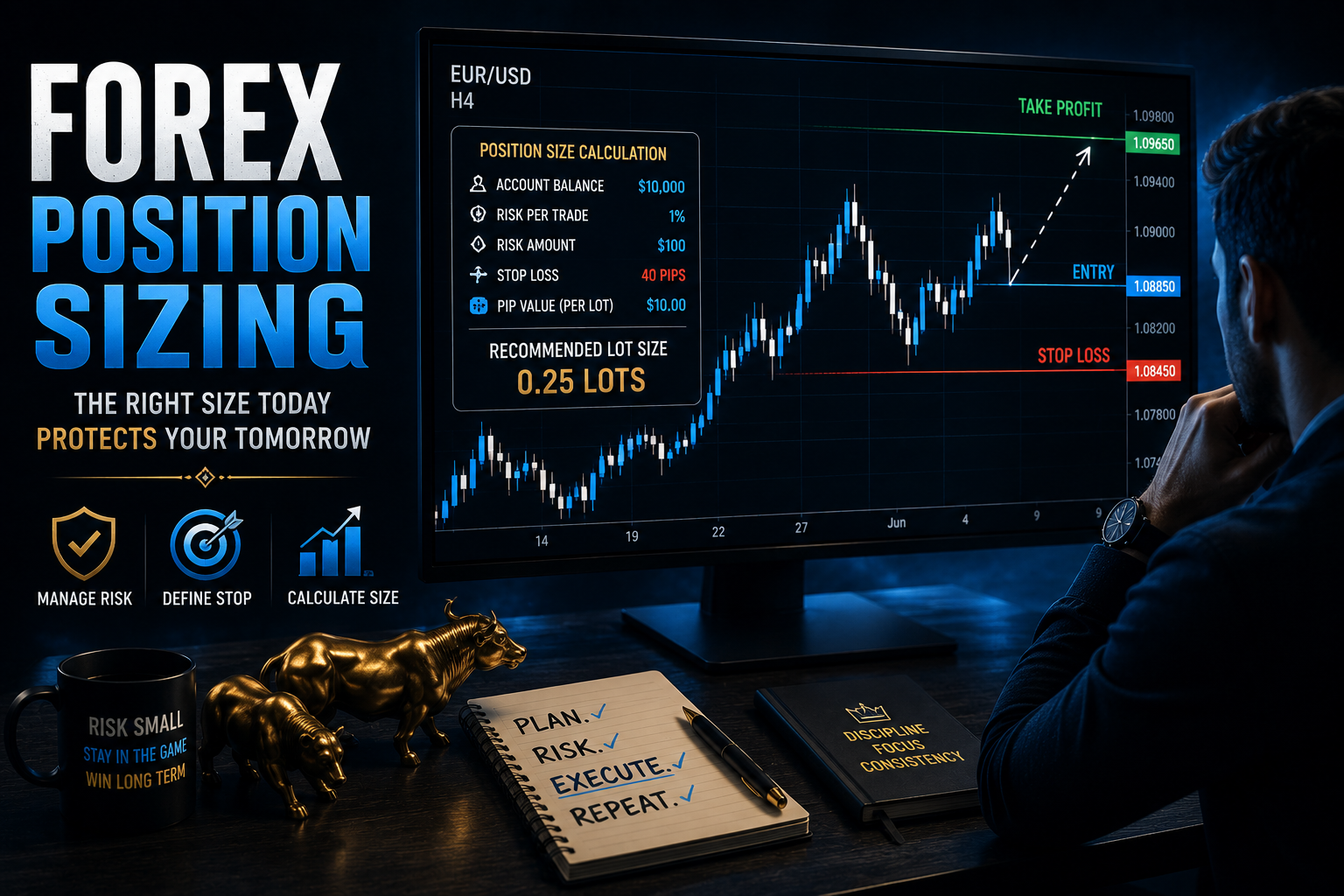
Forex Lot Size Calculation Example
Imagine you have a hypothetical Forex account with:
Account equity: $10,000
You decide that your trading plan allows you to risk:
1%
Your maximum planned risk is therefore:
$10,000 × 1% = $100
Now suppose your EUR/USD trade has a:
40-pip stop loss
For this simplified example, assume one standard lot of EUR/USD has an approximate pip value of:
$10 per pip
The calculation becomes:
Lot Size = $100 ÷ (40 × $10)
Lot Size = $100 ÷ $400
Lot Size = 0.25 lots
Under these simplified assumptions, 0.25 standard lots would represent approximately $100 of risk if the 40-pip stop were reached, before trading costs and assuming the pip value remains as estimated.
The important lesson is not the 0.25 lot figure.
The important lesson is that the position size was calculated from the risk.
Step 1: Determine Your Account Size
Start with your account balance or equity, depending on the rules in your trading plan.
For example:
Account equity = $5,000
If your plan uses a percentage-based risk model, the next step is to calculate the monetary amount corresponding to that percentage.
Your risk percentage should be determined before entering the trade.
There is no single risk percentage that is appropriate for every trader. Your experience, strategy, financial circumstances and tolerance for drawdown all matter.
Step 2: Decide Your Maximum Risk
Suppose your trading plan specifies a hypothetical maximum risk of 1%.
With a $5,000 account:
$5,000 × 1% = $50
Your planned risk is therefore:
$50
This means your position should be sized so that your intended stop-loss risk is approximately $50, subject to spreads, commissions, slippage and execution conditions.
The key is consistency.
Don’t increase your risk simply because you believe a particular setup is “too good to miss.”
Step 3: Determine Your Stop Loss
Your stop loss should be based on your trading strategy and market structure.
For example, you might place your stop beyond:
- A recent swing high
- A recent swing low
- Support
- Resistance
- A supply or demand zone
- A breakout invalidation level
- Another technical level defined by your strategy
The mistake is to choose the stop based on the lot size you want.
For example:
Wrong approach:
“I want to trade 1 lot, so I’ll use a 10-pip stop.”
Better approach:
“The market structure requires a 40-pip stop, so I’ll calculate the appropriate position size for my predefined risk.”
Your analysis determines where the trade is invalid.
Your position size adapts to that distance.
Step 4: Calculate the Stop-Loss Distance
Suppose your EUR/USD trade has:
Entry: 1.0850
Stop loss: 1.0810
The difference is:
40 pips
That 40-pip distance becomes part of your position-sizing calculation.
Now imagine another setup requires an 80-pip stop.
If your maximum monetary risk remains unchanged, the position size generally needs to be smaller.
This is one of the most important concepts in Forex risk management:
A wider stop does not automatically mean you should risk more money.
It generally means you need a smaller position.
Step 5: Understand Pip Value
A pip is a standard measurement of price movement in Forex.
For many non-JPY currency pairs, a pip is generally represented by the fourth decimal place.
For example:
EUR/USD: 1.0850 → 1.0851
This represents one pip.
For many JPY pairs, the pip is generally represented by the second decimal place.
For example:
USD/JPY: 150.20 → 150.21
Again, that represents one pip.
However, pip value is not identical across every currency pair.
It depends on factors including the currency pair, position size, exchange rate and account currency.
That is why traders should verify the actual contract specifications and pip value for the instrument they are trading.
Want to Calculate Your Forex Position Size Automatically?
Calculating your Forex position size manually is useful because it helps you understand exactly how risk, stop-loss distance and lot size are connected.
But you don’t always have to do the mathematics manually before every trade.
Risk Manager EA (RMEA)
If you want to simplify the process, Risk Manager EA (RMEA) was developed to help traders manage position sizing and risk directly from their trading platform.
RMEA can automate risk calculations and help you control your desired risk per trade, trade volume and exposure. It supports both real-time market orders and pending orders, while also providing features for stop-loss and take-profit management and multi-target trading.
Instead of manually calculating your desired position size every time, RMEA is designed to help handle the calculation and volume-control process for you.
The key point is this: a tool like RMEA doesn’t replace your trading analysis. You still decide what to trade, where to enter, where your stop loss belongs and how much risk you’re willing to accept. The tool helps with the execution and calculation side of position sizing.
[Learn More About Risk Manager EA (RMEA)]
Standard, Mini and Micro Forex Lots
Forex brokers commonly express position size using lots.
A standard lot is commonly:
100,000 units
A mini lot is commonly:
10,000 units
A micro lot is commonly:
1,000 units
For a simplified USD-denominated EUR/USD example, a standard lot is often approximately $10 per pip, while 0.10 lots is approximately $1 per pip.
But these figures should be treated as examples rather than universal values.
For pairs where the quote currency differs from your account currency, the pip value may need to be converted.
Always check your broker’s specifications before placing a trade.
How Stop-Loss Distance Changes Your Lot Size
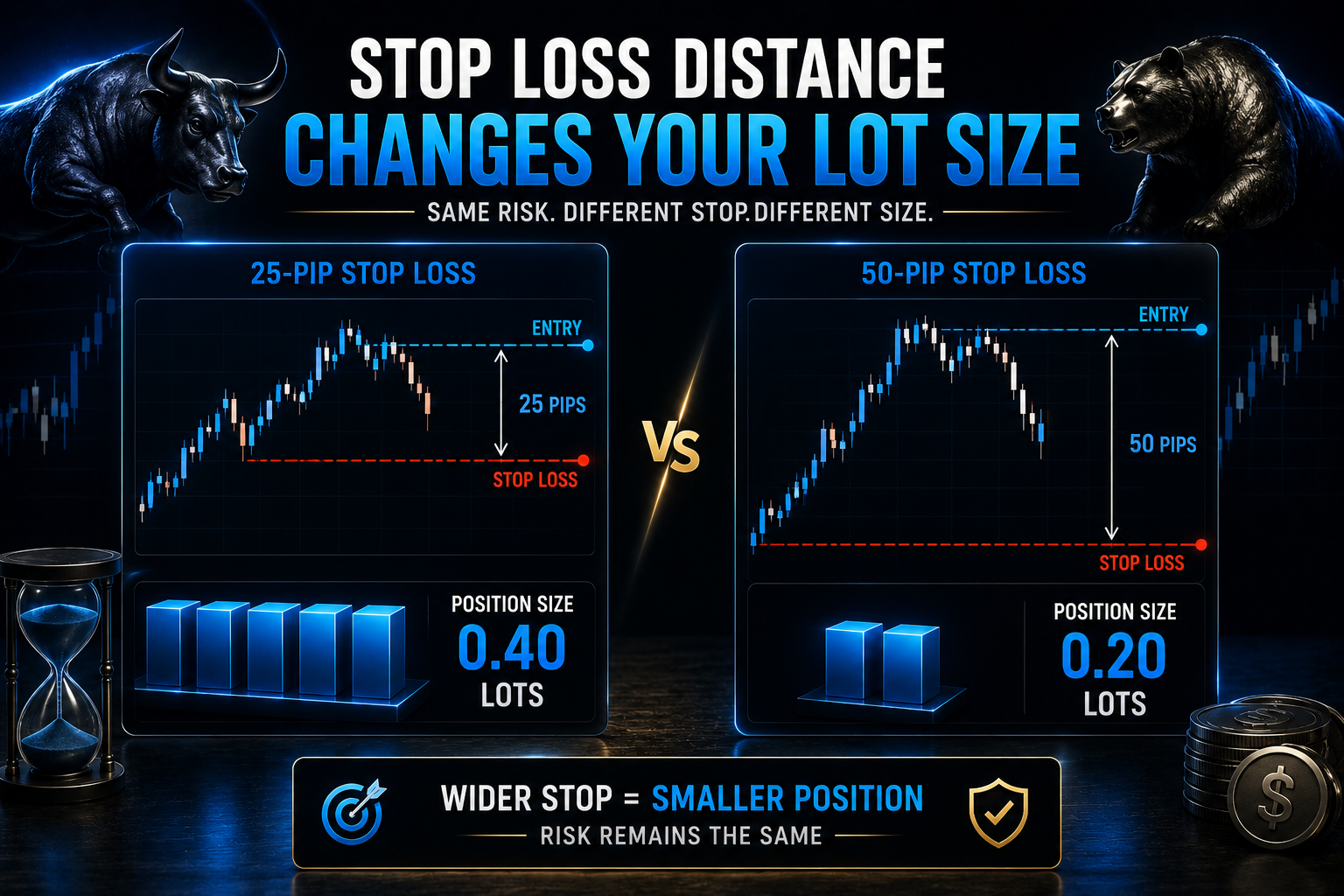
Let’s use a $10,000 account and a hypothetical $100 maximum risk.
Assume the pip value is approximately $10 per standard lot.
Trade A: 25-Pip Stop
Risk per standard lot:
25 × $10 = $250
Position size:
$100 ÷ $250 = 0.40 lots
Trade B: 50-Pip Stop
Risk per standard lot:
50 × $10 = $500
Position size:
$100 ÷ $500 = 0.20 lots
Notice what happened.
The stop doubled from 25 pips to 50 pips.
The position size was reduced from 0.40 to 0.20 lots.
The planned monetary risk remained approximately the same.
This is the foundation of risk-based position sizing.
Position Sizing vs. Leverage
Another common misunderstanding is believing that leverage determines how much you should trade.
It doesn’t.
Leverage determines how much market exposure you can control relative to the capital required as margin.
Your position size should instead be determined by factors such as:
Risk amount + stop-loss distance + pip value
High leverage can make it possible to open a much larger position, but that does not mean you should.
Leverage magnifies both potential gains and losses, which is why traders should understand their exposure before opening a leveraged Forex position.
Common Forex Position Sizing Mistakes
1. Choosing the Lot Size First
“I’ll trade 0.50 lots because this setup looks strong.”
This is not risk-based position sizing.
Your confidence should not determine your exposure.
2. Using the Same Lot Size on Every Trade
A fixed lot size does not guarantee fixed risk.
Different stop distances and pip values can create very different potential losses.
3. Making the Stop Loss Smaller to Trade More Lots
Never move a technically valid stop closer simply because you want a larger position.
The stop should reflect your trading strategy.
The position size should adapt to the stop.
4. Increasing Risk After a Losing Trade
Trying to recover a loss by increasing your next position can quickly turn a normal losing streak into a major drawdown.
Your risk rules should remain consistent even after a losing trade.
5. Ignoring Trading Costs
Your theoretical calculation does not necessarily equal your final realized result.
Spreads, commissions, swaps and slippage can affect the outcome. The bid-ask spread itself is an inherent transaction cost in Forex trading.
6. Ignoring Total Exposure
If you already have several positions involving USD, opening another USD-related trade can increase your overall exposure even if the new trade looks acceptable by itself.
Position sizing should therefore be considered at both the individual trade level and portfolio level.
A Simple Forex Position Sizing Checklist
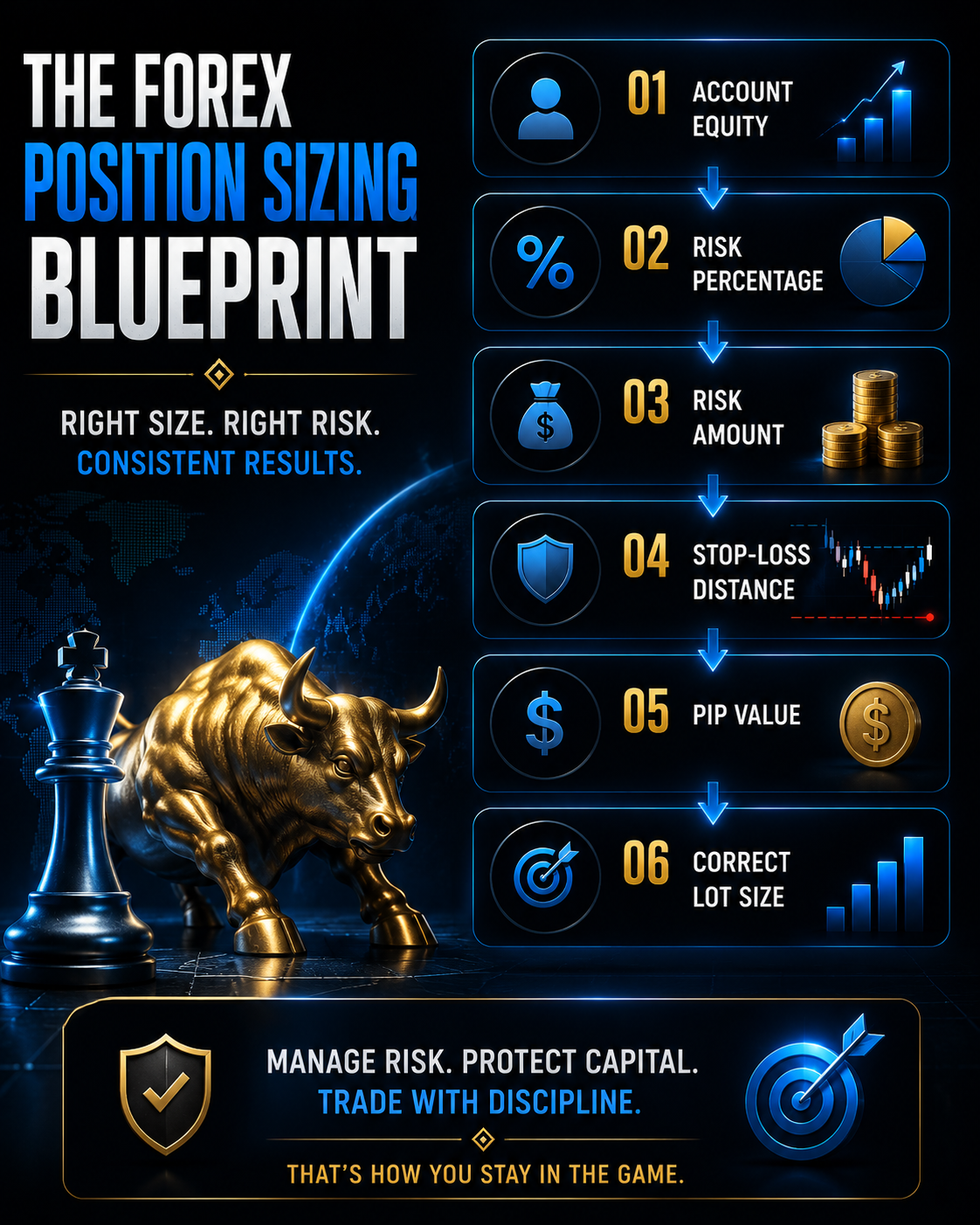
Before entering a trade, ask:
1. What is my account equity?
2. How much am I prepared to risk?
3. Where does my trading setup become invalid?
4. How many pips away is my stop loss?
5. What is the correct pip value?
6. What position size does the calculation produce?
7. Does that volume comply with my broker’s specifications?
8. Have I considered spread, commission and possible slippage?
9. What is my total exposure across all open trades?
If you cannot answer these questions, you probably need to complete your risk calculation before placing the trade.
Position Sizing and Trading Psychology
Position sizing isn’t only about mathematics.
It can also have a major effect on your psychology.
When a position is too large, every small price movement can feel important.
You may start:
- Moving your stop
- Closing trades too early
- Adding to losing positions
- Watching every tick
- Making revenge trades
When your position size is appropriate for your trading plan, it can become easier to accept that losing trades are part of the process.
You already know the planned risk before entering.
That creates structure.
Final Thoughts on Forex Position Sizing
The right lot size is not the largest position your broker allows.
It is the position size that fits your risk-management plan.
The process is straightforward:
1. Determine your account equity.
2. Decide your predefined risk.
3. Identify the technical stop-loss level.
4. Calculate the stop distance in pips.
5. Determine the correct pip value.
6. Calculate the position size.
The basic formula is:
Lot Size = Risk Amount ÷ (Stop-Loss Pips × Pip Value per Lot)
Once you understand this process, you no longer need to guess how many lots to trade.
You can build your position size around your risk.
And that is the key idea to remember:
Don’t choose your risk based on your lot size. Choose your lot size based on your risk.
Forex trading involves significant risk, particularly when leverage is used, so capital preservation should always be part of your trading plan.
Trade smart. Manage your risk. Protect your capital.
To Your Trading Success,
Vladimir Ribakov
Internationally Certified Financial Technician
Home Trader Club
Educational Disclaimer
This article is provided for educational and informational purposes only and does not constitute financial, investment or trading advice. Forex, CFDs and other leveraged financial products involve substantial risk and may not be suitable for every trader. Past performance does not guarantee future results. Always understand the risks associated with trading and verify the specifications, costs and trading conditions of your broker before placing a trade.