


Forex traders constantly monitor economic reports to understand the health of an economy and anticipate potential changes in currency values.
Some economic indicators provide information about what has already happened. Others offer an earlier indication of how economic conditions may be developing.
One particularly important indicator in this category is the Purchasing Managers’ Index (PMI).
PMI reports are closely watched by economists, investors and Forex traders because they provide timely information about business activity across manufacturing and services sectors.
Unlike Gross Domestic Product (GDP), which is generally released quarterly, PMI surveys are published monthly. This gives market participants an opportunity to assess changing economic conditions before official GDP figures become available.
But what exactly does PMI measure? Why is the 50-point level so important? And how can business surveys influence currency movements?
In this article, we will explain how the Purchasing Managers’ Index works, why it matters in Forex fundamental analysis and how traders can interpret PMI releases to better understand potential changes in economic conditions.
- 1 1. What Is PMI (Purchasing Managers’ Index)?
- 2 2. What Does a PMI Reading Above or Below 50 Mean?
- 3 3. Why Is PMI Considered a Leading Economic Indicator?
- 4 4. Manufacturing PMI vs Services PMI: What Is the Difference?
- 5 5. What Is Composite PMI?
- 6 6. How Does PMI Affect Forex Markets?
- 7 7. Why Does the Difference Between Actual PMI and Forecast Matter?
- 8 8. What Is Flash PMI vs Final PMI?
- 9 9. Which PMI Reports Should Forex Traders Monitor?
- 10 10. Why Can Strong PMI Data Sometimes Weaken a Currency?
- 11 11. How Should Forex Traders Use PMI in Fundamental Analysis?
- 12 12. Common Mistakes When Using PMI in Forex
- 13 Conclusion
1. What Is PMI (Purchasing Managers’ Index)?
The Purchasing Managers’ Index is an economic indicator based on monthly surveys of businesses.
These surveys collect information from purchasing managers and other business executives about changes in business activity compared with the previous month.
Depending on the survey, questions cover areas such as:
- Business output and production.
- New orders.
- Employment.
- Purchasing activity.
- Supplier delivery times.
- Inventories.
- Input costs and selling prices.
The objective is to understand whether business conditions are improving, deteriorating or remaining relatively unchanged.
Purchasing managers are particularly useful survey participants because they often have direct knowledge of business demand, production requirements, inventory levels and supply-chain conditions.
Their responses provide an early picture of what is happening within companies.
The information is then converted into an index that helps analysts evaluate the direction of economic activity.
For Forex traders, PMI is important because changes in business conditions can influence expectations about economic growth, inflation and future monetary policy.
These expectations can eventually affect currency demand.
2. What Does a PMI Reading Above or Below 50 Mean?
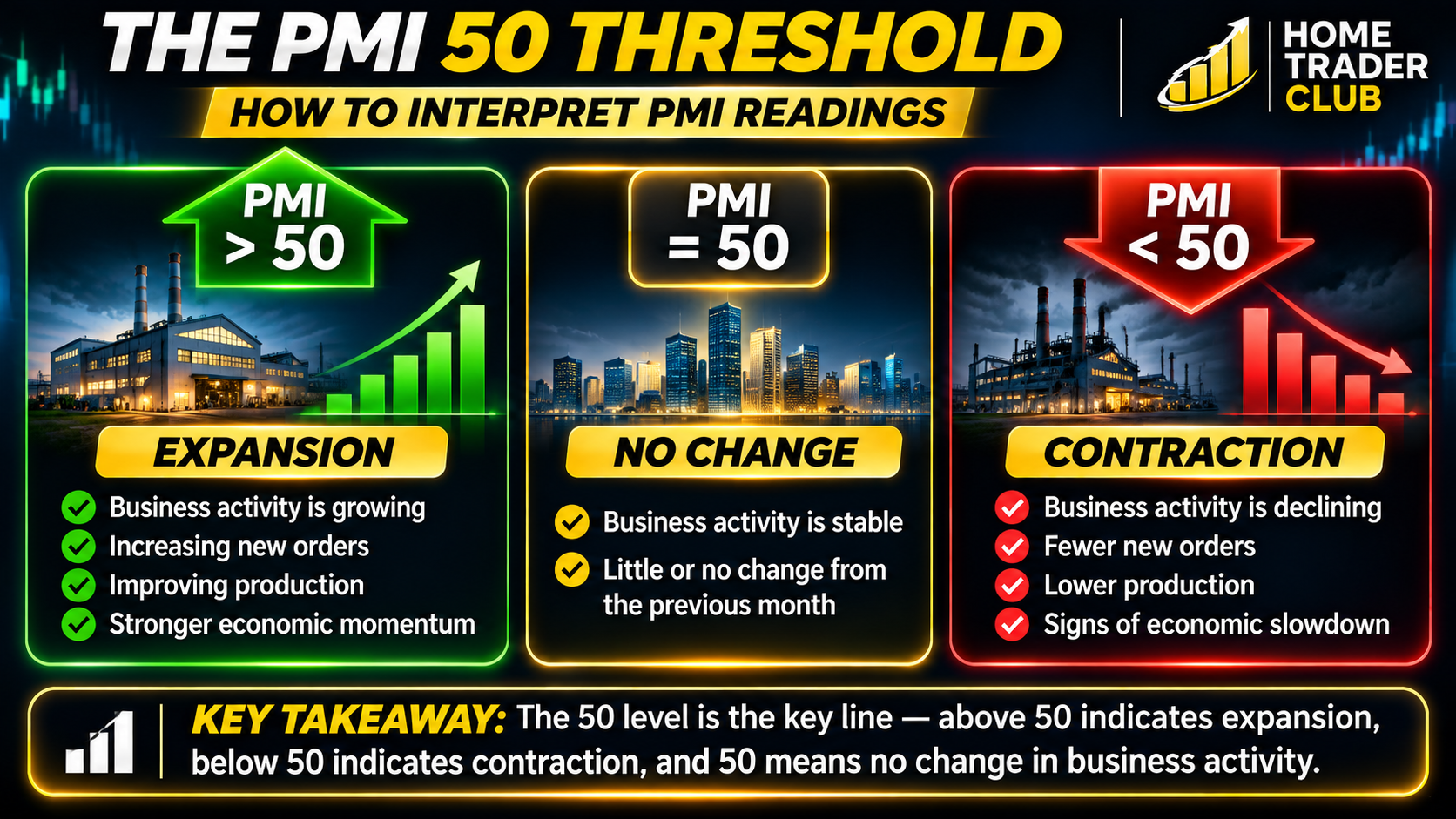
One of the most important things to understand when interpreting PMI is the 50-point threshold.
A PMI reading of 50 generally represents no change in the measured business activity compared with the previous month.
The interpretation is straightforward.
PMI Above 50: Business Expansion
When PMI rises above 50, it indicates that the measured business conditions are generally improving compared with the previous month.
For example, a reading of 55 suggests that business activity is expanding.
A stronger reading may indicate:
- Increasing business demand.
- Improving production conditions.
- Higher new orders.
- Greater business activity.
- Potentially stronger economic momentum.
For Forex traders, this may provide a positive signal about the economy.
However, a reading above 50 does not automatically mean that a currency will strengthen. The market also considers expectations, inflation, monetary policy and conditions in other economies.
PMI Below 50: Business Contraction
When PMI falls below 50, it generally indicates that the measured business conditions are deteriorating compared with the previous month.
For example, a reading of 45 suggests that more businesses are reporting deterioration than improvement under the survey’s calculation method.
This may indicate:
- Weakening business demand.
- Declining new orders.
- Reduced production activity.
- Deteriorating business conditions.
- Potentially slower economic growth.
Such developments may create concerns about the economy and influence expectations about future monetary policy.
PMI at 50: No Change
A reading of exactly 50 generally indicates that the measured activity has remained unchanged compared with the previous month.
It is important to remember that the PMI threshold measures the direction of change, not the absolute size of an economy.
A reading below 50 does not automatically mean that the entire economy is shrinking. It indicates deterioration in the surveyed activity compared with the previous month.
3. Why Is PMI Considered a Leading Economic Indicator?
One of the main reasons Forex traders monitor PMI is its ability to provide early information about changing economic conditions.
Traditional economic indicators such as GDP provide important information, but they generally describe activity over a period that has already passed.
GDP is commonly published quarterly, and initial figures may subsequently be revised.
PMI surveys, on the other hand, are conducted monthly and provide information about business conditions much earlier.
This creates several advantages.
A. Earlier Information About Economic Activity
PMI can reveal changes in business demand, production and employment before comparable official statistics become available.
For example, a sustained deterioration in new orders may indicate that businesses are experiencing weaker demand.
Companies may subsequently adjust production, purchasing and employment decisions.
These changes can eventually appear in broader economic statistics.
B. Identifying Economic Turning Points
PMI can help identify changes in economic momentum.
A prolonged period of declining readings may suggest that economic activity is losing strength.
Similarly, improving readings may indicate that business conditions are recovering.
This information can help analysts recognize possible turning points earlier than they might using quarterly economic data alone.
C. Monitoring Business Expectations
PMI surveys provide information about what companies are experiencing and, in some surveys, their expectations about future business conditions.
Changes in orders, employment and purchasing activity can offer clues about the direction in which businesses believe conditions are developing.
However, PMI should be treated as an early economic signal rather than a guaranteed prediction of future GDP or currency movements.
4. Manufacturing PMI vs Services PMI: What Is the Difference?

PMI reports are not limited to one part of the economy.
Two particularly important categories are Manufacturing PMI and Services PMI.
Understanding the difference is essential because different sectors can experience very different economic conditions.
Manufacturing PMI
Manufacturing PMI measures business conditions in the manufacturing sector.
It provides information about activities related to the production of goods.
Important components may include:
- New manufacturing orders.
- Production levels.
- Employment.
- Purchasing activity.
- Supplier delivery times.
- Inventories.
A rising manufacturing PMI may indicate improving industrial activity and stronger demand for manufactured products.
A declining reading may suggest weaker demand, lower production requirements or increasing pressure on manufacturing businesses.
Manufacturing activity is also influenced by international trade, commodity prices and global supply chains.
For this reason, manufacturing PMI can provide useful information about broader economic conditions.
Services PMI
Services PMI measures business conditions across service-based industries.
These may include areas such as:
- Financial services.
- Transportation.
- Hospitality.
- Information technology.
- Professional services.
- Other business and consumer services.
In many developed economies, services represent a substantial part of economic activity.
This means that services PMI can provide particularly useful information about the overall health of the economy.
A strong services reading may indicate improving business activity and demand across service industries.
A weak reading may suggest that companies are experiencing slower activity or deteriorating business conditions.
Which Is More Important for Forex Traders?
Neither manufacturing PMI nor services PMI should automatically be considered more important in every situation.
Their relevance depends on the structure of the economy and the information contained in each report.
In economies where services represent a larger share of economic output, services PMI can provide particularly important information.
Manufacturing PMI may receive greater attention when industrial activity, international trade or global supply chains are major concerns.
Traders should examine both reports rather than relying on one headline number.
5. What Is Composite PMI?
Some economic reports also provide a Composite PMI.
Composite PMI combines information from manufacturing and services sectors to provide a broader picture of private-sector business conditions.
The calculation generally weights the sector indices according to their contribution to the economy.
This makes Composite PMI particularly useful when traders want to understand the overall direction of business activity rather than focusing on one individual sector.
For example, manufacturing conditions may deteriorate while services activity continues to expand.
Looking at manufacturing PMI alone could therefore provide an incomplete picture of the broader economy.
Composite PMI helps bring these different developments together.
Forex traders can use it alongside the individual sector readings to understand whether economic momentum is strengthening or weakening across the wider business environment.
6. How Does PMI Affect Forex Markets?

PMI can influence Forex markets because it provides information about economic growth, business activity and potential changes in monetary policy expectations.
However, currency markets do not react to economic data in isolation.
They react to how new information changes expectations.
There are several important ways PMI can influence currency prices.
A. Economic Growth Expectations
Stronger PMI readings may suggest that businesses are experiencing improving conditions.
This can increase expectations of stronger economic growth.
If investors believe an economy is becoming relatively stronger, confidence in its currency may improve.
On the other hand, weaker PMI readings may raise concerns about slowing economic activity.
This can reduce investor confidence and potentially create downward pressure on the currency.
B. Interest Rate Expectations
PMI can also influence expectations about future central bank decisions.
Central banks monitor economic conditions when deciding whether monetary policy needs to become tighter, remain unchanged or become more accommodative.
A strong PMI reading may suggest that economic activity remains resilient.
If this is accompanied by persistent inflationary pressure, market participants may reassess expectations about future interest rates.
A weak PMI reading may have the opposite effect if it suggests that economic momentum is deteriorating.
This is particularly important because changes in interest rate expectations can influence international capital flows and currency demand.
C. Inflation Expectations
Some PMI surveys include information about input costs and selling prices.
These components can provide clues about price pressures within businesses.
If companies report increasing input costs, this may indicate that inflationary pressures are building.
Businesses may eventually pass some of these higher costs to customers through increased selling prices.
However, higher input costs do not always translate into higher consumer inflation.
The extent to which businesses can pass on costs depends on demand, competition and pricing power.
Forex traders therefore examine price-related PMI components alongside other inflation indicators.
D. Investor Confidence
Strong business surveys can improve confidence in an economy’s outlook.
If companies report stronger orders, improving activity and healthier business conditions, investors may become more optimistic about future economic performance.
Weak surveys may create the opposite reaction.
These changes in confidence can influence investment decisions and currency demand.
7. Why Does the Difference Between Actual PMI and Forecast Matter?
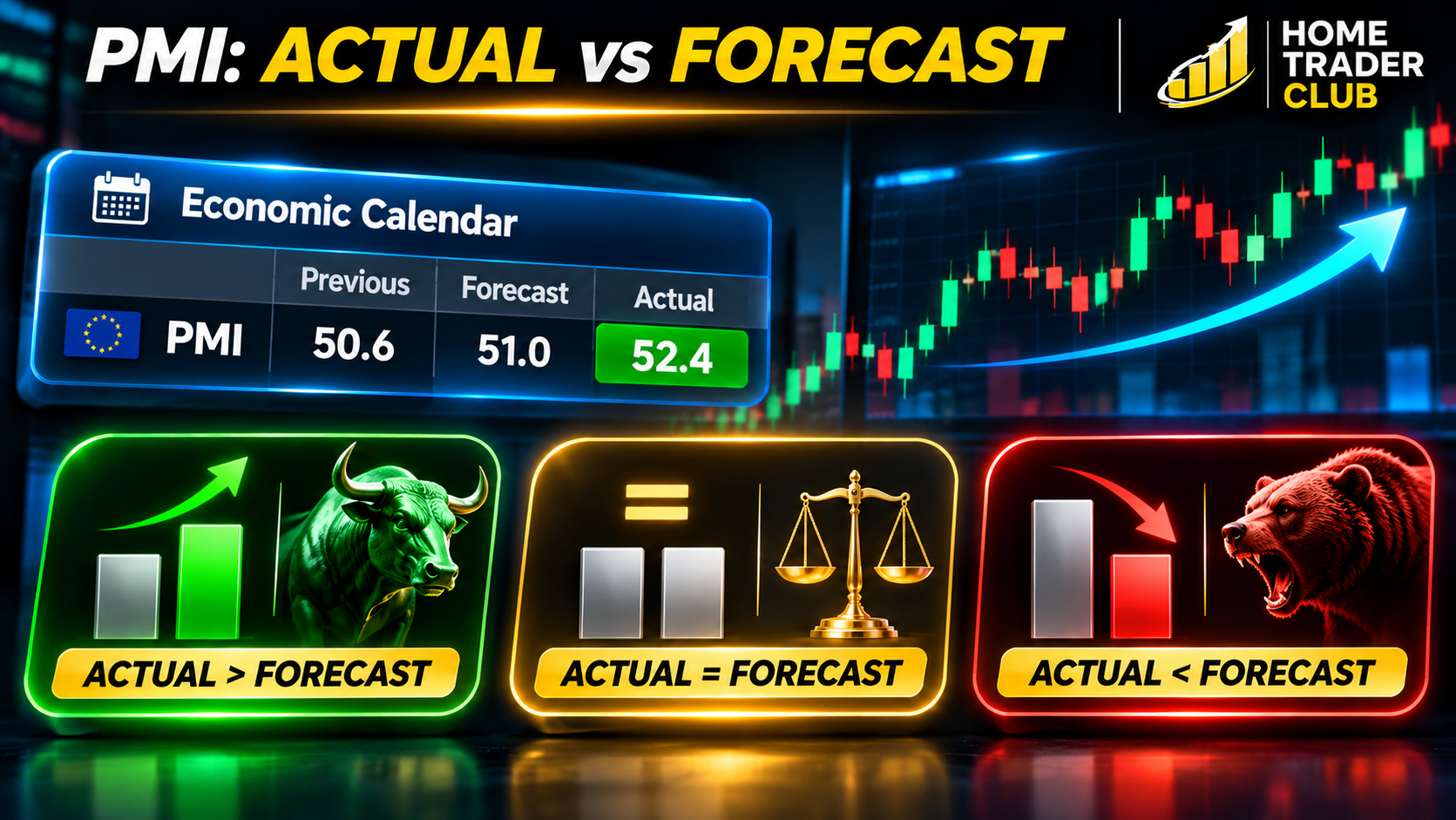
One of the most important concepts in fundamental Forex analysis is the difference between actual economic data and market expectations.
Currencies often react not simply to whether an economic figure is strong or weak, but to whether it is better or worse than anticipated.
Before a PMI report is released, economists and analysts publish forecasts based on available information.
Traders and investors form expectations around these estimates.
When the actual reading becomes available, the market compares it with the forecast.
There are three possible situations.
A. PMI Better Than Expected
When the actual PMI reading is higher than the forecast, it represents a positive surprise.
This may suggest that business conditions are stronger than market participants anticipated.
Depending on the wider economic environment, this can improve growth expectations and potentially support the currency.
B. PMI Worse Than Expected
When the actual PMI reading is lower than the forecast, it represents a negative surprise.
This may indicate that economic activity is weaker than expected.
Market participants may reassess growth expectations and future monetary policy.
Depending on the circumstances, this can create pressure on the currency.
C. PMI Matches Expectations
When the actual reading is close to the forecast, the market may have already priced in much of the information.
The reaction can therefore be more limited.
However, other details within the report may still attract attention.
For example, the headline PMI may match expectations while new orders, employment or price-related components show unexpected changes.
This is why traders should examine the full report rather than focusing exclusively on the headline number.
8. What Is Flash PMI vs Final PMI?
Another important distinction is the difference between Flash PMI and Final PMI.
Understanding this difference can help Forex traders follow economic releases more effectively.
Flash PMI
Flash PMI is an early estimate of the monthly PMI reading.
It is generally released before the final report and provides an initial indication of business conditions.
Because it is available earlier, Flash PMI can influence market expectations before the final figures are published.
For some major economies, Flash PMI estimates are released approximately one week before the final data.
The exact timing and methodology depend on the survey provider and country.
Final PMI
Final PMI is the subsequent published reading based on a more complete set of survey responses.
It provides the finalized result for that reporting period.
The final figure may differ from the earlier Flash PMI estimate.
Why Should Forex Traders Monitor Both?
Flash PMI can be important because it provides an early signal about economic conditions.
Final PMI is also useful because it confirms or adjusts the initial estimate.
If the final reading differs significantly from the Flash PMI, market participants may reassess their interpretation of the economic outlook.
Traders should therefore pay attention to both releases when they are available.
9. Which PMI Reports Should Forex Traders Monitor?
PMI data are published across many major economies.
However, traders should prioritize the reports that are most relevant to the currencies and economies they follow.
Important reports include:
United States PMI: Provides information about business conditions across the world’s largest economy. Both manufacturing and services reports are closely monitored.
Eurozone PMI: Offers insight into business conditions across the common currency area, as well as individual member economies.
United Kingdom PMI: Provides information about manufacturing and services activity in the British economy.
Japan PMI: Helps traders monitor business conditions in one of the world’s major economies.
China PMI: Provides information about business activity in an important global manufacturing and trading economy.
Traders should also understand that different organizations publish PMI surveys.
The methodology, sector coverage and composition of individual indices may vary.
This is why it is important to identify which survey is being released rather than assuming that every PMI report is calculated in exactly the same way.
10. Why Can Strong PMI Data Sometimes Weaken a Currency?
This is an important concept because economic data and currency movements do not always have a straightforward relationship.
A stronger PMI reading may appear positive for an economy, but the currency can still weaken after the announcement.
There are several possible explanations.
A. The Market Expected an Even Stronger Reading
Suppose investors were expecting a particularly strong PMI report.
If the actual figure is positive but falls short of expectations, the market may interpret the release as disappointing.
The currency can weaken despite the reading remaining above 50.
B. Interest Rate Expectations May Not Change
A strong PMI reading does not automatically mean that the central bank will raise interest rates.
If inflation is falling and policymakers remain comfortable with existing monetary conditions, the report may have limited influence on rate expectations.
The currency reaction may therefore be smaller than traders anticipate.
C. Other Economic Indicators May Be Weak
PMI is only one part of the economic picture.
Other reports may show declining employment, weak consumer spending or deteriorating inflation conditions.
Market participants may consider these developments more important than the latest PMI reading.
D. The Report May Contain Mixed Signals
The headline PMI may show expansion while important components indicate weakness.
For example, business activity may be improving while new orders are slowing.
This could suggest that current conditions are relatively healthy but future demand may be weakening.
The market may focus on these underlying details rather than the headline figure.
E. The Information May Already Be Priced In
Currency markets are forward-looking.
If traders have already positioned themselves for a strong PMI report, the release may not create additional buying interest.
In some circumstances, the currency may even move in the opposite direction as traders close existing positions.
This is why understanding expectations is just as important as understanding the economic data itself.
11. How Should Forex Traders Use PMI in Fundamental Analysis?
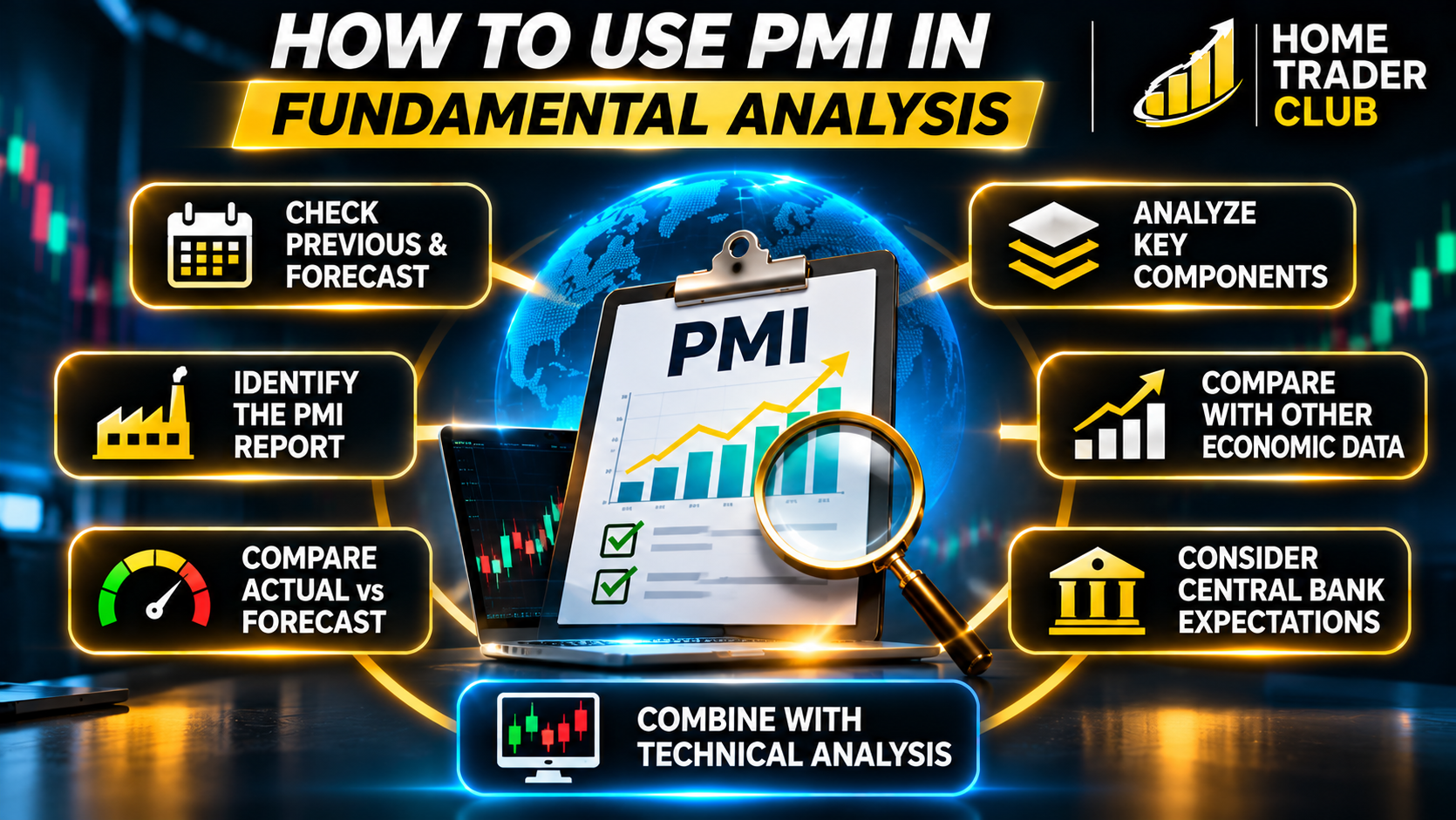
PMI should not be treated as a standalone trading signal.
Instead, it should be combined with other economic information to build a broader understanding of market conditions.
Here is a practical framework.
Step 1: Check the Previous Reading and Forecast
Before the release, understand the previous PMI figure and the market’s current forecast.
This establishes the expectations against which the actual result will be evaluated.
Step 2: Identify the Type of PMI Report
Determine whether the release covers manufacturing, services or the composite economy.
Also identify whether it is a Flash or Final report.
Step 3: Compare the Actual Reading With Expectations
Examine whether the actual result is stronger or weaker than anticipated.
Do not assume that a reading above 50 automatically represents a positive market surprise.
Step 4: Examine the Individual Components
Look beyond the headline figure.
New orders, output, employment, supplier deliveries and price-related components can provide additional information about economic conditions.
Step 5: Compare PMI With Other Economic Indicators
Evaluate whether PMI is consistent with GDP, employment, retail sales, inflation and consumer confidence data.
A collection of indicators generally provides a more complete economic picture than one report.
Step 6: Consider Central Bank Expectations
Ask whether the latest PMI information could change expectations about future monetary policy.
This is particularly important when the market is closely focused on interest rate decisions.
Step 7: Combine Fundamental and Technical Analysis
Fundamental analysis helps explain why market expectations may change.
Technical analysis helps traders evaluate price structure, market momentum and potential trading opportunities.
Combining both approaches can create a more disciplined decision-making process.
12. Common Mistakes When Using PMI in Forex
Although PMI is a useful economic indicator, traders can make several mistakes when interpreting its results.
Mistake 1: Assuming Above 50 Always Means Strong Economic Growth
A reading above 50 indicates that the measured business conditions are generally improving compared with the previous month.
It does not automatically mean that the economy is growing rapidly.
Mistake 2: Ignoring Market Expectations
A positive PMI reading can still disappoint the market if it is weaker than expected.
Always compare the actual result with the forecast.
Mistake 3: Focusing Only on Manufacturing PMI
Manufacturing is only one part of the economy.
Services activity can provide important information, particularly in economies where the services sector represents a substantial share of economic output.
Mistake 4: Ignoring the Sub-Indices
The headline number does not tell the entire story.
New orders, employment, output and price-related components can provide additional insight into the direction of business conditions.
Mistake 5: Treating PMI as a Guaranteed Currency Prediction
PMI is an economic indicator, not a currency forecasting tool.
It can influence market expectations, but exchange rates are also affected by interest rates, capital flows, inflation, global risk sentiment and other developments.
Mistake 6: Ignoring Differences Between Survey Providers
Different PMI surveys may use different methodologies, samples and sector coverage.
Traders should understand which report they are analyzing before comparing readings.
Conclusion
The Purchasing Managers’ Index is one of the most useful indicators for understanding changes in business activity and economic momentum.
Because PMI surveys are published monthly, they can provide valuable information about economic conditions before quarterly GDP figures become available.
By monitoring manufacturing, services and composite PMI readings, Forex traders can gain a better understanding of whether business activity is expanding or contracting.
More importantly, PMI can influence expectations about economic growth, inflation and future central bank decisions.
However, a strong or weak PMI reading does not automatically determine the direction of a currency.
The actual market reaction depends on expectations, the details within the report, broader economic conditions and how the new information changes investor expectations.
The key is to look beyond the headline number.
Successful fundamental analysis involves understanding what economic indicators measure, how they relate to one another and what they reveal about the broader market environment.
When combined with other economic reports, technical analysis and disciplined risk management, PMI can become a valuable part of a Forex trader’s fundamental analysis framework.
To Your Trading Success,
Vladimir Ribakov
Internationally Certified Financial Technician (CFTe)
Home Trader Club
Risk Disclaimer
Forex and CFD trading involve significant risk and may not be suitable for every investor. Leverage can amplify both profits and losses, and traders may lose some or all of their invested capital. Economic indicators such as PMI provide information about historical and current business conditions but cannot predict future currency movements or guarantee trading results. The information in this article is provided for educational purposes only and should not be considered financial or investment advice. Always assess your financial circumstances and risk tolerance before trading.