



Forex trading is not simply about finding the right entry. You can have a well-designed trading strategy, strong technical analysis and a good understanding of the market, yet still suffer serious losses if your risk is not controlled.
That is why Forex risk management should be treated as a core part of your trading strategy—not something added after you find a trade.
The purpose of risk management is not to prevent every losing trade. Losing trades are an unavoidable part of trading. The goal is to make sure that individual losses, losing streaks and periods of difficult market conditions do not cause unnecessary damage to your trading account.
This becomes especially important when trading leveraged Forex and CFDs. Regulators such as the FCA warn that leverage can magnify losses and that leveraged rolling spot Forex and CFDs are high-risk products for retail clients.
Here are the essential Forex risk-management rules every trader should understand.
- 1 Join the Home Trader Club
- 2 What Is Forex Risk Management?
- 3 1. Define Your Risk Before Entering a Trade
- 4 2. Use Position Sizing to Control Your Risk
- 5 3. Let the Market Determine Your Stop Loss
- 6 4. Never Risk More Because You Feel Confident
- 7 5. Understand the Effect of Leverage
- 8 6. Always Consider Your Total Exposure
- 9 7. Don’t Try to Recover Losses With a Larger Trade
- 10 8. Protect Yourself From Losing Streaks
- 11 9. Don’t Move Your Stop Loss to Avoid a Loss
- 12 10. Use Risk-to-Reward as Part of Your Planning
- 13 11. Set a Maximum Daily Loss
- 14 12. Reduce Risk When Conditions Change
- 15 A Simple Forex Risk Management Checklist
- 16 Final Thoughts on Forex Risk Management
 Join the Home Trader Club
Want to access the tools, systems, and real-time education we use daily?
With AvaTrade Broker’s support, you can now enjoy up to one full year of access to the Home Trader Club — including:
-
All professional trading systems
-
Access to our new project, the Home Trader Club trade copier, where our traders trade and you can copy.
-
Real-time trade ideas and setups
-
Full access to our course library and trading marketplace
 Join here: https://tracking.avapartner.com/dR0AAA
What Is Forex Risk Management?

Forex risk management is the process of controlling how much capital you expose to potential loss when trading currency pairs.
It includes decisions such as:
- How much to risk on each trade
- Where to place your stop loss
- How to calculate your position size
- How much total exposure to maintain
- How to use leverage responsibly
- How to handle losing streaks
- When to stop trading
- How to protect your account from excessive drawdown
A simple way to think about it is:
Your trading strategy identifies opportunities. Risk management determines how much you can afford to lose while pursuing them.
1. Define Your Risk Before Entering a Trade
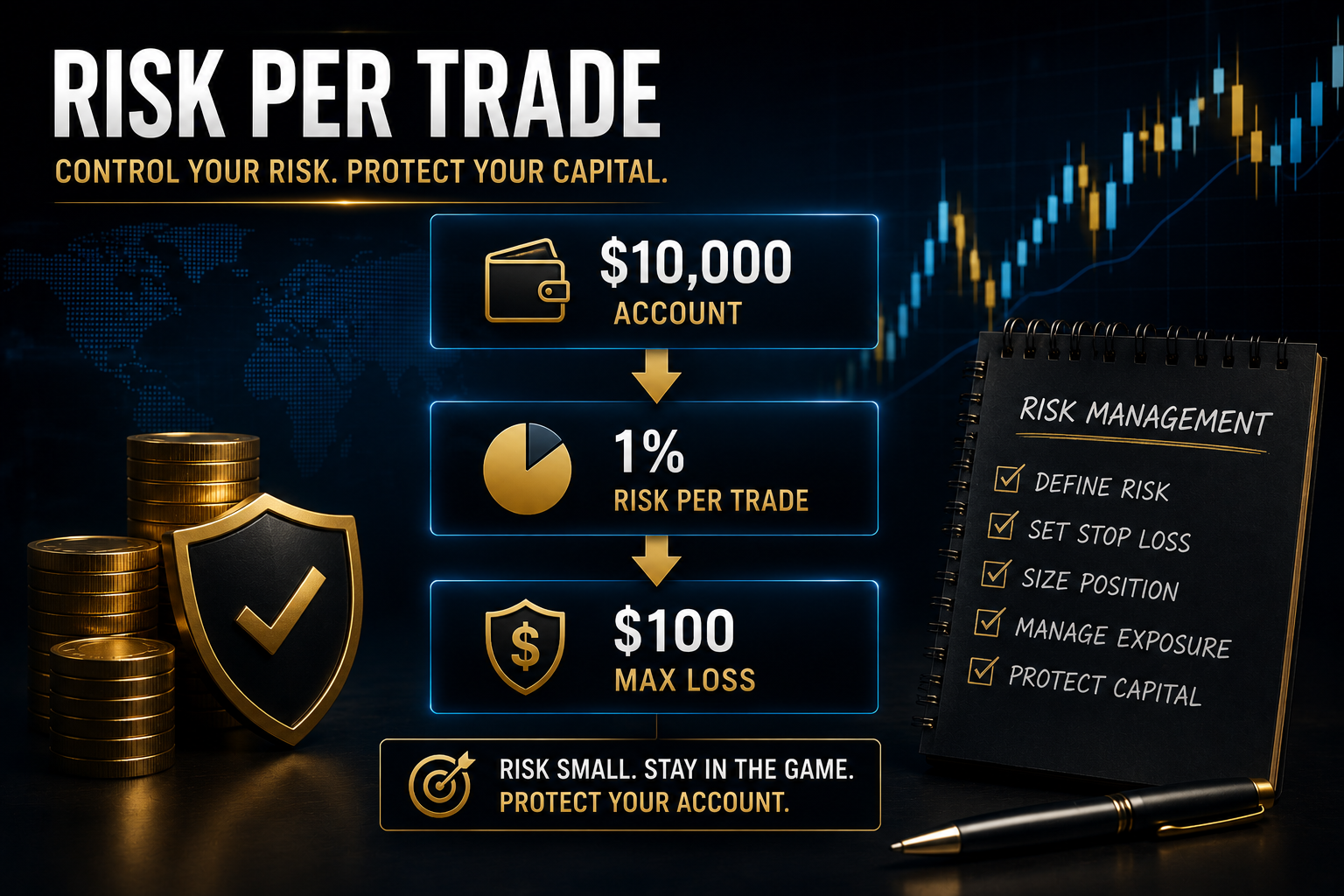
One of the most important Forex risk-management rules is to know your maximum acceptable loss before you enter the market.
For example, imagine a hypothetical account of $10,000 and a trading plan that allows a maximum risk of 1% per trade.
The calculation is:
$10,000 × 1% = $100
So the planned risk is $100.
This does not mean that 1% is the correct risk level for every trader. Your risk percentage should depend on your strategy, experience, account structure and personal circumstances.
The important principle is consistency.
Do not decide to risk more simply because a particular setup looks exceptionally attractive.
2. Use Position Sizing to Control Your Risk
Your lot size should be a consequence of your risk calculation—not an emotional decision.
Before entering a trade, you should know:
How much am I willing to lose?
Then determine:
Where does my trade idea become invalid?
Once you know the stop-loss distance, you can calculate the appropriate position size.
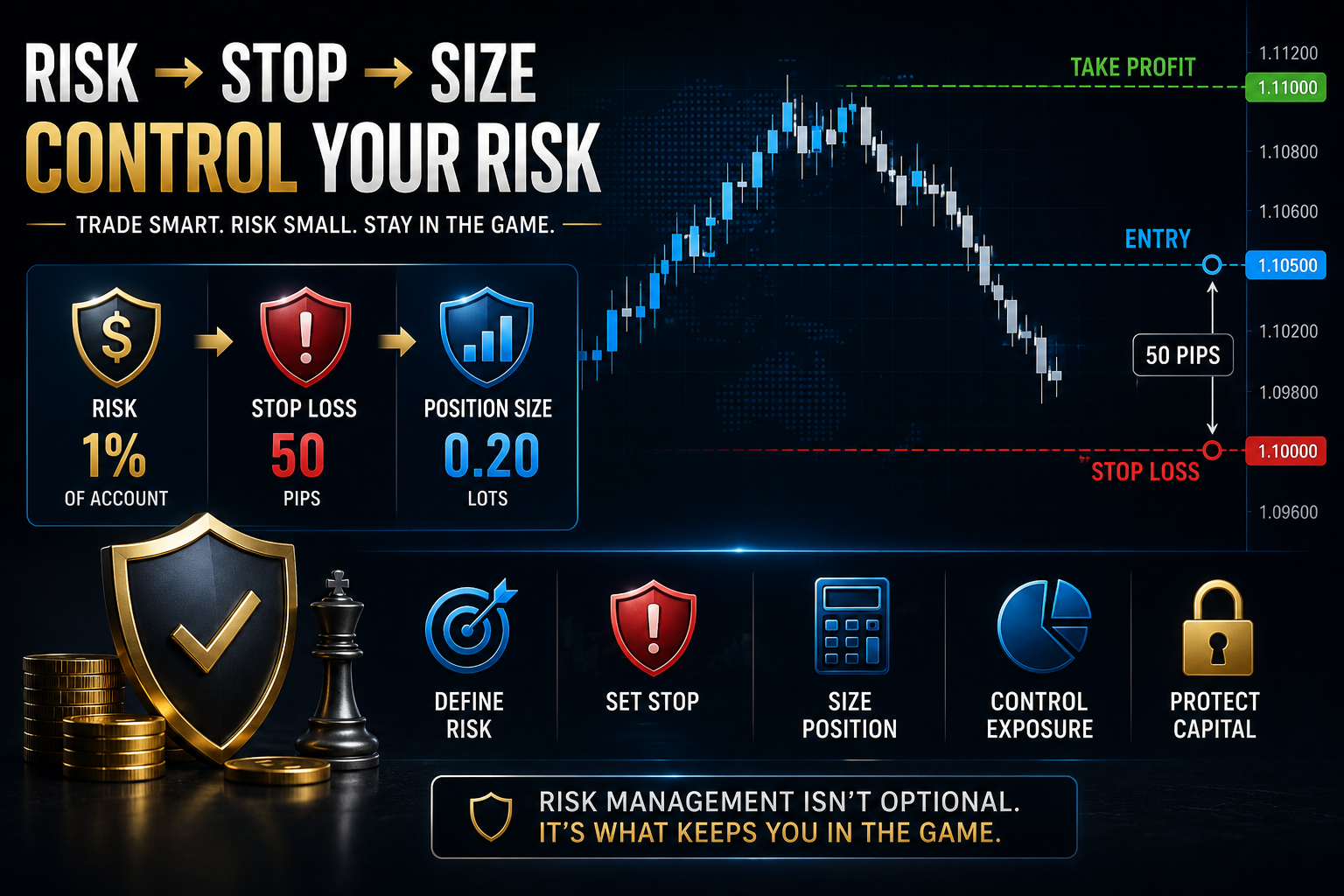
For example, suppose:
- Account size: $10,000
- Planned risk: $100
- EUR/USD stop loss: 50 pips
- Approximate pip value: $10 per pip for one standard lot
A 50-pip stop on one standard lot would represent approximately:
50 × $10 = $500
To limit the planned risk to $100:
$100 ÷ $500 = 0.20 lots
So the theoretical position size is 0.20 lots, before considering spread, commission and slippage.
This is why the same lot size should not automatically be used on every trade. A wider stop generally requires a smaller position if your monetary risk remains unchanged.
For a deeper explanation, see our related guide: Forex Position Sizing: How to Calculate the Right Lot Size for Every Trade.
3. Let the Market Determine Your Stop Loss
A common mistake is choosing a stop loss based on the position size a trader wants.
For example:
“I want to trade 1 lot, so I’ll use a very tight stop.”
That is the wrong order of thinking.
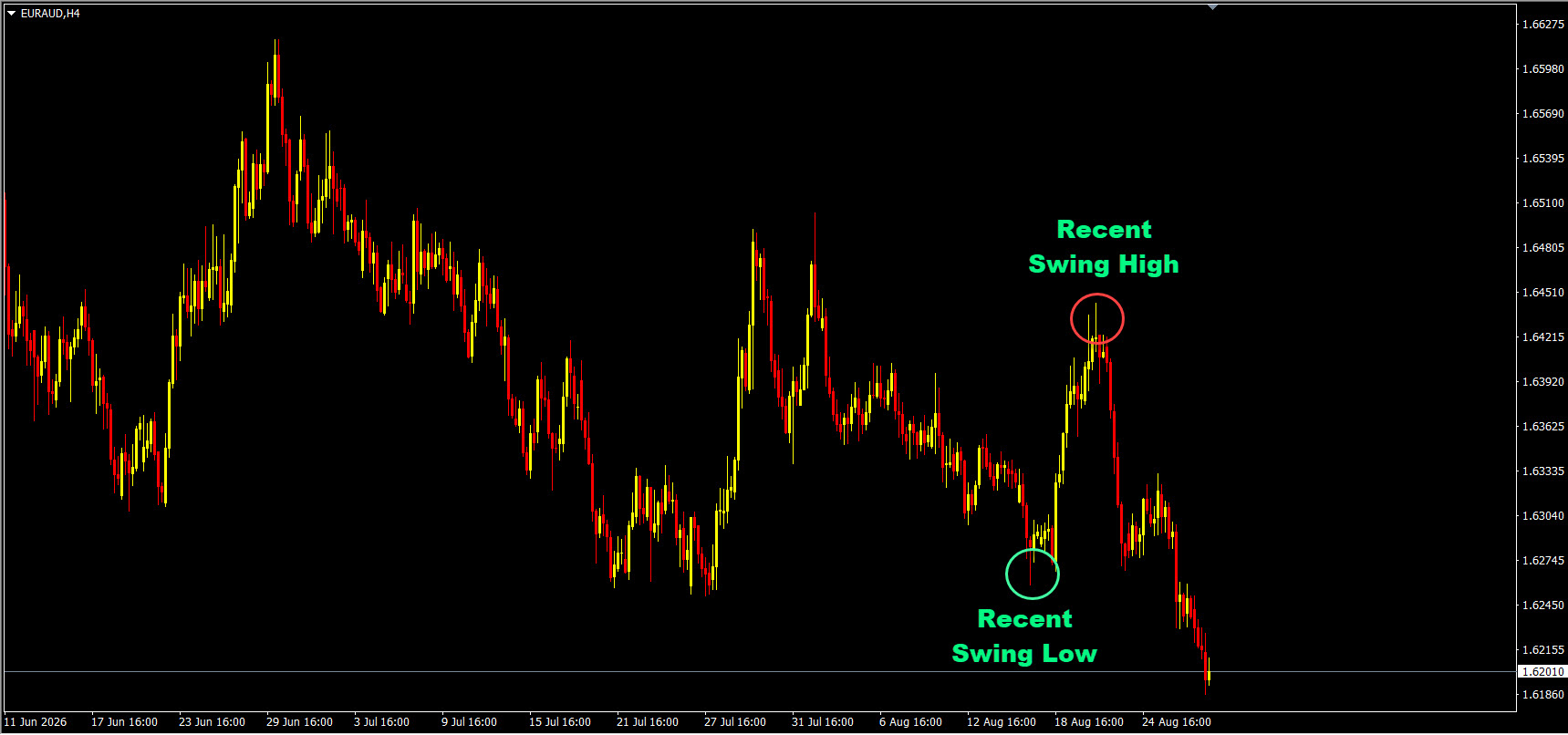
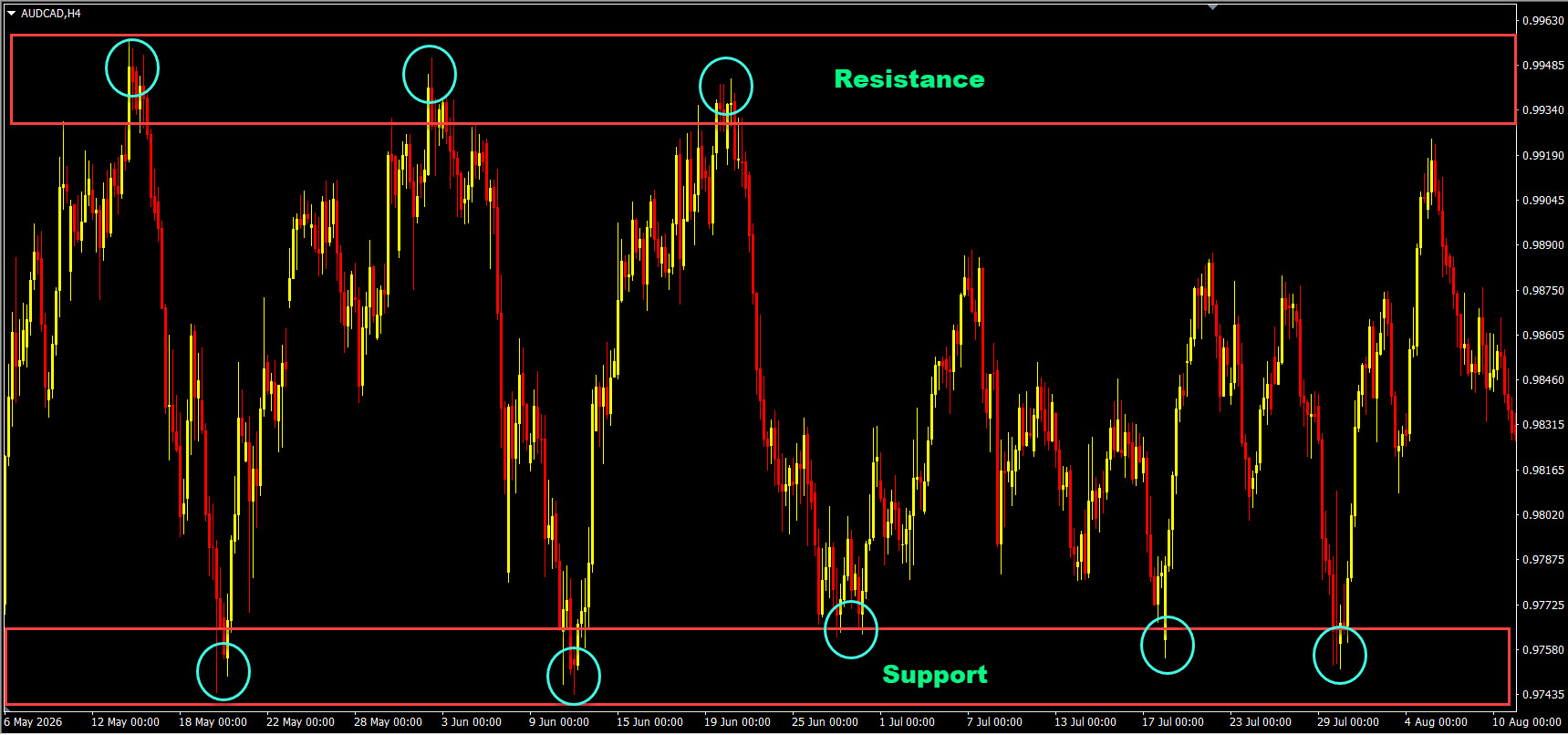
Your stop loss should be based on the technical structure of the trade.
Depending on your strategy, that could mean placing the stop beyond:
- A recent swing high or low
- Support or resistance
- A supply or demand zone
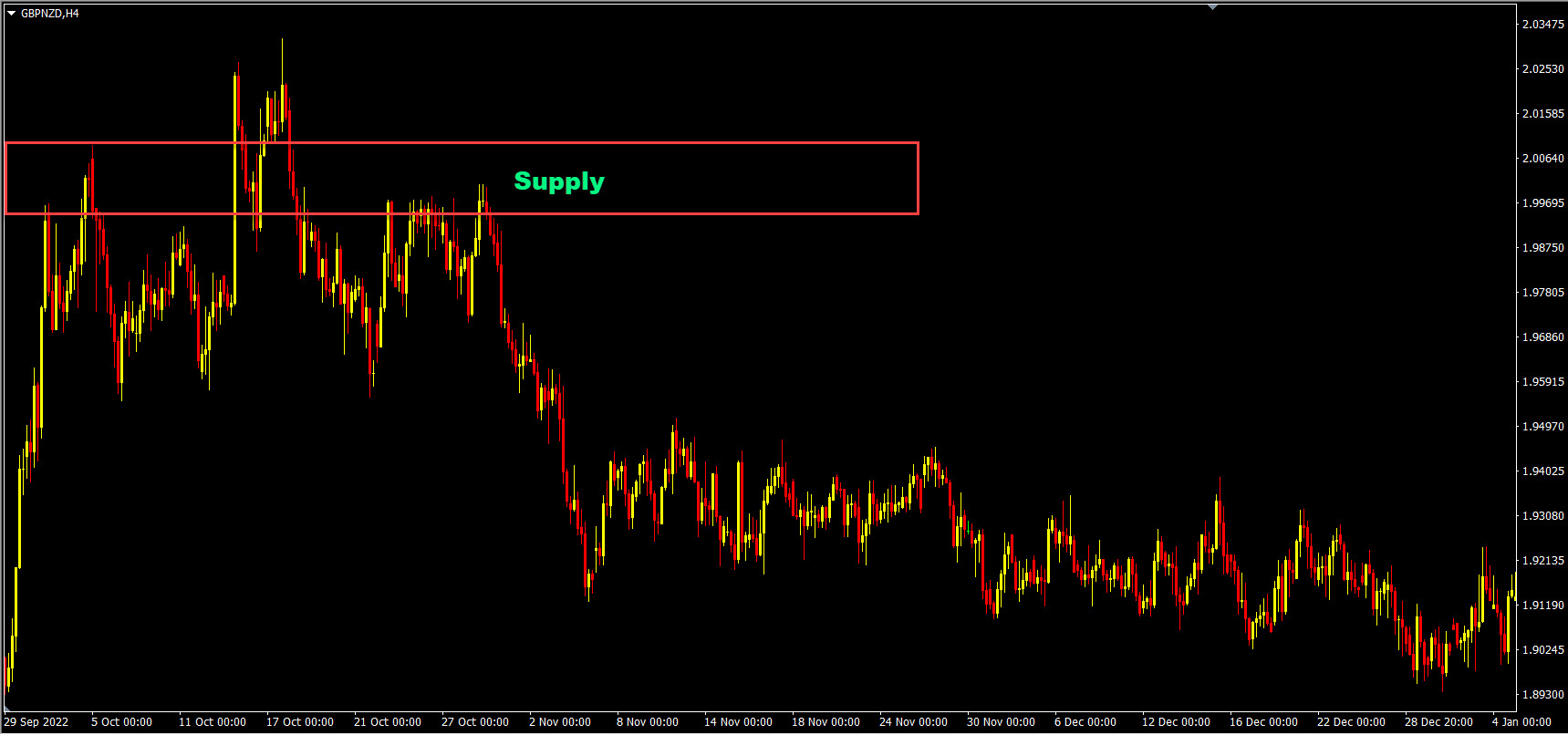
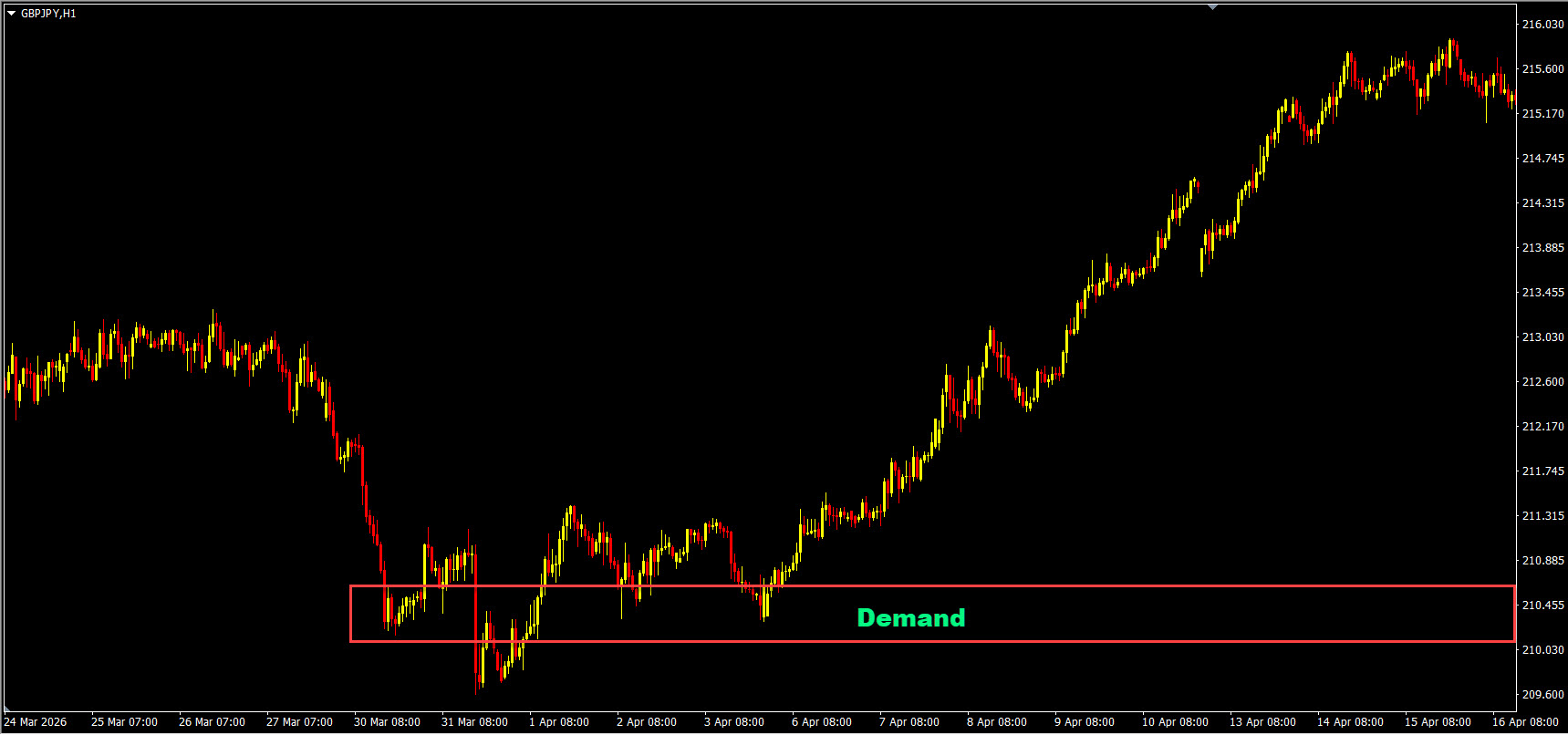
Once the stop is determined, adjust the position size to fit your predefined risk.
Market structure determines the stop. Risk management determines the position size.
4. Never Risk More Because You Feel Confident
Confidence is useful when executing a trading plan.
It is dangerous when it determines your position size.
Even an excellent-looking Forex setup can fail.
There is no entry that guarantees a winning trade, and increasing your risk because you believe a setup is unusually strong can create unnecessary drawdown.
A disciplined trader follows the same risk rules whether the setup feels ordinary or exceptional.
This is particularly important after a series of winning trades, when overconfidence can quietly lead to larger and larger positions.
5. Understand the Effect of Leverage
Leverage allows traders to control a larger market position with a smaller amount of capital or margin.
That can be useful, but it also increases the potential impact of price movements on your account.
The FCA specifically warns that leverage magnifies potential losses in CFDs and rolling spot Forex.
Therefore:
High available leverage does not mean high leverage should be used.
Your broker might allow a much larger position than your risk plan requires.
That does not mean the position is appropriate.
Think about leverage as a mechanism that provides market exposure—not as a reason to increase your risk.
6. Always Consider Your Total Exposure
Risk management should not stop at individual trades.
Imagine you have three open positions:
- Long EUR/USD
- Long GBP/USD
- Short USD/CHF
They are different currency pairs, but they can all create significant exposure to movements in the US dollar.
If the dollar makes a strong move, several positions could potentially be affected at the same time.
This means you should ask two questions:
How much am I risking on this trade?
and:
How much am I risking across all my open trades?
This becomes even more important when trading multiple correlated instruments.
7. Don’t Try to Recover Losses With a Larger Trade
One of the fastest ways to turn a normal losing period into a serious drawdown is revenge trading.
Imagine you lose $100.
You then decide:
“I’ll risk $200 on the next trade and make it back.”
If that trade loses too, the temptation can be to increase the position again.
The problem is that the trader is no longer following a risk-management system.
They are reacting emotionally to the previous result.
A losing trade should not determine the size of your next trade.
Every new trade should be evaluated independently according to your trading plan.
8. Protect Yourself From Losing Streaks
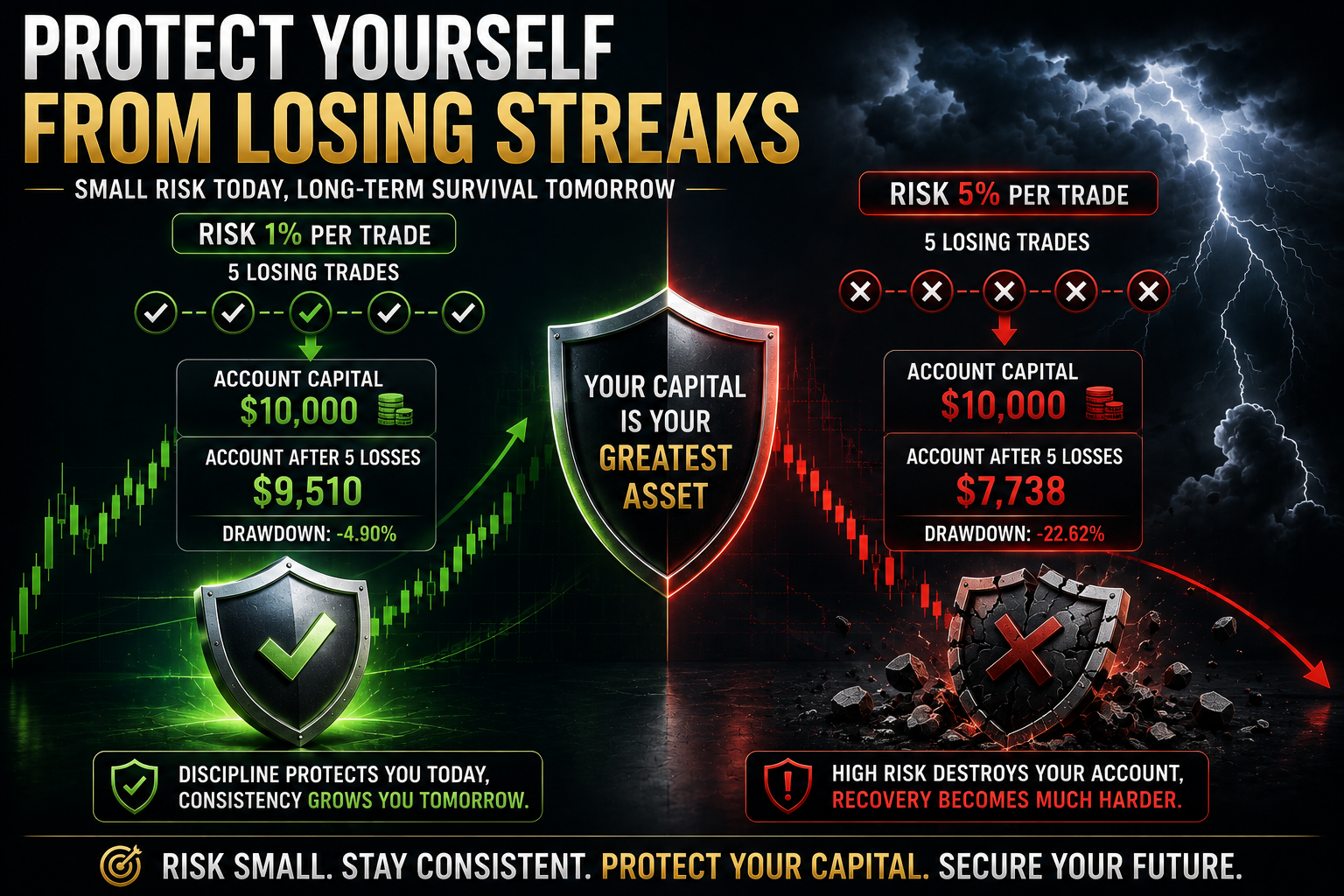
Even a profitable strategy can experience consecutive losses.
Let’s look at a simple mathematical example.
Suppose a trader starts with $10,000 and loses 1% of the current account value on five consecutive trades.
After the first loss:
$10,000 × 0.99 = $9,900
After five consecutive 1% losses, the account would be approximately:
$10,000 × 0.99⁵ = $9,510
The total decline would therefore be approximately 4.90%, assuming each loss is exactly 1% of the remaining balance.
Now compare that with risking 5% per trade:
$10,000 × 0.95⁵ ≈ $7,738
That is a decline of approximately 22.62% after five consecutive losses.
This demonstrates why position sizing matters.
The calculation does not predict how many losses you will experience. It simply illustrates how different risk levels can affect an account during a losing streak.
9. Don’t Move Your Stop Loss to Avoid a Loss
A stop loss exists because your original trade idea has a point of invalidation.
If price reaches that level, you should be prepared to accept the loss according to your trading plan.
Moving the stop farther away simply because you don’t want to take the loss can transform a controlled trade into an uncontrolled one.
There may be legitimate strategy-based reasons for managing a stop dynamically, but changing it purely because the position is losing is a very different thing.
Never let hope replace your original risk-management plan.
10. Use Risk-to-Reward as Part of Your Planning
Risk-to-reward compares what you are willing to risk with the potential reward of a trade.
For example:
Potential loss = $100
Potential profit = $200
That represents a 1:2 risk-to-reward ratio.
If the potential profit were $300 against the same $100 risk, the ratio would be 1:3.
However, a larger ratio does not automatically make a trade better.
A 1:5 target that is unrealistic for the market may be less useful than a realistic 1:2 setup.
The key is to combine risk-to-reward with:
- Market structure
- Probability
- Volatility
- Entry quality
- Stop-loss placement
- Your trading strategy
11. Set a Maximum Daily Loss
Your risk plan should not only define how much you can lose per trade.
It can also define when you stop trading for the day.
For example, if your trading plan establishes a maximum daily loss, reaching that limit means the trading session is finished.
This can prevent a trader from entering a series of emotional trades in an attempt to recover earlier losses.
The exact limit should be appropriate to your strategy and circumstances.
For prop firm traders, this becomes particularly important because firms can impose specific daily and overall drawdown rules.
12. Reduce Risk When Conditions Change
Forex markets do not behave identically every day.
Volatility can increase around:
- Central-bank decisions
- Interest-rate announcements
- Inflation releases
- Employment reports
- Major geopolitical developments
- Unexpected economic news
When volatility increases significantly, the same position size can produce much greater price fluctuations.
Some risk-management models therefore reduce exposure during unusually volatile conditions.
The principle is simple:
Don’t assume yesterday’s market conditions will continue tomorrow.
Your risk framework should account for the environment in which you are trading.
A Simple Forex Risk Management Checklist
Before placing a trade, ask yourself:
Risk
- How much am I risking?
- Is the risk within my predefined limit?
Stop Loss
- Where is my trade idea invalid?
- Is my stop based on market structure?
Position Size
- Have I calculated the correct lot size?
- Am I sizing the position based on risk rather than confidence?
Exposure
- How much risk do I already have open?
- Are my positions correlated?
Leverage
- Am I using more leverage than necessary?
Discipline
- Am I trying to recover a previous loss?
- Am I increasing risk because I feel unusually confident?
- Am I moving my stop because I don’t want to accept the loss?
If something doesn’t fit your plan, there is nothing wrong with skipping the trade.
Sometimes the best risk-management decision is not to participate.
Final Thoughts on Forex Risk Management
Good Forex trading is not simply about finding opportunities.
It is about managing uncertainty.
You will have losing trades.
You will experience periods when your strategy performs better and periods when it performs worse.
The traders who approach risk professionally understand that their first responsibility is to protect their ability to continue trading.
Remember the essential rules:
Define your risk before entering.
Calculate your position size.
Let market structure determine your stop.
Respect leverage.
Control total exposure.
Avoid revenge trading.
Protect yourself from losing streaks.
Respect your daily and overall drawdown limits.
Never allow one trade to damage your entire account.
Risk management will not guarantee profitable trading. Nothing can.
But it can help ensure that a losing trade remains a losing trade—not a catastrophic event.
The objective is not to win every trade.
The objective is to stay disciplined enough to remain in the game.
Trade smart. Manage your risk. Protect your capital.
To Your Trading Success,
Vladimir Ribakov
Internationally Certified Financial Technician
Home Trader Club
Educational Disclaimer
This article is provided for educational and informational purposes only and does not constitute financial, investment or trading advice. Forex, CFDs and other leveraged financial products involve substantial risk and may not be suitable for every trader. Past performance does not guarantee future results. Always understand the risks associated with trading and verify the specifications, costs and trading conditions of your broker before placing a trade.