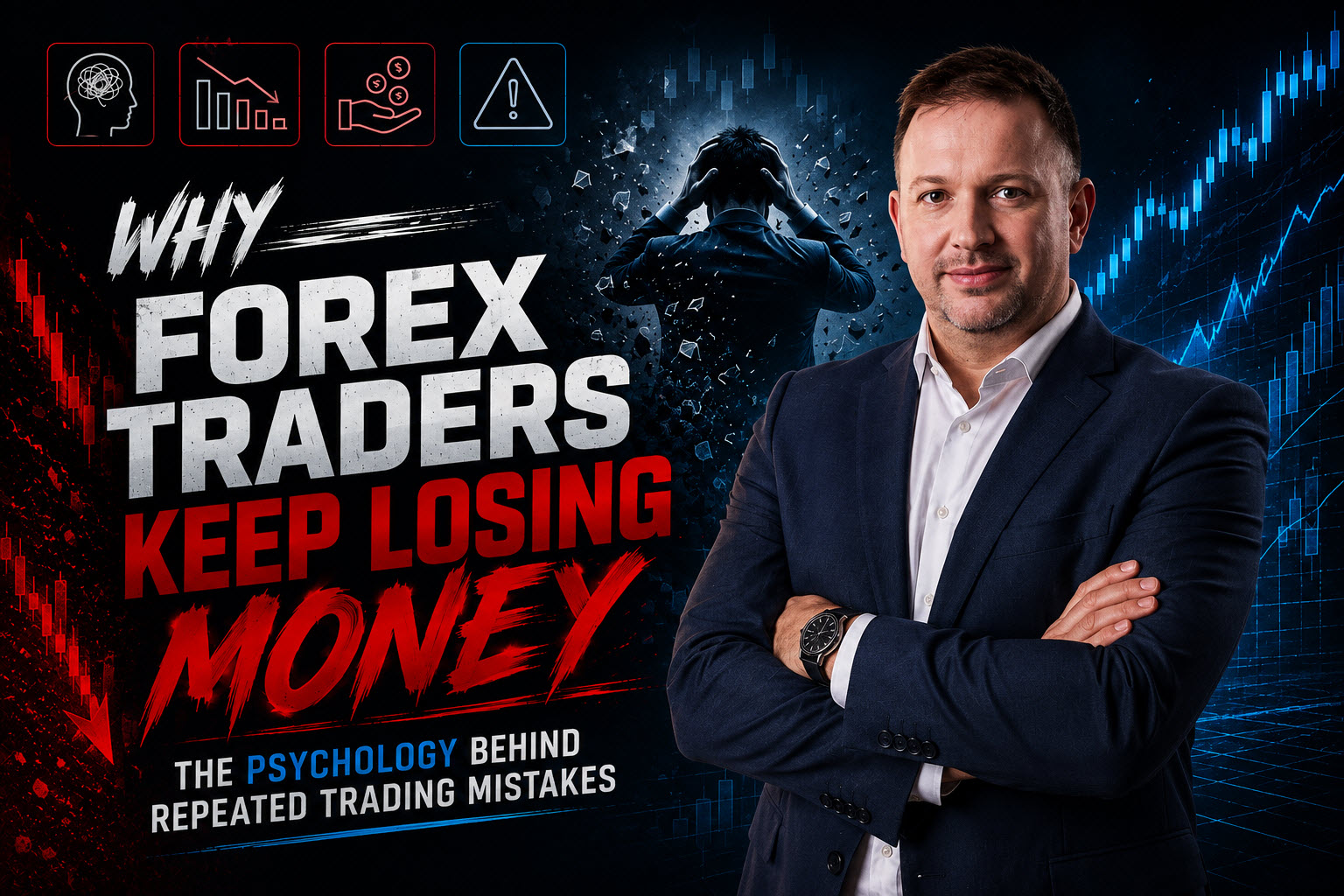



Many Forex traders spend years searching for the perfect strategy.
They study indicators, learn technical analysis, follow economic news, test trading systems and look for better entries. Yet despite having enough market knowledge to identify good setups, they continue to lose money.
Why?
In many cases, the problem isn’t the trading strategy. It is the trader’s behaviour.
Fear, greed, impatience, overconfidence and the inability to accept losses can cause traders to repeatedly break their own rules. A trader may know exactly what they should do but still make the opposite decision when real money is at risk.
This is why Forex trading psychology is such an important part of becoming a disciplined trader.
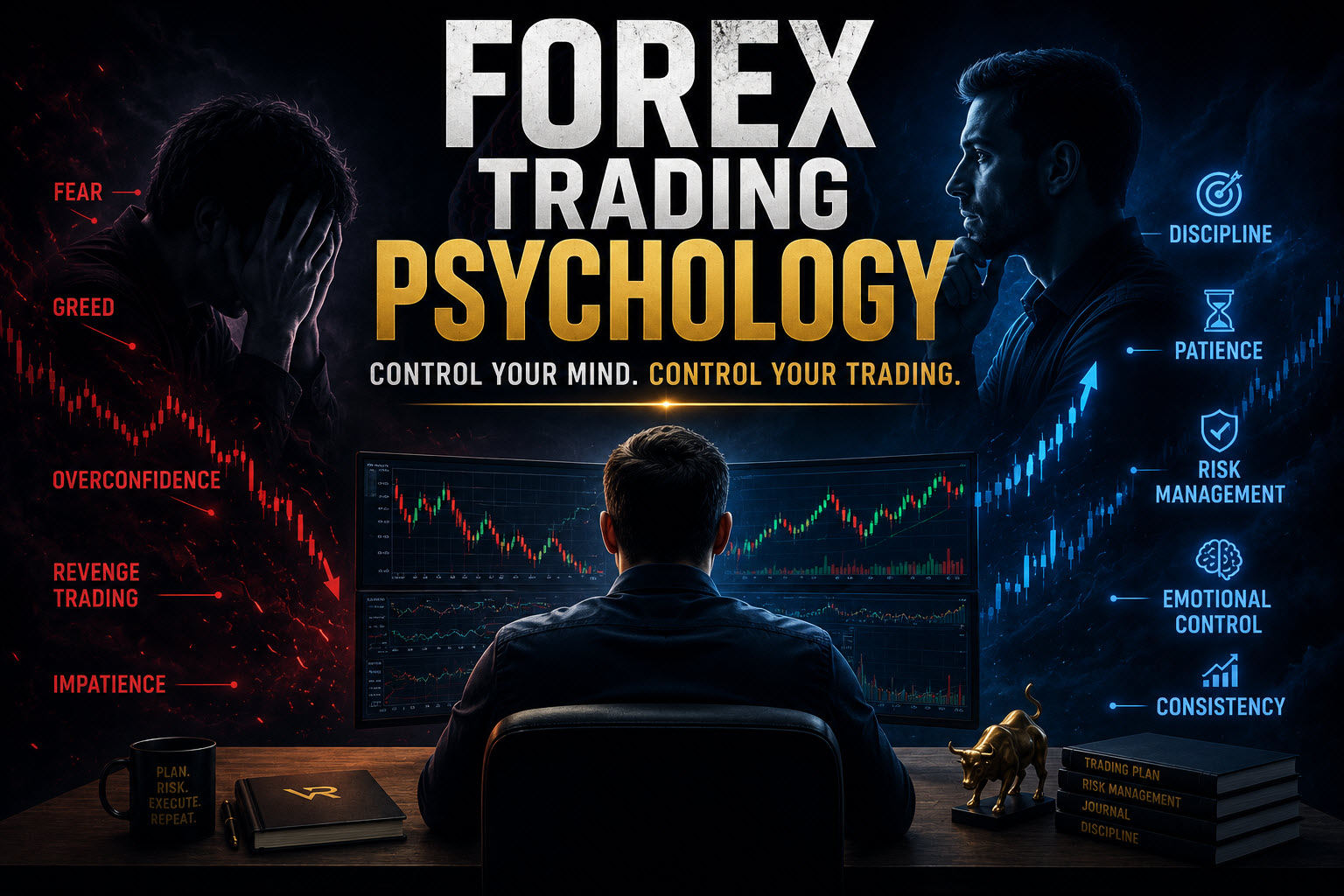
In this article, we’ll look at the psychological reasons Forex traders keep losing money and, more importantly, how you can begin breaking these destructive trading habits.
- 1 Join the Home Trader Club
- 2 Why Do Forex Traders Keep Losing Money?
- 3 1. Trying to Avoid Every Losing Trade
- 4 2. Moving the Stop Loss Because You Don’t Want to Be Wrong
- 5 3. Revenge Trading After a Loss
- 6 4. Overtrading After a Losing Trade
- 7 5. Increasing Risk After a Winning Streak
- 8 6. FOMO: Entering Because You Think You’re Missing the Move
- 9 7. Trading With Money You Cannot Afford to Lose
- 10 8. Changing Strategies Every Time You Lose
- 11 9. Focusing Too Much on Individual Trades
- 12 10. Not Keeping a Trading Journal
- 13 How to Break the Cycle of Repeated Trading Mistakes
- 14 A Simple Psychological Rule for Forex Traders
- 15 The Goal Is Not to Become Emotionless
- 16 Final Thoughts: Control Your Behaviour Before Trying to Control the Market
 Join the Home Trader Club
Want to access the tools, systems, and real-time education we use daily?
With AvaTrade Broker’s support, you can now enjoy up to one full year of access to the Home Trader Club — including:
-
All professional trading systems
-
Access to our new project, the Home Trader Club trade copier, where our traders trade and you can copy.
-
Real-time trade ideas and setups
-
Full access to our course library and trading marketplace
 Join here: https://tracking.avapartner.com/dR0AAA
Why Do Forex Traders Keep Losing Money?
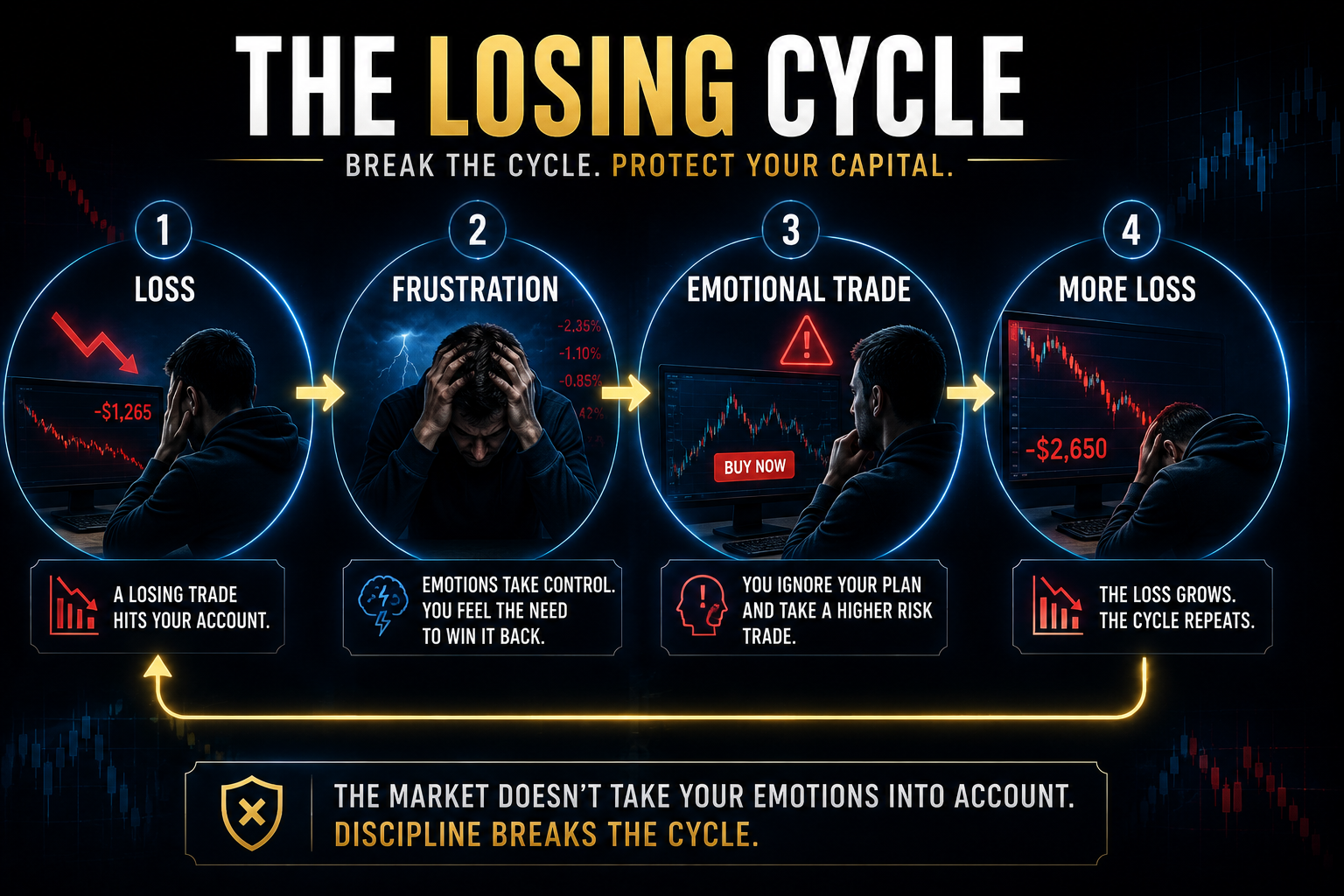
Repeated losses usually don’t come from one single mistake.
More often, traders develop a cycle:
Loss → frustration → emotional decision → another loss → increased risk → larger loss → more frustration
Once this cycle begins, trading becomes less about following a strategy and more about reacting to the previous trade.
The solution is not necessarily to find another strategy.
Sometimes the solution is to change how you behave when the strategy doesn’t work.
1. Trying to Avoid Every Losing Trade
One of the biggest psychological mistakes in Forex is believing that a good trader should avoid losses.
That expectation creates enormous emotional pressure.
Every trading strategy has losing trades. Even a strategy with a strong historical win rate can experience periods of consecutive losses.
The professional mindset is therefore not:
“How can I make sure this trade wins?”
Instead, it is:
“If this trade loses, have I controlled the damage?”
Once you accept that losses are part of trading, you can focus on managing them rather than desperately trying to avoid them.
A losing trade doesn’t automatically mean your analysis was useless. Sometimes the market simply moves differently from the scenario you expected.
2. Moving the Stop Loss Because You Don’t Want to Be Wrong
Imagine you enter a EUR/USD trade and place a stop loss based on your technical analysis.
Price moves against you.
Instead of accepting the planned loss, you move the stop farther away.
Then you move it again.
The original risk is no longer the original risk.
This behaviour is often driven by one simple emotion:
You don’t want to admit that the trade idea was wrong.
But a stop loss isn’t a judgment about you as a trader.
It is simply the point where your original trade scenario is no longer valid.
A disciplined trader understands that being wrong about one trade is normal.
The dangerous behaviour is allowing one wrong trade to become a much larger loss.
3. Revenge Trading After a Loss
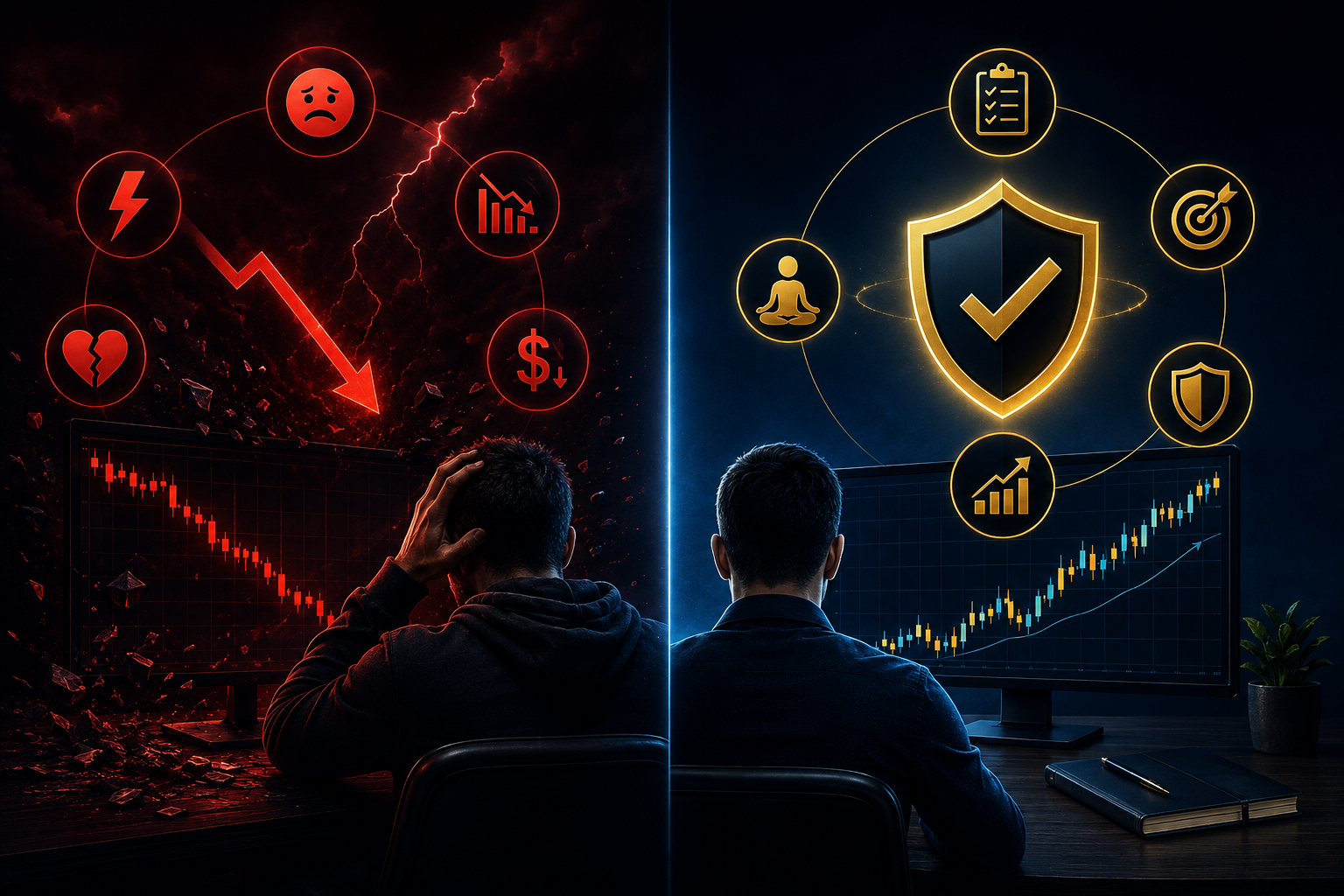
Revenge trading happens when a trader tries to recover a previous loss through another trade.
For example:
You lose $100.
You immediately think:
“I’ll make it back on the next trade.”
You then increase your position size and enter a setup that you might normally ignore.
If that trade loses, frustration increases.
You may then take an even larger trade.
This creates an emotional chain reaction.
Loss → frustration → larger trade → larger loss → revenge → even larger risk
The market doesn’t know that you lost money on your previous trade.
Your next setup has its own probability and risk.
Therefore, the previous loss should not determine the size or quality of your next trade.
4. Overtrading After a Losing Trade
Another common reaction to losses is searching for another opportunity immediately.
The trader closes a losing position and starts scanning every currency pair.
EUR/USD doesn’t look good?
Try GBP/USD.
Nothing there?
Look at USD/JPY.
Still nothing?
Maybe Gold.
The trader isn’t following a strategy anymore. They are looking for a trade because they feel they need to trade.
This is overtrading.
Sometimes the best response to a losing trade is to step away from the charts.
A trading plan should tell you not only when to enter, but also when to remain inactive.
5. Increasing Risk After a Winning Streak
Psychological mistakes don’t happen only after losses.
Winning can create problems too.
After several successful trades, a trader may begin to feel that they have “figured out” the market.
They increase their lot size.
They take more setups.
They become less selective.
Eventually, one losing trade can erase a significant portion of their recent gains.
This is often the result of overconfidence.
A winning streak doesn’t guarantee that the next trade will win.
Your risk rules should remain consistent regardless of whether your last five trades were winners or losers.
6. FOMO: Entering Because You Think You’re Missing the Move
Fear of missing out, commonly called FOMO, is another major Forex psychology problem.
You see EUR/USD making a powerful move.
You didn’t enter.
Price continues moving.
You suddenly think:
“If I don’t enter now, I’ll miss the entire move.”
So you enter late.
The market reverses.
Now you are trapped in a position that didn’t meet your original trading criteria.
FOMO causes traders to replace analysis with urgency.
Remember:
The market will provide another opportunity.
You don’t need to participate in every move.
A missed trade is usually much less damaging than a poorly planned trade.
7. Trading With Money You Cannot Afford to Lose
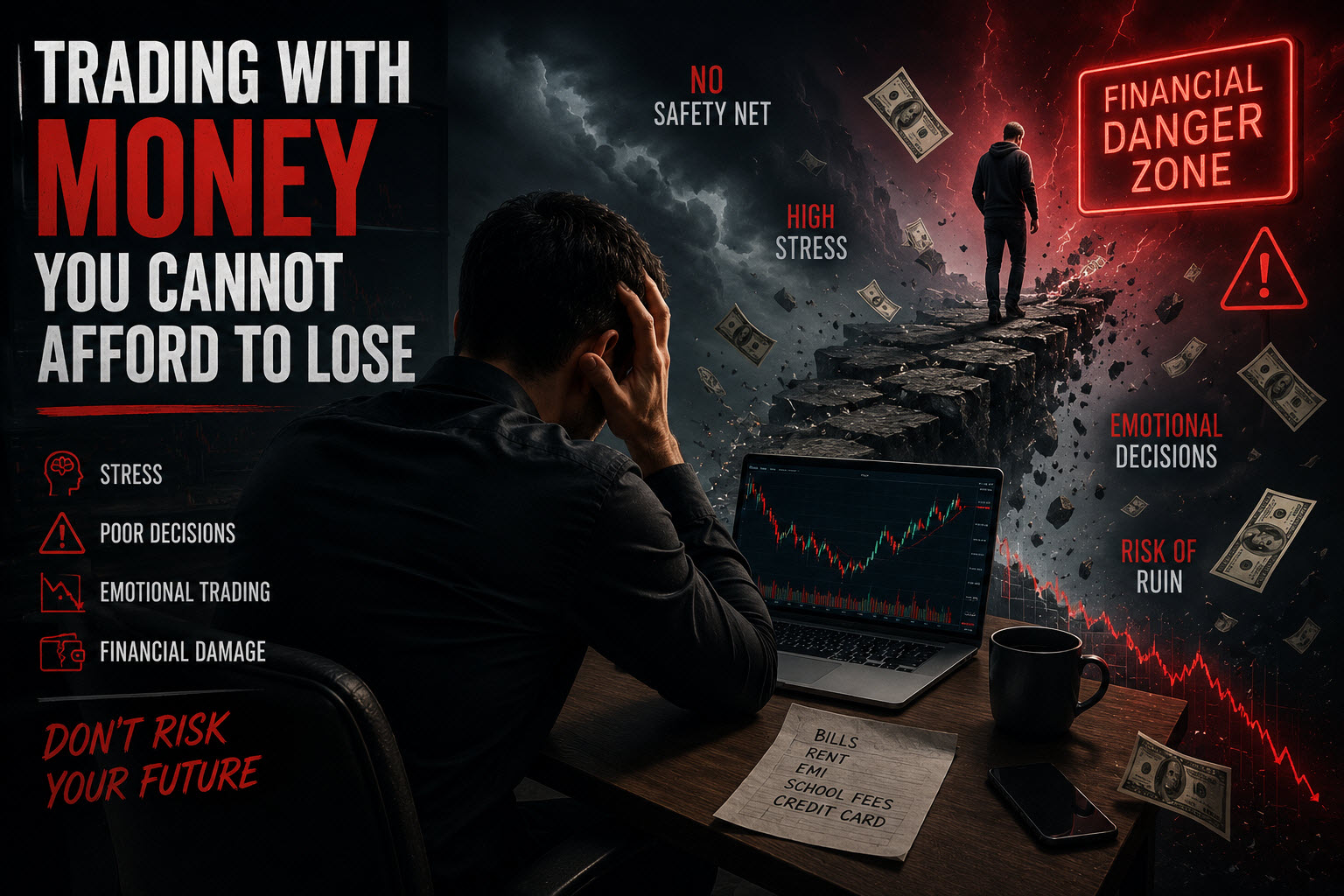
Psychology becomes much harder when the money being traded is essential for your everyday life.
If a trader is using money they cannot afford to lose, every price movement can create intense emotional pressure.
A small drawdown can feel like a crisis.
A losing trade can create fear.
A winning trade can create excessive excitement.
This makes disciplined decision-making much more difficult.
Forex should never be approached as a guaranteed way to generate income.
Only trade capital you can genuinely afford to put at risk, and understand the risks associated with leveraged Forex and CFDs.
8. Changing Strategies Every Time You Lose
A trader discovers a new strategy.
They test it.
The first few trades don’t work.
They abandon it.
Then they find another strategy.
The same thing happens.
Eventually, they have collected dozens of indicators, strategies and trading methods but have never given one approach enough time to evaluate properly.
This is strategy hopping.
A losing trade does not automatically prove that your entire strategy is broken.
Before changing your system, ask:
- Did I actually follow the strategy?
- Was the setup valid?
- Was my entry according to the rules?
- Was my stop correctly placed?
- Was the loss within my planned risk?
- Do I have enough historical data to evaluate the strategy?
Sometimes the strategy didn’t fail.
The trader failed to follow the strategy.
Those are two very different problems.
9. Focusing Too Much on Individual Trades
Another psychological trap is judging yourself based on the result of one trade.
A winning trade doesn’t necessarily mean you made a good decision.
A losing trade doesn’t necessarily mean you made a bad decision.
Consider this:
You follow your strategy perfectly, use appropriate position sizing and accept your predefined stop loss.
The trade loses.
That can still be a good trade from a process perspective.
Now imagine another trader ignores their rules, enters randomly and gets lucky.
The trade makes money.
That doesn’t make the decision good.
Professional trading is about evaluating the quality of the process, not just the outcome of one trade.
10. Not Keeping a Trading Journal
If you don’t record your trades, it becomes difficult to identify repeated psychological mistakes.
A useful Forex trading journal can record:
- Currency pair
- Entry price
- Stop loss
- Take-profit level
- Position size
- Risk percentage
- Trade setup
- Reason for entry
- Trade result
- Emotional state
- Whether you followed your rules
After enough trades, patterns become easier to identify.
You may discover that your biggest losses happen when you:
- Trade after a losing streak
- Enter outside your normal trading hours
- Increase position size
- Move stop losses
- Trade without a clear setup
- Enter because of FOMO
Once you identify the pattern, you can create a specific rule to address it.
How to Break the Cycle of Repeated Trading Mistakes

Improving Forex psychology isn’t about trying to eliminate emotions.
You are human. Fear and excitement will naturally appear.
The goal is to prevent emotions from controlling your decisions.
Here are several practical steps.
Create Rules Before the Market Opens
Decide your risk, entry conditions, stop-loss rules and trade-management approach before you’re under pressure.
Use Consistent Position Sizing
Don’t dramatically increase your position after a loss or winning streak.
Accept the Stop Loss
A controlled loss is part of trading.
Take a Break After Emotional Trading
If you notice frustration, anger or the urge to recover money immediately, stepping away can be more valuable than finding another setup.
Review Your Process
At the end of the week, analyze your decisions—not just your profits and losses.
Ask:
Did I follow my rules?
That question is often more useful than:
Did I make money?
A Simple Psychological Rule for Forex Traders
Before entering a trade, ask yourself:
“If this trade reaches my stop loss, will I be completely comfortable accepting the loss?”
If the answer is no, something may need to change.
Perhaps the position is too large.
Perhaps the stop is too wide.
Perhaps the setup doesn’t meet your rules.
Or perhaps you’re emotionally attached to the outcome.
A properly sized trade should allow you to accept either outcome without feeling the need to interfere.
The Goal Is Not to Become Emotionless
Many traders believe successful trading requires eliminating fear.
That’s unrealistic.
A better objective is to become less reactive.
You can feel nervous and still follow your plan.
You can experience a losing streak and still maintain your risk rules.
You can miss a major market move and wait for another opportunity.
You can take a loss without immediately trying to win the money back.
That is trading discipline.
The strongest traders aren’t necessarily those who feel no emotions.
They are the traders who have built a process that prevents emotions from controlling their actions.
Final Thoughts: Control Your Behaviour Before Trying to Control the Market
You cannot control whether your next Forex trade will win.
You cannot control unexpected economic news.
You cannot control market volatility.
And you certainly cannot control what the market does after you enter a position.
What you can control is your risk, your position size, your stop loss, your trading frequency and your behaviour.
That is where your attention should be.
If you repeatedly lose money in Forex, don’t immediately assume that you need another indicator or another strategy.
Look at your behaviour.
Are you moving stops?
Are you revenge trading?
Are you increasing risk after losses?
Are you entering because of FOMO?
Are you overtrading?
Are you changing strategies before properly testing them?
Are you judging your ability based on individual trades?
These questions can reveal problems that no new indicator will solve.
A trading strategy can give you an edge, but discipline is what allows you to execute that edge consistently.
The market will always produce another setup.
Your job is to make sure you are still prepared to take it.
To Your Trading Success,
Vladimir Ribakov
Internationally Certified Financial Technician
Home Trader Club
Educational Disclaimer
This article is provided for educational and informational purposes only and does not constitute financial, investment or trading advice. Forex, CFDs and other leveraged financial products involve substantial risk and may not be suitable for every trader. Past performance does not guarantee future results. Always understand the risks associated with trading and verify the specifications, costs and trading conditions of your broker before placing a trade.