


Losing a Forex trade is part of trading. Even a well-planned setup can fail. The market can reverse unexpectedly, news can change sentiment, or price can simply move in the opposite direction.
The real problem begins when a trader refuses to accept the loss.
Instead of moving on to the next valid opportunity, they become determined to get the money back.
This is known as revenge trading.
Revenge trading can turn one normal losing trade into a much larger problem because decisions are no longer based purely on the trading plan. The trader becomes emotionally focused on recovering what was lost.
The thought is often simple:
“I need to make that money back.”
But once recovering the previous loss becomes the objective, trading can quickly become dangerous.
In this article, we’ll look at why revenge trading happens, how it affects your decisions and, most importantly, how you can break the cycle.
- 1 What Is Revenge Trading in Forex?
- 2 Why Does Revenge Trading Happen?
- 3 2. You Want the Loss Back Immediately
- 4 3. Your Risk Changes
- 5 Revenge Trading Can Create a Dangerous Chain Reaction
- 6 The Most Important Question to Ask Yourself
- 7 Never Make Your Next Trade Responsible for Your Previous Trade
- 8 Give Yourself Permission to Finish the Day Down
- 9 Create a Post-Loss Rule
- 10 Reduce the Emotional Importance of Each Trade
- 11 Don’t Try to Predict When You Will Recover
- 12 What Should You Do Immediately After a Losing Trade?
- 13 Losing Streaks Require Even More Discipline
- 14 A Simple Rule to Remember
- 15 How Professional Traders Think About Losses
- 16 Final Thoughts: Don’t Trade Against Your Own Emotions
What Is Revenge Trading in Forex?
Revenge trading is the act of taking a trade primarily because you want to recover money lost from an earlier trade.
Taking another trade after a loss is not automatically revenge trading.
For example, suppose you lose a EUR/USD trade. Later, a completely new setup appears that meets all your normal trading conditions. You take the trade using your usual risk.
That is simply trading.
Revenge trading is different.
The previous loss becomes part of the reason for entering the next position.
You may:
- Enter before your setup is confirmed
- Take a trade you would normally ignore
- Increase your position size
- Risk more than planned
- Enter the market simply because you want your money back
The problem isn’t the desire to recover a loss.
The problem is allowing that desire to control your decisions.
Why Does Revenge Trading Happen?
Revenge trading usually begins with an emotional reaction to losing money.
Let’s look at some of the most common triggers.
1. You Feel the Loss Personally
A losing trade can feel like more than a financial setback.
You may think:
“I should have seen that coming.”
Or:
“How did I get this trade wrong?”
This can create frustration and a strong desire to prove yourself right.
But Forex trading isn’t about being right on every prediction.
Markets are uncertain by nature. Even a high-quality setup can fail.
A single losing trade doesn’t mean you are a bad trader.
It means that particular market scenario didn’t produce the outcome you expected.
The faster you separate your self-worth from an individual trade, the easier it becomes to make rational decisions.
2. You Want the Loss Back Immediately
This is perhaps the biggest psychological trap.
Imagine you lose $100.
Instead of accepting that $100 as part of your planned trading risk, your mind immediately starts calculating how to recover it.
You look for another setup.
Then another.
You may start thinking:
“If I make $200 on the next trade, I’ll be back in profit.”
That sounds logical at first.
But the market doesn’t know you lost $100.
It doesn’t know your account balance.
It doesn’t know your daily target.
And it certainly doesn’t owe you a profitable trade.
The next opportunity should be judged according to its own setup—not according to what happened previously.
3. Your Risk Changes
One of the clearest signs of revenge trading is changing your normal risk.
Suppose your trading plan normally allows you to risk 1% per trade.
You lose.
Instead of keeping the same risk, you decide to risk 2% on the next position.
If that trade loses, you might increase the risk again.
Now the previous loss is influencing your position sizing.
This is extremely dangerous.
A larger position doesn’t make the next setup better.
It simply means the financial impact of the trade will be larger.
Your position size should be determined by your trading plan, stop-loss distance and acceptable risk—not by how much money you want to recover.
Revenge Trading Can Create a Dangerous Chain Reaction
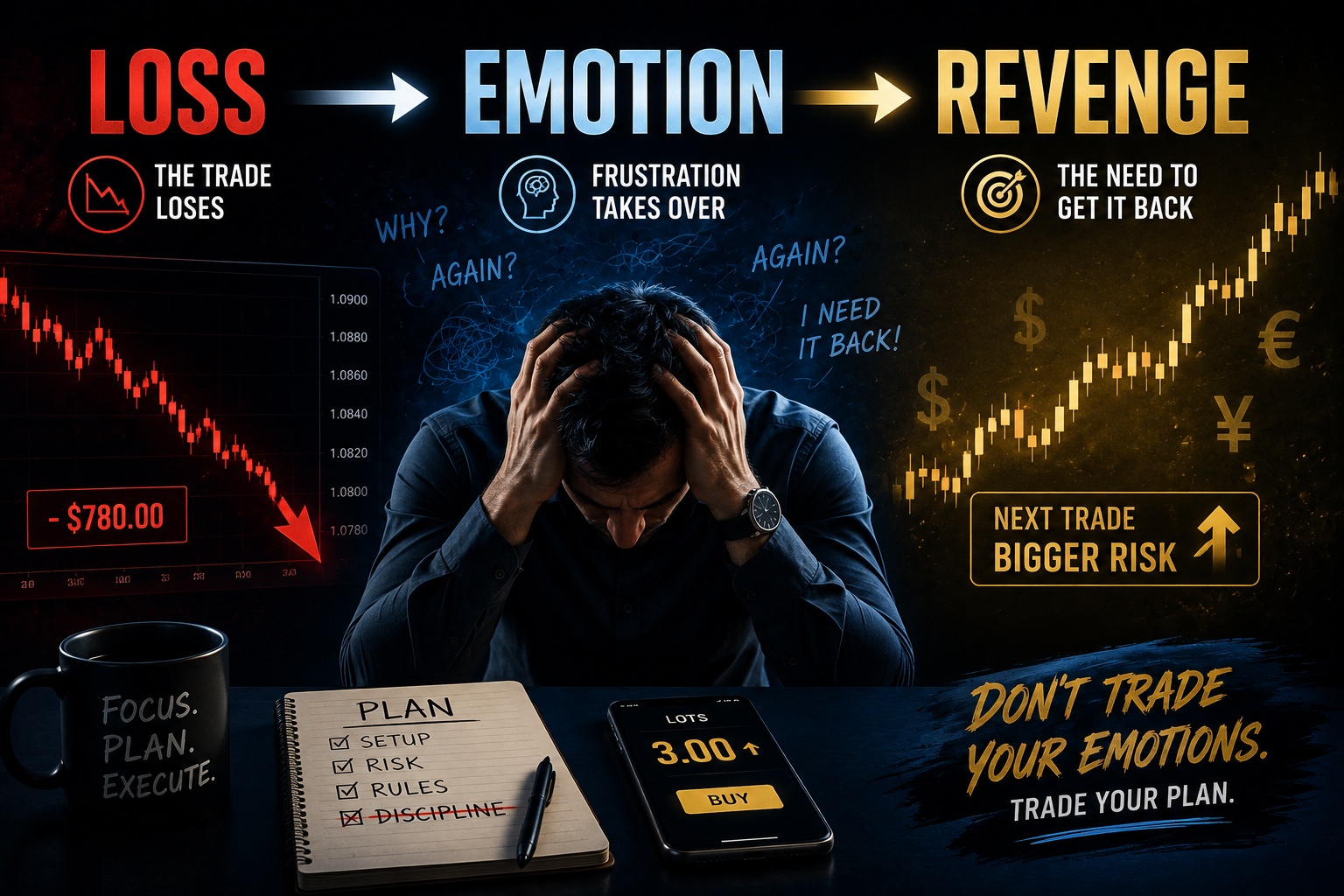
The biggest problem with revenge trading is that one emotional decision can create another.
For example:
Losing trade
↓
Frustration
↓
Need to recover the money
↓
Higher-risk trade
↓
Another loss
↓
Greater emotional pressure
↓
Even greater risk
This can continue until a relatively small losing trade becomes a significant drawdown.
The first loss may have been completely normal.
The damage comes from what happens afterward.
This is why controlling your behaviour after a loss can be just as important as finding good trade setups.
The Most Important Question to Ask Yourself
Before taking another trade after a loss, ask yourself:
“If my previous trade had been a winner, would I still take this trade?”
This is a powerful question.
If the answer is yes, then the setup may genuinely meet your strategy’s requirements.
If the answer is no, stop.
You may not be trading the market anymore.
You may be trading your previous loss.
Another useful question is:
“Am I taking this trade because of the opportunity or because of the money I just lost?”
Be honest with yourself.
You don’t need to prove anything to the market.
Never Make Your Next Trade Responsible for Your Previous Trade
This is one of the most important principles in trading psychology.
Your previous trade is finished.
Its result cannot be changed.
Your next trade is a completely different decision.
If the previous trade lost $100, your next trade doesn’t need to make $100.
It simply needs to satisfy your trading rules.
Sometimes that means taking another trade.
Sometimes it means waiting.
And sometimes it means finishing the trading session without entering another position.
There is nothing wrong with that.
Protecting your capital is more important than satisfying the need to recover a loss immediately.
Give Yourself Permission to Finish the Day Down
This may sound strange, but it can be incredibly helpful.
Many traders struggle with the idea of ending the day with a loss.
They think:
“I can’t stop now. I have to get back to breakeven.”
That mindset can create enormous pressure.
Instead, accept that some trading days will finish negative.
A losing day doesn’t automatically mean your strategy failed.
It doesn’t mean you need to recover the money tomorrow.
And it certainly doesn’t mean you should increase your risk.
Your objective should be to protect your account over a large number of trades—not to make every single day profitable.
Create a Post-Loss Rule
Don’t wait until you’re angry or frustrated to decide what you should do.
Create the rule beforehand.
For example:
“After a losing trade, I will review the setup before considering another position.”
Or:
“If I notice that I am trying to recover the previous loss, I will stop trading for the session.”
Your rule can be different.
What matters is that you already know what to do when emotions become stronger.
A predefined process can prevent a temporary emotional reaction from becoming an expensive mistake.
Reduce the Emotional Importance of Each Trade
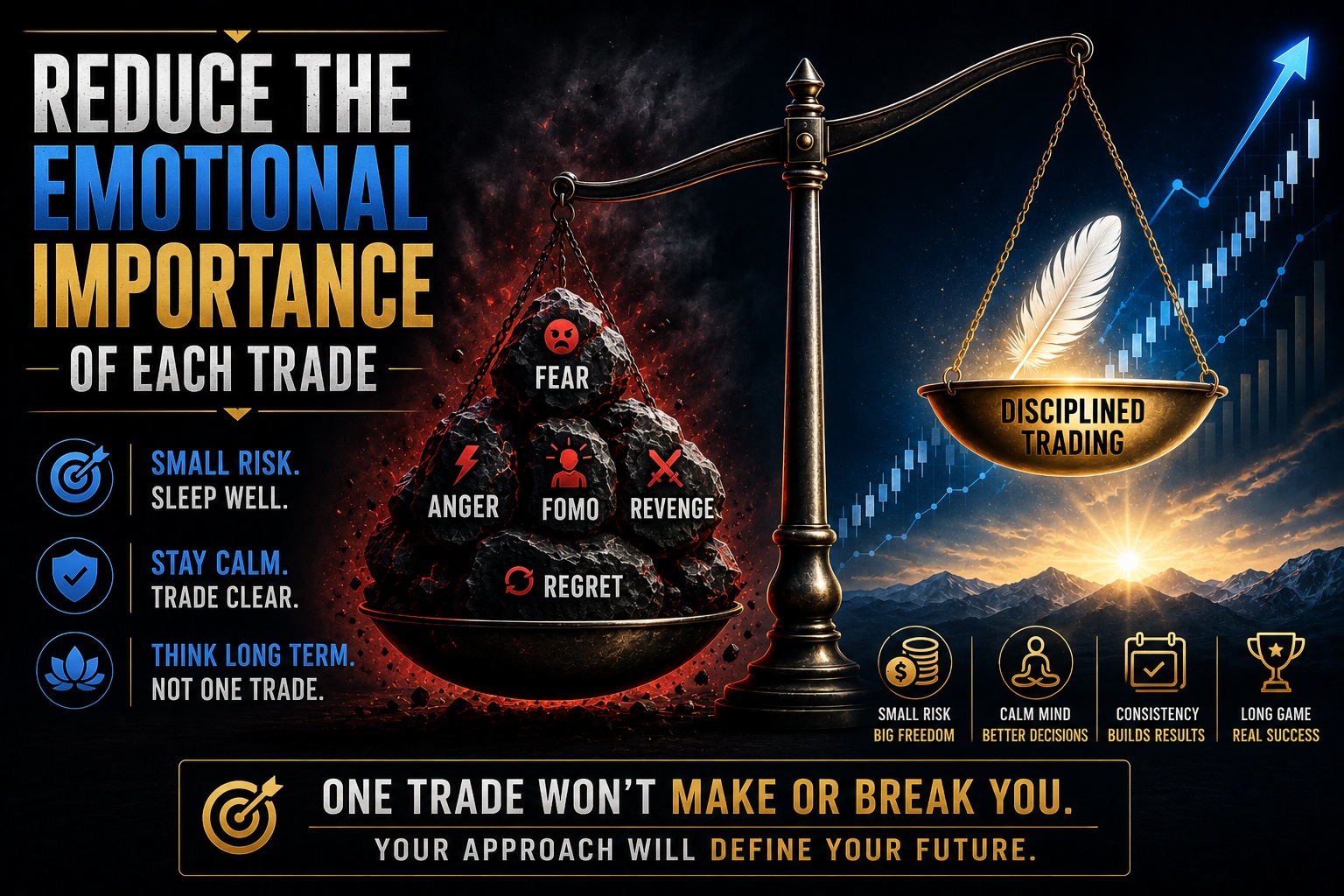
If one trade feels extremely important, your position may be too large for your comfort level.
When too much money is at stake, every movement can feel personal.
A small drawdown suddenly feels like a disaster.
A losing trade feels unacceptable.
And the temptation to recover the money becomes stronger.
Appropriate position sizing can reduce this pressure.
The objective isn’t to make every trade meaningless.
It’s to make sure one trade doesn’t have enough financial importance to push you into irrational decisions.
Don’t Try to Predict When You Will Recover
Another common mistake is creating a deadline for recovery.
For example:
“I lost $500 this week, so I need to make $500 back by Friday.”
This creates unnecessary pressure.
The market doesn’t operate according to your financial schedule.
If you force yourself to reach a recovery target, you may start accepting trades that don’t meet your normal criteria.
Instead, focus on the process.
If you execute your strategy correctly, control your risk and remain selective, you give yourself the opportunity to benefit from future valid setups.
What Should You Do Immediately After a Losing Trade?
You don’t necessarily need to stop trading after every loss.
But you should stop and assess your state of mind.
Ask yourself:
Was the trade valid according to my strategy?
Did I use my planned risk?
Did the trade reach my predefined stop loss?
Am I frustrated or angry?
Do I feel an urge to win the money back immediately?
If everything is normal and a new valid setup appears, you can evaluate it objectively.
But if you feel an emotional need to recover the loss, stepping away from the charts may be the better decision.
Losing Streaks Require Even More Discipline
Revenge trading becomes particularly dangerous during a losing streak.
After several losses, traders can start questioning everything.
They may believe their strategy has stopped working.
They may increase risk in an attempt to recover.
Or they may completely abandon their trading plan.
But a losing streak doesn’t automatically tell you what the problem is.
You need to examine the quality of your execution.
Were the trades valid?
Did you follow your rules?
Was your risk consistent?
Did market conditions change?
Only after answering those questions should you decide whether something in your strategy needs to change.
A Simple Rule to Remember

When you lose a trade, don’t ask:
“How can I get my money back?”
Ask:
“What is the best decision I can make from this point forward?”
That small change in thinking can make a major difference.
The first question is focused on the past.
The second is focused on the next decision.
You cannot change the previous trade.
But you can control what you do next.
How Professional Traders Think About Losses
A disciplined trader doesn’t expect every trade to work.
They understand that losses are part of the business.
Their goal isn’t to avoid every losing trade.
Their goal is to ensure that losses remain controlled and don’t trigger destructive behavior.
After a losing trade, the mindset becomes:
“That trade is over. Let’s wait for the next opportunity.”
There is no argument with the market.
No attempt to win back money.
No need to prove that the original analysis was correct.
Just another decision based on the trading plan.
That is a much healthier way to approach Forex.
Final Thoughts: Don’t Trade Against Your Own Emotions
Revenge trading isn’t caused by a bad Forex indicator.
It isn’t solved by finding a new currency pair.
And it certainly isn’t fixed by increasing your lot size.
It is primarily a problem of decision-making after a loss.
You will lose trades.
You may experience losing streaks.
There will be days when the market doesn’t behave according to your expectations.
That is part of trading.
What matters is what you do next.
Don’t allow one losing trade to determine your next position.
Don’t increase your risk simply because you want your money back.
Don’t create artificial recovery targets.
And don’t feel that you must finish every trading session in profit.
Instead, protect your capital, follow your trading plan and wait for opportunities that genuinely meet your criteria.
The market doesn’t need to give your money back.
Your responsibility is simply to manage your next decision correctly.
One controlled loss is manageable.
The real danger is allowing that loss to control everything that comes afterward.
To Your Trading Success,
Vladimir Ribakov
Internationally Certified Financial Technician
Home Trader Club