



- 1 Why Consumer Confidence Matters in Forex Trading
- 2 Trade with AvaTrade and Unlock Unlimited Home Trader Club Access
- 3 1. What Is Consumer Confidence?
- 4 2. How Consumer Confidence Influences Economic Growth
- 5 3. The Relationship Between Consumer Confidence and Consumer Spending
- 6 4. How Consumer Confidence Affects Inflation Expectations
- 7 5. The Connection Between Consumer Confidence and Interest Rates
- 8 6. Consumer Confidence Reports: What Forex Traders Should Monitor
- 9 7. Why Forex Markets React to Consumer Confidence Surprises
- 10 8. Why Consumer Confidence Can Sometimes Send Mixed Signals
-
11
9. How Forex Traders Should Analyze Consumer Confidence
- 11.1 1. Compare the Actual Result With Market Expectations
- 11.2 2. Examine the Previous Reading
- 11.3 3. Examine the Components of the Report
- 11.4 4. Compare Sentiment With Retail Sales
- 11.5 5. Monitor Inflation and Employment
- 11.6 6. Evaluate Central Bank Expectations
- 11.7 7. Compare the Relative Economic Outlook
- 12 10. Common Mistakes When Using Consumer Confidence in Forex Trading
- 13 11. Combining Consumer Confidence With Technical Analysis
- 14 Conclusion: Consumer Confidence Provides Valuable Insight Into Economic Expectations
Why Consumer Confidence Matters in Forex Trading
When analyzing the Forex market, traders often pay close attention to important economic indicators such as inflation, employment, GDP growth, and interest rates.
However, there is another economic indicator that provides valuable insight into the health of an economy: consumer confidence.
Consumer confidence measures how optimistic or pessimistic households feel about their financial situation and the broader economic outlook.
This matters because consumers play an important role in economic activity. Their expectations about employment, income, prices, and future financial conditions can influence how much they spend, save, and borrow.
When consumers feel confident, they may be more willing to increase spending and make significant purchases. When confidence deteriorates, households may become more cautious, reduce discretionary spending, and increase their savings.
These behavioral changes can influence economic growth, business activity, inflation expectations, and eventually monetary policy decisions.
For Forex traders, understanding consumer confidence is important because these developments can affect expectations about the future strength of an economy and its currency.
But how exactly does consumer confidence influence exchange rates? Why can improving economic sentiment support a currency? And how should traders interpret consumer confidence reports as part of their fundamental analysis?
Let’s explore.
Trade with AvaTrade and Unlock Unlimited Home Trader Club Access
We have partnered with AvaTrade, one of the industry’s leading regulated brokers.
When you open and trade with AvaTrade through our partnership, you receive:
- Unlimited access to Home Trader Club
- Real-time trading education
- Daily and swing trading opportunities
- Our complete educational library
- Access to our Trade Copier Project
- Members-only trading community
If you’re looking to accelerate your trading journey while enjoying premium education, this partnership gives you everything you need under one roof.
If you already have account with them, still follow this link to open separate account with separate email. Once you did that, contact me with the telegram link below and we will give you the access.
Telegram Channel: https://t.me/vladimirribakovtradingchannel
1. What Is Consumer Confidence?
Consumer confidence refers to the degree of optimism or pessimism that households have about the economy and their personal financial circumstances.
It reflects how consumers perceive current economic conditions and what they expect to happen in the future.
When consumers believe that the economy is performing well, employment opportunities are available, and their financial situation is likely to remain stable, confidence generally improves.
On the other hand, concerns about unemployment, inflation, economic uncertainty, or declining income can reduce consumer confidence.
Governments and research organizations measure consumer sentiment through surveys that ask households about their financial situation, spending intentions, employment expectations, and views about economic conditions.
The results are commonly presented through a Consumer Confidence Index or similar sentiment indicator.
These reports help economists, investors, businesses, and policymakers understand how households perceive the economy.
For Forex traders, consumer confidence provides information that may help assess future economic activity.
It is important to understand that consumer confidence measures expectations and perceptions rather than actual spending. Therefore, it should be analyzed alongside other economic indicators.
2. How Consumer Confidence Influences Economic Growth
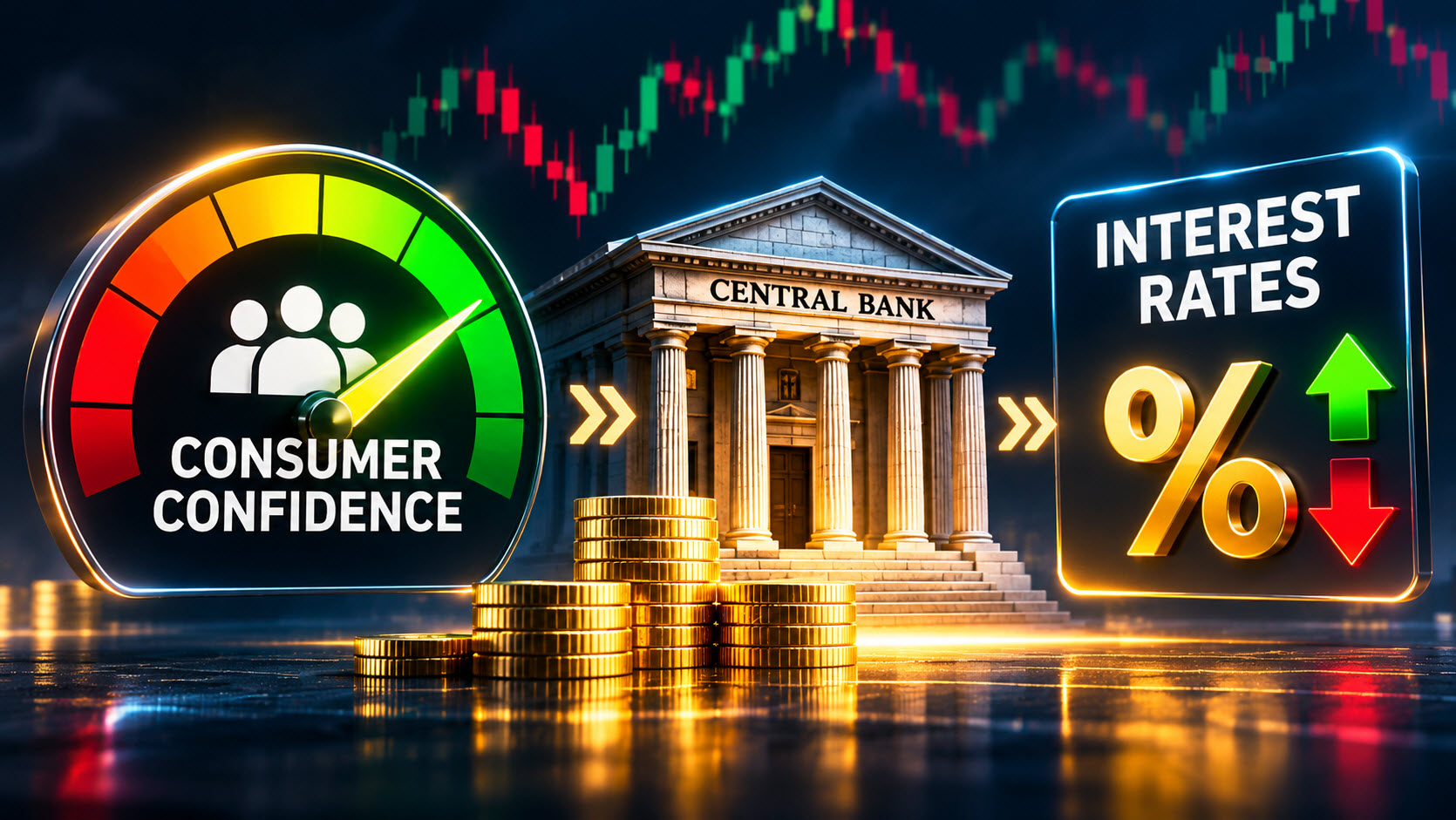
Consumer spending represents a major component of economic activity in many countries.
When households feel financially secure, they are generally more willing to spend money on goods and services.
This can support business revenues, encourage companies to increase production, and contribute to economic expansion.
Improving consumer confidence may therefore indicate stronger future spending activity.
However, when confidence declines, consumers may become more cautious.
They might postpone large purchases, reduce discretionary spending, or increase savings because they are concerned about future financial conditions.
If this behaviour becomes widespread, businesses may experience weaker demand, potentially affecting production, investment, and employment.
This can create a negative cycle:
- Consumer confidence declines.
- Households become more cautious about spending.
- Business demand may weaken.
- Companies may reduce investment or hiring.
- Economic growth expectations may deteriorate.
The opposite can happen when confidence improves.
For Forex traders, these developments matter because expectations about economic growth can influence investor sentiment and currency valuations.
However, a rise in consumer confidence does not automatically guarantee stronger economic growth. Actual spending behaviour, income levels, employment conditions, and access to credit also matter.
3. The Relationship Between Consumer Confidence and Consumer Spending
Consumer confidence and consumer spending are closely connected, although they do not always move together.
When households feel optimistic about their financial future, they may be more comfortable making purchases and committing to long-term financial decisions.
This can support retail activity and demand for services.
For example, stronger confidence may encourage consumers to spend on:
- Household goods and electronics.
- Vehicles and transportation.
- Travel and leisure.
- Housing-related purchases.
- Restaurants and entertainment.
- Other discretionary goods and services.
When confidence weakens, households may prioritize essential expenses and postpone purchases that are not immediately necessary.
This can reduce demand in certain sectors of the economy.
Why is this important for Forex traders?
Consumer spending influences business activity and economic growth. If spending remains strong, it may support expectations for continued economic expansion.
If spending weakens significantly, markets may begin to reconsider the economic outlook.
However, traders should distinguish between consumer sentiment and actual retail activity.
A confidence survey indicates how consumers feel and what they expect to do. Retail sales data provides information about actual purchasing activity.
Comparing these indicators can help traders determine whether improving sentiment is translating into stronger economic performance.
4. How Consumer Confidence Affects Inflation Expectations
Consumer confidence can also influence inflation expectations.
When households feel optimistic about their financial situation, they may be more willing to spend.
If demand for goods and services increases faster than businesses can expand supply, upward pressure on prices may develop.
This can contribute to inflationary pressure.
However, stronger consumer confidence does not necessarily mean inflation will increase. Inflation also depends on production costs, energy prices, supply conditions, wages, productivity, and monetary policy.
On the other hand, declining consumer confidence may reduce spending demand.
If households become more cautious, businesses may face weaker demand and experience less pressure to increase prices.
This can influence expectations about future inflation.
For Forex traders, the important consideration is how consumer sentiment affects the broader inflation outlook and how central banks may respond.
A change in inflation expectations can influence monetary policy expectations, which may eventually affect currency valuations.
5. The Connection Between Consumer Confidence and Interest Rates

One of the most important channels through which consumer confidence can affect Forex markets is monetary policy.
Central banks monitor economic activity, employment, inflation, and financial conditions when making interest-rate decisions.
Consumer confidence is not usually a direct target of monetary policy. However, it can provide useful information about the direction of household spending and economic demand.
When consumer confidence remains strong, it may suggest that households are comfortable with their financial situation and that spending activity could remain resilient.
If this contributes to stronger economic growth or persistent inflationary pressure, markets may adjust their expectations about future interest rates.
Conversely, a significant decline in consumer confidence may raise concerns about weaker spending and slower economic growth.
If these concerns become widespread and are supported by other economic indicators, markets may begin anticipating a more accommodative monetary policy.
These changing expectations can influence currency demand.
Why Interest-Rate Expectations Matter
Interest rates are an important factor in international investment decisions.
Investors consider the potential returns available in different economies, taking into account interest rates, expected currency movements, inflation, and risk.
When markets expect an economy’s interest rates to remain relatively attractive compared with those of other countries, its currency may benefit from increased investment demand.
However, currency movements depend on relative expectations rather than interest rates in isolation.
A positive consumer confidence report may therefore support a currency if it changes expectations about future economic conditions and monetary policy.
But the market reaction depends on the complete economic picture.
6. Consumer Confidence Reports: What Forex Traders Should Monitor
Different countries publish consumer confidence indicators using their own survey methodologies.
Although the exact calculations differ, most reports provide information about how households view current economic conditions and future expectations.
Forex traders should understand the main components of these reports.
Current Economic Conditions
This component measures how consumers perceive the economy at the present time.
It may include their assessment of employment opportunities, household finances, and general business conditions.
Improving current conditions can indicate greater confidence in the existing economic environment.
Future Expectations
Future expectations measure how consumers feel about the economic outlook over the coming months.
This may include expectations about employment, income, household finances, and broader economic activity.
This component can be particularly useful because financial markets are forward-looking.
Investors often react to information that changes expectations about future economic conditions rather than focusing exclusively on the present situation.
Spending Intentions
Some consumer surveys also examine whether households intend to increase or reduce spending.
These responses can provide additional information about potential demand for goods and services.
Improving spending intentions may support expectations for stronger consumption, although actual spending data is needed to confirm whether those intentions translate into real economic activity.
Consumer Confidence Index
The overall index combines different survey components into a single measure of consumer sentiment.
Traders should understand how the particular index is calculated before interpreting its movements.
Some indices use a base-year methodology, while others use different scales and calculations.
A higher index value does not necessarily mean the economy is performing better than another country. Comparisons should generally focus on changes within the same indicator and its historical context.
7. Why Forex Markets React to Consumer Confidence Surprises
Financial markets constantly form expectations about upcoming economic releases.
Before a consumer confidence report is published, analysts and investors may already have an estimate of the expected result.
When the actual figure becomes available, the market compares it with those expectations.
This difference can influence currency movements.
When Consumer Confidence Is Better Than Expected
A stronger-than-expected result may indicate that households are more optimistic than analysts anticipated.
Depending on the broader economic environment, this could improve expectations for future spending and economic activity.
If investors believe that stronger demand may influence inflation or monetary policy expectations, the currency may receive support.
However, a positive report does not guarantee currency appreciation.
Markets may have already anticipated the improvement, or other economic developments may outweigh the release.
When Consumer Confidence Is Worse Than Expected
A weaker-than-expected result may indicate growing concerns among households.
This could raise questions about future consumption, business activity, and economic growth.
If investors believe that weaker sentiment may eventually affect monetary policy expectations, the currency could experience downward pressure.
Again, the reaction depends on the wider economic environment.
When the Report Matches Expectations
When the published result is close to market expectations, the immediate currency reaction may be limited.
However, the report may still provide useful information about the broader economic outlook.
Forex traders should therefore avoid interpreting economic releases based only on whether the headline figure increased or decreased.
The difference between the actual result and market expectations is often an important part of understanding the reaction.
8. Why Consumer Confidence Can Sometimes Send Mixed Signals
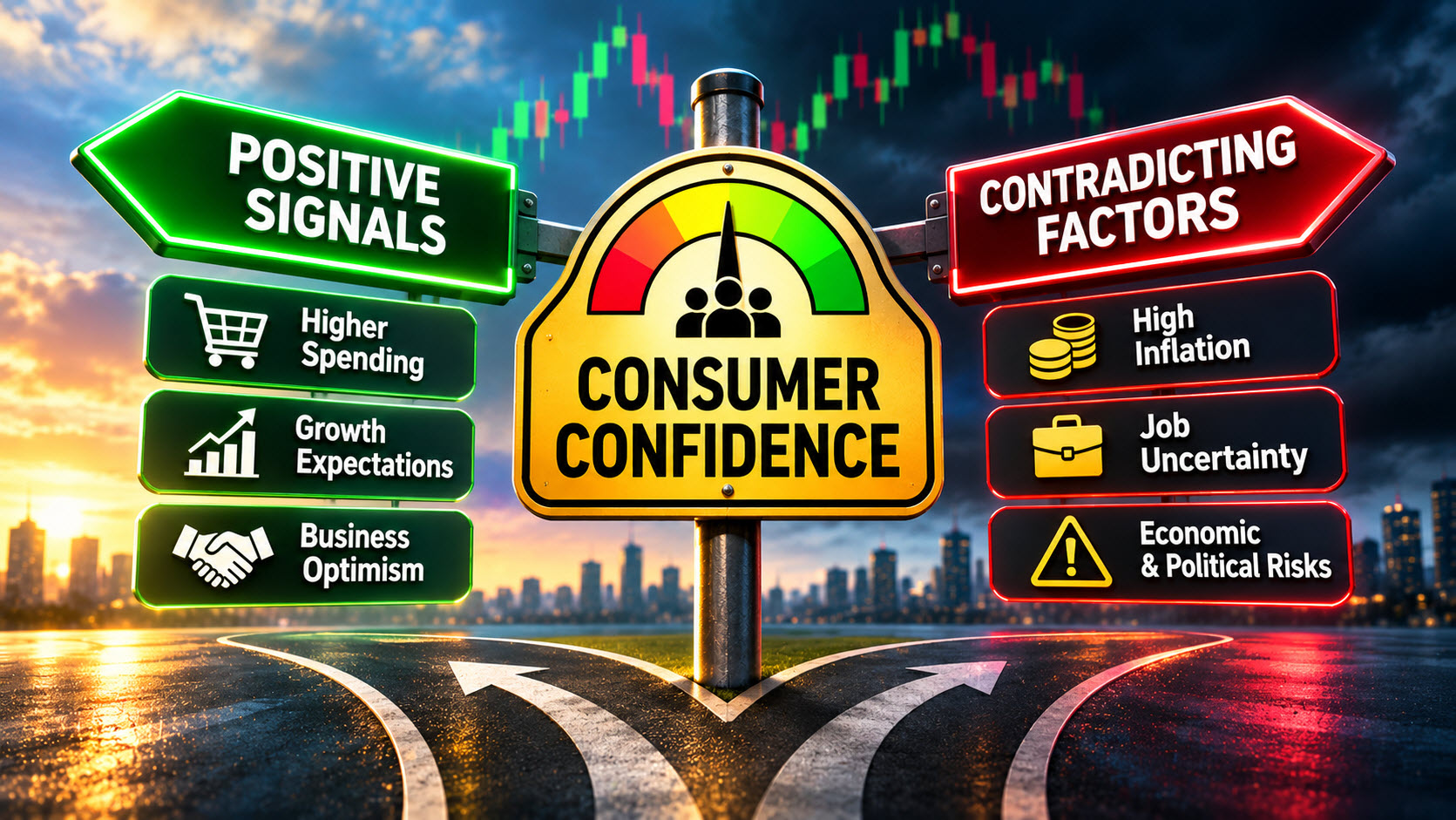
Consumer confidence is useful, but it is not a perfect predictor of future economic performance.
There are several reasons why the relationship between sentiment and actual economic activity can be complicated.
Confidence Does Not Always Translate Into Spending
Consumers may express optimism about the economy but still avoid increasing spending because of high borrowing costs, existing debt, or financial commitments.
Similarly, households may continue spending despite declining confidence because essential purchases cannot easily be postponed.
This means sentiment and actual consumption may sometimes move in different directions.
Inflation Can Reduce Household Confidence
Even when employment conditions are strong, rising living costs can make consumers feel financially insecure.
Households may become less optimistic because their purchasing power is being reduced.
Therefore, a country can experience relatively strong employment conditions while consumer confidence remains weak.
Employment Conditions Matter
Consumers generally feel more secure when they believe their jobs and income are stable.
Concerns about unemployment or job security can weaken confidence even when other economic indicators appear positive.
This is why employment data should be considered alongside consumer sentiment.
Political and Economic Uncertainty Can Influence Surveys
Consumer sentiment may change because of elections, government decisions, international developments, and uncertainty about future economic policies.
These changes do not always lead to immediate shifts in actual economic activity.
Traders should therefore avoid treating a single survey result as a complete representation of the economy.
9. How Forex Traders Should Analyze Consumer Confidence
Consumer confidence becomes more useful when it is included in a broader fundamental analysis framework.
Instead of interpreting the report in isolation, traders should evaluate how it relates to other economic indicators and monetary policy expectations.
Here are several important considerations.
1. Compare the Actual Result With Market Expectations
The first step is to understand whether the published result was better or worse than expected.
Markets frequently react to surprises rather than simply to changes in the headline figure.
2. Examine the Previous Reading
Look at the previous report and any revisions.
A new result should be considered in the context of the recent trend rather than as an isolated number.
A sustained improvement or deterioration may provide more meaningful information than a single monthly change.
3. Examine the Components of the Report
Whenever possible, review current conditions, future expectations, and spending intentions separately.
The headline index may not reveal the complete picture.
For example, current conditions may remain relatively stable while future expectations weaken.
Understanding these differences can provide a clearer view of consumer sentiment.
4. Compare Sentiment With Retail Sales
Retail sales provide information about actual consumer purchases.
Comparing retail activity with confidence surveys can help traders determine whether changes in sentiment are being reflected in spending behaviour.
If confidence improves but actual spending remains weak, further investigation may be necessary.
5. Monitor Inflation and Employment
Employment conditions and inflation influence household financial confidence.
Strong employment may support spending, while high inflation can reduce purchasing power.
Considering these indicators together provides a more complete understanding of the consumer environment.
6. Evaluate Central Bank Expectations
Determine whether changing consumer sentiment could influence expectations about economic growth, inflation, or monetary policy.
A confidence report becomes more relevant to currency valuations when it changes expectations about the future economic outlook.
7. Compare the Relative Economic Outlook
Forex trading involves comparing two currencies.
A change in consumer confidence in one country should be considered alongside economic sentiment and monetary policy expectations in the other country.
The relative outlook matters more than analyzing one economy independently.
10. Common Mistakes When Using Consumer Confidence in Forex Trading
Although consumer confidence is an important economic indicator, traders can easily misinterpret its significance.
Avoid the following mistakes.
Treating Consumer Confidence as a Direct Trading Signal
An improving confidence index does not automatically mean a currency will strengthen.
It provides information about economic sentiment, but currency valuations depend on several other factors.
Ignoring Market Expectations
A report can show an improvement and still disappoint investors if the result is weaker than expected.
Understanding the difference between actual figures and forecasts is essential.
Confusing Sentiment With Actual Economic Activity
Consumer confidence measures perceptions and expectations.
It should not be treated as a direct measurement of actual spending, production, or economic growth.
Compare it with other indicators to understand whether sentiment is translating into measurable economic activity.
Focusing Only on the Headline Figure
The overall index may hide important differences between current conditions and future expectations.
Examining the report’s components can provide additional context.
Ignoring the Broader Monetary Policy Environment
Consumer confidence is only one part of the economic picture.
Interest rates, inflation, employment, economic growth, and central bank guidance can have a stronger influence on currency valuations.
Ignoring Risk Management
Economic releases can create sudden market volatility.
Even when a fundamental assessment appears convincing, unexpected information or changing market expectations can produce unpredictable price movements.
Position sizing, predefined risk limits, and disciplined execution remain essential.
11. Combining Consumer Confidence With Technical Analysis
Fundamental analysis helps traders understand the economic forces that may influence currency values.
Technical analysis helps traders evaluate market structure, trends, momentum, and potential trading opportunities.
Combining both approaches can provide a more complete framework.
Consumer confidence reports can help traders understand whether economic sentiment is improving or deteriorating.
Other fundamental indicators can then help determine whether those changes are supported by actual spending, employment, inflation, and monetary policy developments.
Technical analysis can be used to evaluate how the market is responding to this information.
For example, traders can examine broader price trends, important support and resistance areas, and momentum conditions when assessing the market’s response to changing economic expectations.
However, a positive economic indicator does not guarantee a bullish price movement, just as a negative report does not guarantee a bearish outcome.
The purpose of combining fundamental and technical analysis is to understand the market from different perspectives rather than relying on a single indicator.
Conclusion: Consumer Confidence Provides Valuable Insight Into Economic Expectations
Consumer confidence is an important economic indicator because it provides insight into how households perceive their financial situation and the future direction of the economy.
Changes in consumer sentiment can influence spending behaviour, business activity, economic growth expectations, inflation pressures, and monetary policy expectations.
For Forex traders, these developments can provide useful information when evaluating the relative strength of different economies and their currencies.
However, consumer confidence should never be analyzed in isolation.
A complete fundamental assessment should consider actual spending data, employment conditions, inflation, interest rates, central bank expectations, and the broader economic environment.
Remember that consumer confidence measures how people feel about the economy, not necessarily what they will do next.
A disciplined Forex trader looks beyond the headline number, studies the underlying components, compares the result with market expectations, and evaluates how the information fits into the broader fundamental picture.
The more effectively you understand the relationship between economic sentiment and actual economic performance, the better equipped you will be to interpret the forces influencing currency markets.
To Your Trading Success,
Vladimir Ribakov
Internationally Certified Financial Technician (CFTe)
Home Trader Club
Risk Disclaimer: Forex trading involves significant financial risk and may not be suitable for every investor. Economic indicators can influence currency markets unpredictably, and no fundamental or technical analysis method guarantees profits. Always understand the risks involved and apply appropriate risk-management practices.